 Matribhumi Samachar English


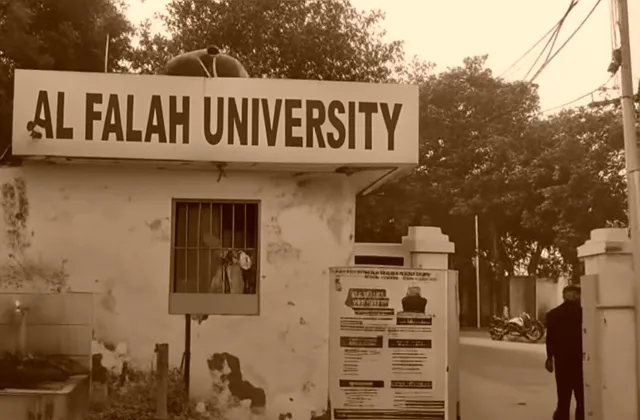
The Directorate of Enforcement (ED) has exposed what it describes as a massive and systematic financial scam operating under the guise of charitable education, with Al-Falah Charitable Trust and its associated institutions at the centre of the investigation. The probe, conducted under the Prevention of Money Laundering Act (PMLA), 2002, has flagged alleged illicit proceeds of at least Rs 415 crore generated through deception, regulatory manipulation and diversion of funds meant for educational and charitable purposes.
Notably, the investigation has culminated in the arrest of Jawad Ahmad Siddiqui, chairman-cum-chancellor of Al-Falah University, who is currently in judicial custody. His arrest followed coordinated, high-intensity searches at over 20 locations across the National Capital Region, during which investigators seized documents, digital evidence and financial records pointing to an entrenched web of fraud.
According to the ED, Al-Falah University functioned as the apex body overseeing at least nine educational institutions offering courses across humanities, languages, molecular sciences, engineering and medical sciences. While publicly projecting itself as a charitable education hub, the university allegedly operated as a revenue-generating enterprise through misrepresentation and illegal financial practices.
The institution came under sharper scrutiny after the investigation into the November 10 car blast near Delhi’s Red Fort, which killed at least 13 people, reportedly revealed links between individuals associated with the terror module and the university campus. This development brought national security agencies into the picture and widened the scope of the probe beyond financial irregularities.
One of the most serious findings of the ED relates to large-scale academic deception. Investigators allege that Al-Falah University and its medical college induced thousands of students and parents to pay hefty fees by making false claims about accreditation and statutory recognition.
Despite the expiry of its NAAC “Grade A” accreditation, the university website allegedly continued to display the rating to attract new admissions. Additionally, the institution is accused of falsely claiming eligibility under UGC Section 12(B), a status that allows access to central grants, even though it never possessed such recognition.
The ED believes these false representations enabled the institution to generate massive revenues, which were subsequently laundered through a complex network of entities controlled by Siddiqui and his family members.
The probe has also uncovered disturbing irregularities at the Al-Falah School of Medical Sciences in Faridabad. According to investigators, mandatory inspections by the National Medical Commission were allegedly manipulated through fraudulent means.
These included the deployment of “on-paper” doctors, fake patient admissions and artificial inflation of infrastructure and faculty records to meet regulatory requirements during inspections. The ED has termed this a deliberate attempt to bypass statutory norms and continue operations illegally.
Compounding the controversy, the medical college campus has also come under the radar of federal agencies after being linked to suspects involved in the Red Fort blast case. Investigators are examining allegations that the premises were used by individuals connected to the terror module, raising serious questions about campus oversight and security.
A key focus of the ED’s investigation is the alleged diversion of charitable funds into related-party businesses controlled by Siddiqui’s immediate family. Construction contracts for the university hospital complex were allegedly awarded to M/s Karkun Construction and Developers, a firm almost entirely owned by Siddiqui’s son and daughter.
Similarly, catering contracts for student hostels were outsourced to a company controlled by Siddiqui’s wife. The ED claims these transactions were designed to siphon off charitable funds and convert them into personal wealth under the appearance of legitimate business expenses.
The investigation has also flagged an alleged land fraud involving the Tarbia Education Foundation. According to the ED, the foundation used a forged General Power of Attorney purportedly signed by deceased landowners to acquire a plot in Madanpur Khadar.
Funds diverted directly from the university’s accounts were allegedly used for the transaction, indicating criminal conspiracy, forgery and money laundering. The land acquisition has now been placed under scrutiny for possible attachment under the PMLA.
The ED is now tracing the international footprint of the Al-Falah network. Investigators have identified a UK-based entity, Ennoble Education and Training Limited, recently incorporated with Siddiqui’s children listed as directors and British nationals, despite holding Indian passports.
Digital evidence has also pointed to a jewellery business operating in Dubai and substantial cross-border financial holdings. These findings have been formally shared with the Income Tax Department and the Delhi Police for parallel investigations under tax laws, passport regulations and criminal statutes.
Officials involved in the probe as quoted in media say the case exposes a troubling pattern where charitable and educational institutions are allegedly misused as fronts for financial crimes, regulatory evasion and even activities with national security implications.
Credit : Organiser Weekly