 Matribhumi Samachar English


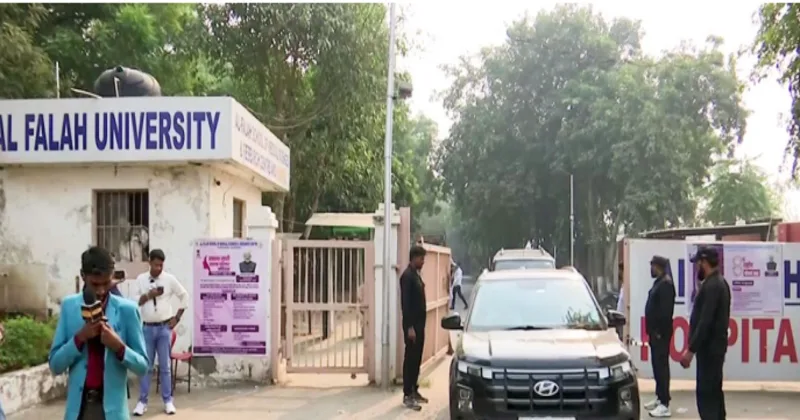
The Haryana government’s decision to amend the Haryana Private Universities Act, 2006, did not emerge in isolation. It followed a series of developments triggered by the November 10, 2025, terror attack near Delhi’s Red Fort, an incident that claimed more than 15 lives and sent shockwaves across the country. As investigations progressed, security agencies uncovered that the suicide bomber, identified as Dr Umar Un Nabi, had been associated with Al-Falah University in Faridabad, a private institution established in 2014 by the Al-Falah Charitable Trust.
Further probes revealed that the terror attack was not the work of an isolated individual but part of a larger “white-collar terror module” allegedly linked to Pakistan-based terrorist organisations, including Jaish-e-Mohammad and Ansar Ghazwat-ul-Hind. The emerging evidence placed Al-Falah University under intense scrutiny, forcing the Haryana government to re-examine how private universities were being regulated and whether existing laws were adequate to deal with national security threats emanating from educational institutions.
It was against this backdrop that the Haryana Private Universities (Amendment) Bill, 2025, was introduced and passed on December 22, 2025, the final day of the Winter Session of the state Assembly.
What the Amendment Changes
The amended law strengthens state oversight over all 26 private universities operating in Haryana, including Al-Falah University. While penalties and dissolution clauses existed earlier, the government acknowledged that the previous law lacked clarity, procedural detail and enforcement teeth.
Under the amended provisions, private universities can now face fines ranging from Rs 10 lakh to Rs 1 crore for maladministration, providing false information, or failing to meet prescribed academic and regulatory standards. More significantly, if a university fails to correct violations within 30 days of receiving a notice, the state government can stop admissions and initiate a phased dissolution process.
One of the most consequential additions is the insertion of a new Section 44B. This provision empowers the state government to appoint an administrator or a committee to take complete control of a private university’s management, assets and operations in cases involving threats to national security, public order, national sovereignty, or other unlawful or anti-national activities.
The administrator appointed by the state will ensure that academic operations continue until the last enrolled batch of students completes its course. Once this process is complete, the assets of the university will revert to the sponsoring body.
Tighter Controls on Courses, Admissions and Audits
The amendment also places strict controls on how private universities introduce new courses or alter intake capacities. The state government noted that several institutions had exploited ambiguities in Section 34A of the earlier law to start new programmes, increase seats or change course names without official approval.
Under the new regime, prior government approval is mandatory for introducing new courses or modifying student intake. Annual academic and administrative audits have also been made compulsory. These audits are designed to assess not just educational standards, but also governance practices and compliance with the law.
If violations are found during audits, the government can issue notices and escalate action if corrective steps are not taken.
Haryana Education Minister Mahipal Dhanda stated that a comprehensive review of the 2006 Act revealed serious gaps in Sections 34A, 34B, 44, 44A and 46. He pointed out that while the law spoke of penalties and dissolution, it did not clearly define how these powers were to be exercised.
According to Dhanda, the absence of a structured process made enforcement weak and left room for misuse. The amendment, he said, was necessary to streamline procedures, close loopholes and strengthen regulatory oversight over private universities operating in the state.
Why Al-Falah University Became Central to the Debate
Although the amendment does not name Al-Falah University, its timing and scope make the connection evident. Al-Falah University was established by an Act of the Haryana Assembly in 2014 and later recognised by the University Grants Commission in 2015. However, following the Delhi terror attack, the institution found itself at the centre of multiple investigations.
Security agencies identified Dr Umar Un Nabi, an assistant professor at Al-Falah University, as the suicide bomber who carried out the November 10 attack by detonating an explosives-laden Hyundai i20. Investigators alleged that two other faculty members, Dr Muzammil Ahmed Ghanaie, also known as Muzammil Shakeel, and Dr Shaheen Shahid, provided logistical support, including helping store nearly 2,900 kilograms of explosives and assisting with recruitment for the terror module.
Parallel to the terror investigation, regulatory and financial agencies began examining the university’s administrative practices. The National Assessment and Accreditation Council issued a show-cause notice after discovering that Al-Falah University continued to advertise a “Grade A” accreditation on its website even though the accreditation of its constituent colleges had expired years earlier.
The university also claimed eligibility for central grants under Section 12(B) of the UGC Act, a status it did not possess. These misleading claims allegedly helped the institution attract students and collect high fees.
In November 2025, the Enforcement Directorate arrested Al-Falah University Chancellor Jawad Ahmed Siddiqui on charges of money laundering. The ED alleged that between 2018 and 2025, Siddiqui defrauded students of approximately Rs 415 crore by misrepresenting the university’s accreditation and recognition status. Investigators claimed that student fees, including up to Rs 90 lakh per MBBS seat, were diverted for personal use.
Land Fraud and Forged Documents
The ED investigation also uncovered alleged land fraud linked to Siddiqui. Using his private firm, Tarbia Education Foundation, he is accused of acquiring prime land in Madanpur Khadar, south-east Delhi, through forged General Power of Attorney documents. Investigators stated that some GPAs were executed in 2004, decades after the original Hindu landowners had died.
One such plot in Khasra No. 792, valued at Rs 75 lakh, was allegedly transferred using forged signatures and thumb impressions.
The Delhi attack was not the first time Al-Falah University appeared in terror-related investigations. Mirza Shabad Baiq, a key accused in the 2008 Delhi and Ahmedabad serial blasts and a senior Indian Mujahideen operative, was also an alumnus of Al-Falah University. Baiq completed his B.Tech in Electronics and Instrumentation from Al-Falah Engineering College in 2007 and later headed the Azamgarh module of the terror outfit before fleeing to Pakistan.
Despite lacking UGC 12(B) status, Al-Falah University received crores of rupees under minority-focused government schemes. In 2016 alone, more than Rs 10 crore was disbursed as MoMA scholarships to its students. In 2015, around Rs 6 crore was allocated for approximately 2,600 minority students. Additional funds came from AICTE, including Rs 1.10 crore for scholarships to students from Jammu and Kashmir and laboratory modernisation grants under the MODROB scheme.
With investigations into Al-Falah University still ongoing, the Haryana government’s amendment sends a wider message. By removing ambiguities, tightening oversight and empowering the state to intervene on national security grounds, the government has sought to ensure that private universities do not become safe havens for financial fraud, radicalisation or anti-national activities.
Officials have indicated that the amended law is not punitive by default, but corrective and preventive in nature. However, in cases involving national security, the state has made it clear that it will not hesitate to act decisively.
As agencies continue to probe Al-Falah University’s operations, the amended Private Universities Act marks Haryana’s attempt to address what officials describe as systemic vulnerabilities, ensuring that educational institutions remain centres of learning, not conduits for criminal or extremist networks.
Credit : Organiser Weekly