 Matribhumi Samachar English


The Bangladesh Hindu Buddhist Christian Unity Council on December 27 intensified its demand for institutional safeguards to protect religious minorities, warning that persecution and intimidation have become routine across the country. In a statement issued after a high-level dialogue in Dhaka, the organisation said minorities are increasingly being targeted, threatened, and attacked, often branded with political or ideological labels for their voting choices in local and national elections.
The council stressed that sporadic condemnations and ad hoc relief measures are no longer sufficient, arguing that the absence of a robust legal and institutional framework has left minorities dangerously exposed.
The demands were articulated during a roundtable discussion on “Human Rights of Minorities,” chaired by veteran minority rights advocate Nirmal Rosario and moderated by Ranjan Karmakar. Participants urged all political parties contesting the upcoming 13th National Parliamentary Election to publicly commit, in their election manifestos, to concrete minority protections.
These include the enactment of a comprehensive Minority Protection Law, the establishment of a National Minority Commission with statutory powers, and the creation of a dedicated Ministry for Minorities. The council also called for the effective implementation of the Vested Property Return Act and proportional representation of minorities in government services, parliament, law enforcement agencies, and the armed forces in line with demographic realities.
Beyond institutional mechanisms, the council placed strong emphasis on political inclusion. It demanded the reservation of 60 parliamentary seats for minorities through direct elections, legal protection for Debottar or religious endowment properties, and the enactment of a nationwide Anti-Discrimination Law.
The statement further called for the faithful implementation of long-pending agreements, including the Chittagong Hill Tracts Accord, the Hill District Councils Acts, and the Chittagong Hill Tracts Regional Council Act, noting that delays and selective enforcement have compounded insecurity among indigenous and minority populations.
Economist Debapriya Bhattacharya, speaking at the dialogue, warned of a pervasive climate of fear that is eroding public trust in democratic institutions. He said citizens are increasingly reluctant to participate in elections due to insecurity and the perception that the state is unable or unwilling to protect vulnerable groups.
Bhattacharya cautioned that violence rooted in religious identity and divisive politics could have long-term consequences, weakening social cohesion, economic development, and even Bangladesh’s sovereignty and international standing.
Senior advocate Sara Hossain delivered a sharp indictment of institutional silence, arguing that inaction has normalised rights violations across sectors. She specifically cited the lynching of Hindu man Dipu Chandra Das, who was attacked, tortured, and set on fire following unfounded allegations of hurting religious sentiments.
Describing the killing as both inhumane and illegal, Hossain said such incidents represent a grave failure of the state’s duty to protect its citizens and uphold basic human rights.
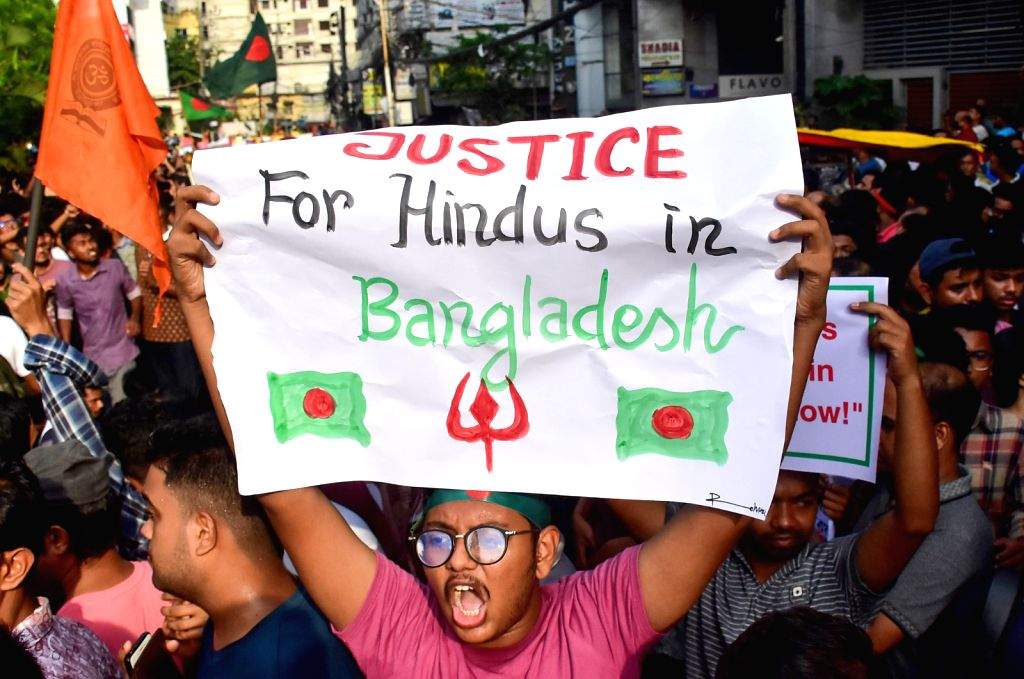
Dipu Chandra Das was lynched by an Islamist mob over false blasphemy allegations, an incident that triggered protests in Bangladesh and demonstrations outside the Bangladesh High Commission in New Delhi. Another Hindu man, Amrit Mandal, was also lynched in a separate incident over allegations of extortion, further intensifying concerns over mob justice and minority safety.
India’s Ministry of External Affairs has stated that around 2,900 incidents of violence against minorities have been reported during the tenure of Bangladesh’s interim government, underscoring the scale of the crisis.
The spike in violence has coincided with widespread unrest following the death of Sharif Osman Hadi, a key organiser of last year’s July uprising. His death in Singapore, after sustaining a gunshot wound in Dhaka, sparked protests, attacks on public institutions, and heightened political tensions across the country.
Credit : Organiser Weekly