 Matribhumi Samachar English


New Delhi. Thursday, 11 June 2026
If you have been seeing worrying headlines about a sudden halt in the sweet trade of Indian mangoes across the border, you can breathe a sigh of relief. The Ministry of Agriculture and Farmers Welfare has officially stepped forward to clear the air, confirming that reports claiming Nepal has banned or suspended the import of Indian mangoes are entirely false and misleading.
On June 10, 2026, the Government of Nepal’s Plant Quarantine and Pesticide Management Center formally verified that no such restrictions exist. While the rules for shipping these beloved fruits have seen a few technical updates, the border remains completely open to Indian mangoes.
The Hard Numbers: Inside the 2026 Mango Trade Data
Despite the media friction, the actual trade data proves that the supply chains have not skipped a beat. Millions of people in Nepal are still enjoying fresh Indian mangoes this summer.
-
Year-to-Date Volume: Since January 2026, India has successfully dispatched 149 consignments crossing the border, translating to a massive 2,005 metric tonnes (MT) of mangoes.
-
Current Month Progress: In the first ten days of June 2026 alone, 18 consignments containing 266 MT have been exported seamlessly.
What Actually Changed? Understanding the New Rules
The confusion in recent media reports seems to stem from a modification in import documentation rather than an outright trade restriction. Nepal recently revised its border entry conditions to include stricter phytosanitary measures—which are standard international health checks designed to prevent the cross-border spread of plant pests.
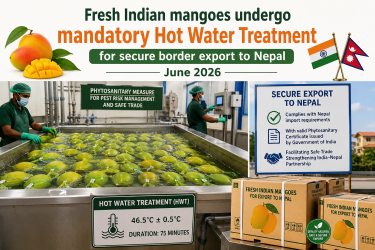
The biggest operational shift is the introduction of a mandatory Hot Water Treatment (HWT) for all incoming mango shipments.
What is Hot Water Treatment (HWT)? It is a clean, non-chemical pest-control method where clean mangoes are submerged in hot water (usually between 46–48°C) for a specific timeframe. This naturally eliminates fruit fly larvae without damaging the fruit’s flavor or quality, ensuring safer agricultural consumption.
The Indian government is actively helping local exporters adapt to these new guidelines, ensuring all shipments leave with the required Hot Water Treatment logs and valid phytosanitary certificates securely attached.
Addressing Border Consultation Challenges
While India is fully complying with these safer food guidelines to keep trade lines moving, it has also formally raised concerns with Nepal through bilateral diplomatic routes.
According to global trade protocols—specifically the World Trade Organization’s Sanitary and Phytosanitary (WTO SPS) Agreement and the International Plant Protection Convention (IPPC)—member countries are generally expected to consult their trading partners before abruptly shifting regulatory requirements. India is currently addressing this lack of prior notice through appropriate bilateral channels.
Advisory for Traders and the Public
Moving forward, the Ministry of Agriculture has strongly advised all stakeholders, wholesale traders, and the general public to disregard unverified social media updates or unofficial news bulletins. To protect economic interests and avoid costly logistical delays at the border, always cross-verify shipping protocols through official government portals.
For continuous multi-sector updates covering emerging business policies, regional trade shifts, and official clarifications, check out the latest international breakdowns directly through the Matribhumi Samachar English Business Archive.