 Matribhumi Samachar English


New Delhi. Wednesday, 1 July 2026
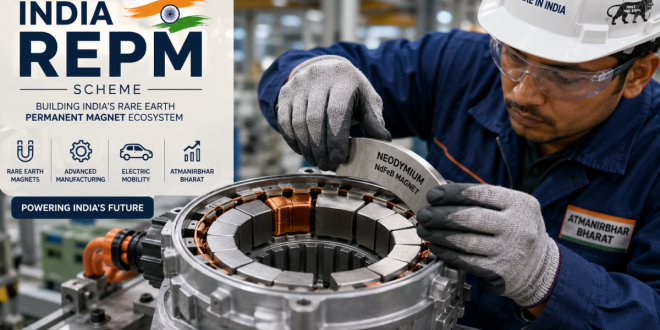
In a move to fortify its high-tech industrial supply chains, the Government of India has officially extended the bid submission deadline for its ambitious ₹7,280-crore Rare Earth Permanent Magnet (REPM) Manufacturing Scheme. Originally slated for June 29, the Ministry of Heavy Industries pushed the final submission date to July 29, 2026, following extensive feedback and formal requests from key industry stakeholders.
This administrative shift ensures that prospective domestic and international consortiums have sufficient time to lock down complex global technology transfers, refine intricate financial models, and establish robust raw material sourcing strategies.
For real-time updates on India’s latest policy rollouts, check the Matribhumi Samachar Business Section.
Why Rare Earth Magnets Are the Backbone of Modern Tech
Rare earth permanent magnets—predominantly Neodymium-Iron-Boron (NdFeB) variants—are unparalleled in their magnetic strength-to-weight ratios. They are critical, non-negotiable building blocks for multiple high-growth industries that define 21st-century manufacturing:
-
Electric Vehicle (EV) Ecosystem: Powering high-efficiency traction motors in passenger EVs, commercial trucks, and electric two-wheelers.
-
Semiconductor Manufacturing: Integrated deeply into precision robotics, wafer-handling automation, and clean-room industrial motors.
-
Defense & Aerospace: Vital for missile guidance systems, radar arrays, military drones, and naval propulsion mechanisms.
-
Green Energy infrastructure: Dictating the efficiency of next-generation wind turbine generators.
Despite possessing substantial raw deposits of rare earth elements within its monazite beach sands, India historically lacked the specialized midstream capacity required to process raw oxides into final, high-grade permanent magnets. This reliance on imports—predominantly from nations like China, which controls over 85% of global processing—left India’s core technology sectors vulnerable to unexpected supply blockades and geopolitical shocks.
Inside the ₹7,280-Crore REPM Architecture
The overarching objective of this mega-scheme is to catalyze the creation of a 6,000 Metric Tonnes Per Annum (MTPA) integrated REPM ecosystem within the country. The financial framework is meticulously broken down into two distinct pillars:
| Incentive Type | Allocation | Primary Objective |
| Sales-Linked Incentives | ₹6,450 Crore | Offsets early-stage production scaling costs over a multi-year period to guarantee global price competitiveness. |
| Capital Subsidies | ₹750 Crore | Directly absorbs a portion of the massive upfront capital expenditures required to construct highly advanced, dust-free manufacturing units. |
The decision to delay the deadline by a month is highly strategic. Building an integrated rare earth magnet facility requires deep powder-metallurgy expertise. By extending the window, the Indian government is encouraging deep-tier global technology partnerships between local manufacturing giants and international tech pioneers from countries like Japan, Germany, and South Korea.
To see how this aligns with neighboring infrastructure trends, read our comprehensive coverage on the India Semiconductor Mission Progress.
Boosting the “Make in India” Multiplier Effect
The REPM scheme does not operate in isolation. It serves as a downstream anchor designed to leverage several other flagship national initiatives:
-
The National Critical Minerals Strategy: Ensuring the raw materials excavated are refined locally rather than exported raw.
-
The Production-Linked Incentive (PLI) Schemes: Creating direct supply-chain harmony with domestic EV automakers who receive subsidies for sourcing localized components.
-
Dedicated Rare Earth Corridors: Synergizing with the newly designated coastal processing zones across Odisha, Andhra Pradesh, and Tamil Nadu.
By moving away from import dependence, local automakers and defense labs can radically reduce lead times, mitigate currency fluctuation risks, and safeguard strategic autonomy.
Frequently Asked Questions (FAQ)
What is the new deadline for the India REPM Manufacturing Scheme?
The Ministry of Heavy Industries has extended the bid submission deadline from June 29 to July 29, 2026, to give companies more time to finalize global partnerships and technical bids.
Why are rare earth permanent magnets important for EVs?
Rare earth magnets (like NdFeB) deliver the extreme magnetic fields required to run high-torque, highly efficient electric vehicle traction motors, allowing EVs to achieve greater driving range per charge.
What is the production target of the REPM scheme?
The program aims to establish an integrated domestic manufacturing capacity of 6,000 Metric Tonnes Per Annum (MTPA) of rare earth permanent magnets.
How does this scheme benefit India’s defense sector?
By localizing magnet production, India removes foreign dependence on vital components used inside missile guidance systems, military drones, and advanced communication gear, significantly bolstering national security.
Disclaimer: This article is intended solely for informational and educational purposes. The details regarding the ₹7,280-crore REPM scheme extension are based on recent ministerial notifications and industrial reports available as of July 2026. Prospective bidders and investors should consult the official guidelines issued by the Ministry of Heavy Industries, Government of India, before making financial or corporate commitments.