 Matribhumi Samachar English


Mumbai. Wednesday, 1 July 2026
The Indian financial ecosystem is standing on the precipice of a massive structural shift. In a major move to modernize the country’s financial plumbing, the Reserve Bank of India (RBI) recently released its draft Master Directions for the Call, Notice, and Term Money Markets.
By breaking down the walls of what has historically been a highly restrictive, bank-dominated club, the central bank aims to deepen liquidity, build a reliable short-term yield curve, and radically improve how monetary policy changes flow through to businesses and consumers.
Here is a detailed breakdown of how these reforms work, who wins, and how the new regulations safeguard the system from systemic risks.
Understanding the Core: What is Changing?
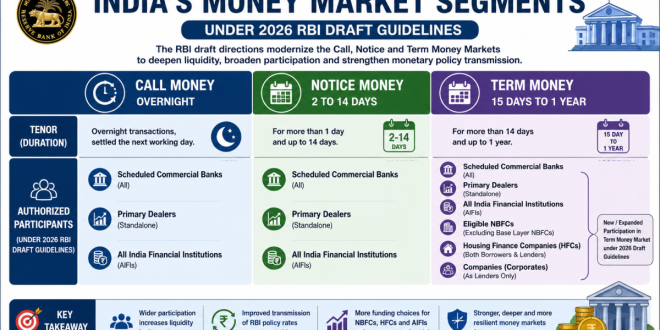
The wholesale money market is where banks and financial institutions borrow or lend cash for short durations to manage day-to-day liquidity imbalances. It operates across three distinct time horizons:
-
Call Money: Overnight borrowing and lending.
-
Notice Money: Funds borrowed or lent from 2 days up to 14 days.
-
Term Money: Short-term funding spanning 15 days up to a full year.
While India’s overnight Call Money market is incredibly active and deep, the Term Money Market has historically remained shallow and illiquid. Most non-bank institutions and corporations had to rely on fragmented instruments like Commercial Paper (CP) or direct bank lines to manage multi-month cash gaps. The RBI’s new framework directly targets this bottleneck.
The New Participant Matrix: Opening the Doors
The draft directions completely overhaul who is allowed to participate, introducing a massive influx of new capital into the 15-day to 1-year segment.
| Market Segment | Tenor Range | Permitted Participants (Borrowers & Lenders) |
| Call Money | Overnight | Scheduled Commercial Banks, Small Finance Banks (SFBs), Regional Rural Banks (RRBs), Co-operative Banks, Payments Banks, and Standalone Primary Dealers (SPDs). |
| Notice Money | 2 to 14 Days | Same as Call Money (Restricted to banking institutions and SPDs). |
| Term Money | 15 Days to 1 Year | [NEW] Eligible NBFCs (excluding Base Layer), Housing Finance Companies (HFCs), All India Financial Institutions (AIFIs). Corporates are allowed as Lenders only. |
1. NBFCs and HFCs Graduate to Direct Access
Previously, Non-Banking Financial Companies (NBFCs) and Housing Finance Companies (HFCs) were largely locked out of direct term money participation. Under the 2026 draft, eligible middle, upper, and top-layer NBFCs alongside registered HFCs can now actively borrow and lend across the term curve. This reduces their heavy, singular reliance on direct commercial bank loans.
2. Corporate Cash Unleashed
Large companies frequently sit on massive pools of temporary surplus cash (e.g., ahead of tax payouts or capital expenditures). The RBI is now letting these corporates act as lenders in the term money market. While they cannot borrow from this market, their entry as lenders injects a massive wave of non-bank liquidity directly into the financial system.
Guardrails against Risk: Pruning and Limits
Opening up the money markets requires strict safety parameters to ensure a sudden liquidity crunch doesn’t trigger a domino effect across interconnected institutions. The RBI has built two major safety valves into the proposal:
Capital-Linked Borrowing Caps
To prevent over-leveraging, the RBI has capped borrowing limits based on an institution’s financial strength:
-
NBFCs and HFCs: Outstanding borrowings in the term money market cannot exceed 200% of their Net Owned Funds (NOF) at any given time.
-
Standalone Primary Dealers (SPDs): To support market-making activities, their combined borrowing limit across term money and inter-corporate deposits has been increased to 400% of their NOF.
The 15-Minute Reporting Rule
Transparency is paramount. For any trade executed over-the-counter (OTC) rather than on the automated NDS-CALL platform, participants must report the full details to the platform within 15 minutes of striking the deal. This provides the central bank with real-time visibility into systemic risk and prevents delayed data printing.
The Macro Objective: Fixing Monetary Policy Transmission
The ultimate goal of these changes extends far beyond helping institutions balance their books—it is about economic control.
When the RBI adjusts the repo rate, the change impacts overnight call rates almost instantly. However, that impact historically struggled to smoothly glide down into 3-month, 6-month, or 1-year borrowing costs because the term market lacked volume.
By inviting a diverse array of lenders (like corporate treasuries) and borrowers (like HFCs), the market will naturally establish a clear, market-driven short-term yield curve. When term money rates are accurately priced by a wide pool of participants, commercial bank lending rates and consumer loan pricing become much more rational, predictable, and reactive to the RBI’s macro decisions.
Frequently Asked Questions (FAQs)
1. Will these RBI reforms immediately lower my home loan or car loan EMIs?
No, retail consumers will not see an immediate change in their EMIs. However, over the medium to long term, a deeper money market lowers funding stress for lenders (like HFCs), which creates more competitive and stable lending rates for consumers.
2. Why are Base Layer NBFCs excluded from the term money market?
Base Layer NBFCs are typically smaller, localized non-bank lenders with less capital. The RBI excludes them to shelter smaller institutions from the high-volatility, wholesale institutional funding markets, ensuring financial stability.
3. Can a private limited company borrow money under this new framework?
No. Under the draft guidelines, corporates are strictly permitted to act as lenders only to deploy their surplus liquidity. They cannot utilize the term money market to raise short-term debt.
Disclaimer
The information provided in this article is based on the draft directions released by the Reserve Bank of India (RBI) for stakeholder feedback. The final framework implemented by the central bank may include modifications, refinements, or altered operational limits based on market feedback.
Stay Updated
For continuous coverage on Indian macroeconomic shifts, policy updates, and financial regulations, visit the official English portal of Matribhumi Samachar.