 Matribhumi Samachar English


Mumbai. Thursday, 2 July 2026
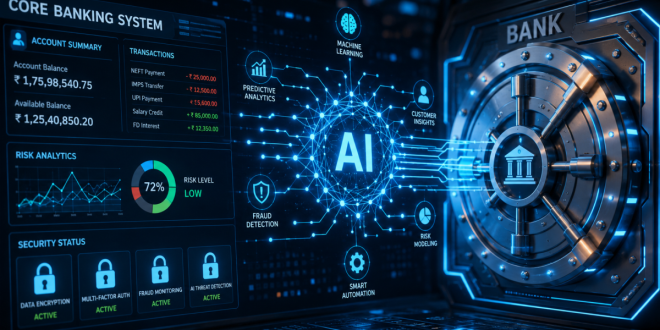
Artificial Intelligence (AI) has officially evolved from a futuristic concept into the backbone of India’s financial sector. If you think AI in banking is just about those helpful virtual assistants popping up to tell you your account balance, it is time to look behind the scenes.
The Indian banking industry is undergoing one of its most massive technological shifts. Driven by heavy digital infrastructure investments and guided by the Reserve Bank of India’s (RBI) focus on responsible tech adoption, banks are deploying AI across deep, complex operational layers where customers may never directly see it—but will certainly feel its benefits.
From Front-Desk Chatbots to Deep Core Operations
For years, customer-facing chatbots were the primary way people interacted with banking AI. Today, modern AI models process millions of transactions per second to keep our money safe, expedite decisions, and simplify regulatory hassles.
This silent operational revolution is helping financial institutions drastically reduce overhead costs while increasing speed, security, and precision.
1. Smarter Fraud Detection in Real Time
Traditional fraud detection relied heavily on rigid, pre-defined rules. If an activity fell slightly outside a set parameter, it either slipped through or triggered an annoying false alarm.
AI-powered fraud monitoring systems change the game by analyzing behavioral patterns and transaction histories continuously. They can instantly spot an account takeover attempt, flag unusual payment trends, and dramatically reduce false alerts by learning from new, evolving cyber-attack methodologies before major losses occur.
2. Lightning-Fast Loan Approvals
Waiting days or weeks for credit approval is fast becoming a thing of the past. Through AI credit underwriting for MSMEs and retail customers, banks evaluate a wider, more holistic matrix of financial health indicator data:
-
Consistency of monthly income and cash flows
-
Daily transaction histories and spending habits
-
Existing liabilities alongside active repayment habits
This data-driven approach allows lenders to make highly accurate risk assessments within minutes. Micro, Small, and Medium Enterprises (MSMEs), which historically struggled with collateral-backed evaluations, stand to benefit enormously from digital footprint-based lending.
3. Tightening Cybersecurity and Compliance
With the rapid evolution of financial cyber threats, reactive security is no longer enough. Banks leverage AI for continuous authentication, phishing detection, network anomaly identification, and monitoring internal policy adherence.
Concurrently, compliance teams utilize AI to automate Anti-Money Laundering (AML) screening, handle complex Know Your Customer (KYC) verifications, and prepare flawless regulatory reports.
4. Generative AI and Personalization
Generative AI is unlocking the next frontier in banking productivity. Internal knowledge assistants help bank employees digest complex policies, summarize legal documents, and draft accurate financial reports or customer emails.
On the consumer end, this data density allows banks to move away from generic marketing campaigns. Instead, users receive intelligent, tailored financial health alerts, hyper-personalized savings recommendations, and customized loan offers based on real-time behavior.
Navigating the Future: The RBI and Responsible AI
The future of AI in Indian banking is deeply tethered to ethics and governance. Recognizing both the power and risks of these systems, the Reserve Bank of India (RBI) has introduced comprehensive draft governance frameworks. Financial institutions are actively addressing critical hurdles, including:
-
Protecting absolute user data privacy
-
Eradicating algorithmic model bias
-
Ensuring “explainability” (understanding how an AI reached a specific credit or risk decision)
-
Maintaining robust human oversight over fully automated systems
Ultimately, AI is not designed to replace human bankers; it is here to augment human decision-making, wipe out administrative friction, and create a safer, hyper-personalized ecosystem for millions of savers and businesses across India.
For more deep-dives into India’s growing financial landscape and the latest tech developments shaping our markets, explore the business and technology columns over at Matribhumi Samachar.
Frequently Asked Questions (FAQs)
How is AI making banking safer for regular customers in India?
AI continuously monitors your account activity for unusual behavior—like a sudden transaction from an unfamiliar location or an irregular spending spike. By recognizing these anomalies in real time, it can block fraudulent activities and prevent account takeovers much faster than manual human review.
What are the RBI guidelines for responsible AI adoption?
The RBI guidelines for responsible AI stress that banks must maintain clear accountability, eliminate data bias, protect consumer privacy, and ensure that automated decisions can be easily explained and audited by human managers.
Can MSMEs get loans easier because of AI?
Yes. Many small businesses lack the traditional collateral or lengthy credit history that legacy banking systems require. AI allows banks to evaluate alternative data—such as digital transaction histories and cash flow consistency—to approve business loans quickly and securely.
Disclaimer: The information provided in this article is for informational and educational purposes only. It does not constitute formal financial, legal, or investment advice. For specific guidance on banking policies and digital financial security, please consult your financial institution or official guidelines from the Reserve Bank of India (RBI).