 Matribhumi Samachar English


New Delhi. Friday, 3 July 2026
If you are one of the millions who rely on the vast Indian Railways network for your daily commute or occasional holidays, it is time to take note. A significant legislative shift came into effect this July. Under the Jan Vishwas (Amendment of Provisions) Act, 2026, the government has completely updated the railway penalty framework.
The primary objective of this modification is to replace traditional criminal prosecution with a strict, monetary penalty-based enforcement system for minor offenses. This strategic update aims to enhance passenger discipline, safeguard women and senior citizens, protect public property, and modernize how regulations are managed across the network.
Why the Fine Structure Has Been Revised
According to official railway authorities, the new rules focus heavily on civic discipline and public safety. The key focus areas include:
-
Discouraging ticketless travel and optimizing revenue.
-
Maximizing safety inside trains and on station platforms.
-
Offering stricter protections for women traveling alone.
-
Restricting public nuisances, hazardous goods transportation, and property damage.
For more national travel updates and systemic infrastructure overhauls, you can read more about ongoing National News on Matribhumi Samachar.
The Updated Fines Matrix: Old vs. New Rules
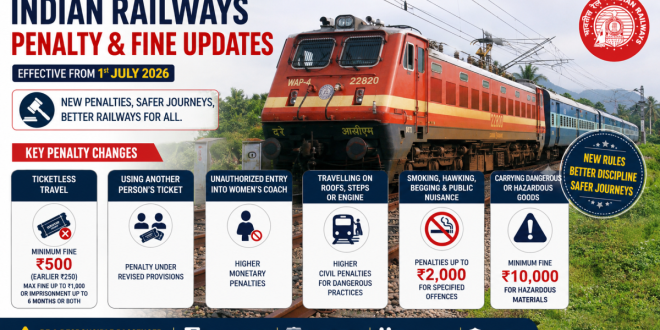
The changes introduce much higher civil penalties for behavioral infractions and double the minimum fine for travelers without valid documentation.
| Violation Type | Old Penalty Structure | Revised Rule (July 2026) |
| Ticketless Travel | Minimum fine of ₹250 | Minimum fine increased to ₹500 (Maximum up to ₹1,000 and/or 6 months imprisonment remains possible depending on intent). |
| Public Nuisance & Conduct (Smoking, begging, illegal hawking, intoxication, or abusive behavior) | Varies by zone | Monetary fines up to ₹2,000 for specified offenses. Failure to pay forwards the matter directly to a court. |
| Safety Violations (Traveling on roofs, steps, footboards, or inside the engine area) | Mild warnings/fines | Significantly higher civil penalties implemented immediately. |
| Women’s Coach Intrusions (Unauthorized entry by male passengers) | Regular eviction/minor fine | Substantially higher monetary penalties to protect female passenger safety. |
| Ticket Scams (Traveling on someone else’s reserved ticket) | General forfeiture | Strict action under revised provisions with tighter automated verification check-ins. |
| Hazardous Transports (Carrying dangerous or explosive items without authorization) | Standard seizure | Stricter penalties under the amended framework to safeguard public infrastructure. |
Tips for a Penalty-Free Journey
Staying on the right side of the law is simple if you maintain general travel discipline:
-
Verify Your Ticket & ID: Always secure a valid ticket or pass prior to boarding and keep an official government ID ready during reserved travel.
-
Respect Reserved Spaces: Do not step into dedicated compartments like ladies’ coaches or first-class sections unless your ticket specifically permits it.
-
Keep It Clean and Quiet: Refrain from smoking within station boundaries or inside coaches, and report unauthorized hawkers or beggars to station authorities.
-
Prioritize Personal Safety: Never stand on running boards or attempt to board moving trains.
Frequently Asked Questions (FAQs)
1. When did these new Indian Railways penalty rules take effect?
The revised penalty structure officially rolled out in July 2026 under the Jan Vishwas (Amendment of Provisions) Act, 2026.
2. What happens if I accidentally board a train without a ticket now?
The minimum penalty for ticketless travel has doubled from ₹250 to ₹500. Depending on the scenario, offenders can face up to a ₹1,000 fine and potentially up to six months of imprisonment for structural non-compliance or evasion.
3. Has criminal imprisonment been completely removed under the Jan Vishwas Act?
No. While the Act prioritizes civil monetary fines over courtroom prosecution for minor public nuisances, serious violations—such as carrying dangerous goods or repeating severe offenses under the Railways Act—can still lead to criminal prosecution and jail time.
4. Can someone else travel on my reserved train ticket?
No, using someone else’s reserved ticket is unauthorized. Railway checking staff have increased verification routines to prevent ticket misuse under the revised July 2026 terms.
Disclaimer
The data provided in this article regarding the Indian Railways revised penalty framework is intended purely for general informational purposes. While efforts are made to align with the July 2026 updates of the Jan Vishwas Act, passengers are advised to verify real-time rules and official gazette notifications through the Ministry of Railways or local station administrative offices before planning their journeys.