 Matribhumi Samachar English


Mumbai. Saturday, 4 July 2026
India is undergoing a fundamental economic transformation, moving away from being a consumption-heavy market to establishing itself as a dominant global manufacturing and services powerhouse. To achieve its highly publicized $1 trillion annual export target over the coming years, the country is executing a comprehensive, multi-layered strategy. This massive shift relies on aggressive infrastructural, regulatory, and digital interventions designed to lower the cost of doing business and enhance cross-border competitiveness.
7 Major Pillars Powering India’s Export Strategy
The strategy to secure the $1 trillion milestone is anchored across seven distinct pillars of industrial and logistical reform.
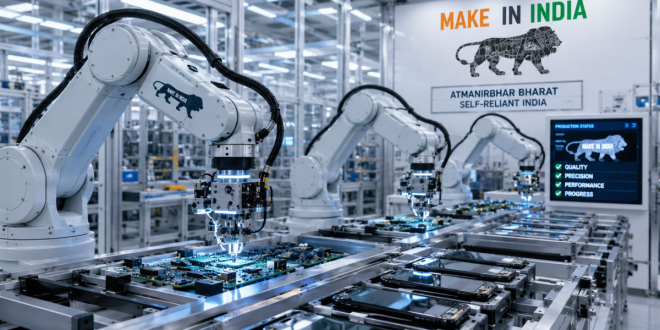
1. Expanding Manufacturing Through “Make in India”
Global supply chains are actively shifting away from single-source dependencies, giving the “Make in India” initiative immense geopolitical momentum. Central to this manufacturing expansion is the Production-Linked Incentive (PLI) scheme, alongside deep industrial subsidies. The state is systematically drawing multi-billion dollar foreign and domestic capital deployments into highly technical ecosystems. The primary sectors accelerating this output include:
-
Electronics and Semiconductors: Scaling localized smartphone assembly and component packaging lines.
-
Automobiles: Moving rapidly up the global value chain with an emphasis on Electric Vehicles (EVs) and advanced automotive components.
-
Pharmaceuticals & Defence Equipment: Establishing self-reliance in Active Pharmaceutical Ingredients (APIs) and heavy military hardware.
-
Renewable Energy Components & Textiles: Localizing the manufacturing of solar cells, wind turbine generators, and value-added technical garments.
2. Modernizing Ports and Logistics
Historically, high domestic logistics costs (averaging 13–14% of GDP) heavily penalized Indian goods entering the international marketplace. To systematically compress this friction, the state has initiated the PM Gati Shakti National Master Plan. This structural upgrade involves deploying dedicated freight corridors to move cargo rapidly between industrial heartlands and coastal hubs, setting up smart ports with digitized automated customs clearance systems, and building integrated multi-modal logistics parks featuring real-time digital cargo tracking.
3. Expanding Free Trade Agreements (FTAs)
Recognizing that market access is just as vital as factory-floor production, India has pivoted aggressively toward negotiating deep, high-yield trade agreements. Moving past its historic hesitation toward multilateral pacts, the country is executing modernized FTAs with economic blocs like the UAE, Australia, the European Free Trade Association (EFTA), and ongoing negotiations with the UK and EU. These frameworks explicitly lower import tariffs on essential inputs, dismantle non-tariff blockades, and build reliable long-term regulatory frameworks for exporters to expand out of traditional zones.
4. Boosting High-Value Technology Exports
India is orchestrating an ambitious transition up the industrial sophistication ladder, pivoting from low-margin raw material shipments into deep-tech, high-value systems. A prime example is the domestic defense technology ecosystem. For insights into how localized high-tech engineering is driving this pivot, see The Rise of Indigenous Defence Drones: How India Is Engineering Its New Era of Military Self-Reliance.
Beyond automated military systems, this technical evolution spans artificial intelligence (AI) enterprise solutions, commercial aerospace tracking, and precision medical devices. Furthermore, the electronics space relies on securing critical supply chains. To understand the strategic backing of raw inputs for these industries, read about how India Extends ₹7280-Crore Rare Earth Permanent Magnet (REPM) Scheme Application Deadline to July 29, 2026.
5. Supporting MSMEs Through Digital Platforms
Micro, Small, and Medium Enterprises (MSMEs) constitute the backbone of the domestic economy but have historically lacked the scale to deal directly with global corporate entities. The current structural solution leverages Digital Public Infrastructure (DPI) to build end-to-end digital export marketplaces. By integrating automated customs portals, providing easier credit lines, and helping small businesses with quality compliance certifications online, smaller enterprises can bypass traditional brick-and-mortar trade middle-men.
6. Improving Product Quality and Global Standards
Sustaining deep penetration into strict Western and East Asian jurisdictions requires flawless alignment with international safety, environmental, and quality metrics. India is continuously standardizing its manufacturing lines by developing accredited testing laboratories and strictly regulating environmental compliance. This systemic focus on cross-border transparency eliminates arbitrary export rejections while building India’s reputation as a reliable, high-end supplier.
7. Encouraging Services Exports
While tangible merchandise receives significant visibility, the global technology services industry remains India’s strongest competitive engine. Generating hundreds of billions of dollars annually, this cluster is actively re-engineering itself through the integration of generative AI and automated analytics. The expansion goes far beyond typical IT maintenance, capturing significant global market share in financial technology engineering, business process management (BPM), advanced healthcare advisory, and specialized engineering consultancy.
Overcoming Key Macroeconomic Headwinds
The pathway toward a $1 trillion export volume faces several global challenges that require careful navigation:
-
Cooling Western Economies: Slower private sector growth in core Western markets can temporarily soften consumer demand for outbound shipments. For tactical insight into these cycles, see Navigating Market Shifts: How Slower Private Sector Growth Impacts Your Portfolio.
-
Geopolitical and Supply Friction: Persistent maritime route vulnerabilities, localized international conflicts, and sudden energy blockades can trigger unexpected shipping cost hikes.
-
Currency Volatility: Fluctuations in major international trading currencies require sophisticated hedging and robust monetary policy support from the Reserve Bank of India (RBI).
Frequently Asked Questions (FAQ)
What are the main sectors driving India’s $1 trillion merchandise export push?
The primary sectors leading the charge include electronics manufacturing (especially smartphones and components), engineering goods, pharmaceuticals, value-added chemicals, and indigenous defense systems.
How does the PLI scheme assist Indian exporters?
The Production-Linked Incentive (PLI) scheme provides direct financial cashbacks and sales-linked payouts to companies operating on Indian soil based on their incremental production capacity, lowering cost barriers and making final goods highly competitive globally.
Why is port and logistics modernization vital for India’s export growth?
Reducing domestic transport delays and logistical friction lowers the overall landed cost of Indian goods in international markets, turning speed and pricing into core competitive advantages.
Disclaimer: This article is prepared strictly for educational and informational purposes. All assessments regarding economic policies, export projections, and industrial schemes are modeled around data points and official notifications available as of July 2026. Readers and prospective investors are advised to cross-reference direct policy documents from the Ministry of Commerce and Industry and relevant administrative bodies before executing specific financial or corporate strategies.