 Matribhumi Samachar English


New Delhi. Monday, 6 July 2026
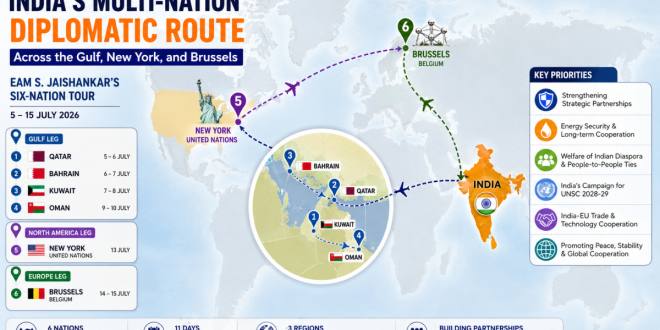
India’s foreign policy is stepping into an ambitious new phase. External Affairs Minister Dr. S. Jaishankar has officially embarked on a comprehensive six-nation diplomatic tour. Spanning the Gulf region, the United Nations in New York, and the European Union headquarters in Brussels, this multi-tiered tour highlights New Delhi’s growing focus on strategic partnerships, energy security, multilateral diplomacy, and advanced technology cooperation.
Taking place against a backdrop of shifting geopolitical alignments in West Asia and intense global technological competition, the visit underscores India’s evolving role as a leading voice of the Global South and a pragmatist player on the world stage.
1. Strengthening Strategic Partnerships in the Gulf
The initial phase of the tour focuses on four vital Gulf cooperation partners: Qatar, Bahrain, Kuwait, and Oman. These nations sit at the crossroads of India’s economic and energy security interests.
During high-level bilateral meetings, the agenda is packed with critical priority areas:
-
Trade and Investment Expansion: Moving beyond buyer-seller dynamics into deep structural investments.
-
Defense and Maritime Security: Ensuring freedom of navigation and robust counter-terrorism cooperation across vital sea lanes.
-
Regional Stability: Navigating the complex geopolitical architecture of West Asia through balanced engagement.
Energy Security and the Green Transition
The Gulf region remains one of India’s largest trading blocks, supplying a major portion of the country’s crude oil and liquefied natural gas (LNG). However, Jaishankar’s discussions are expected to push past traditional fossil fuel dependency. While long-term oil supply agreements and LNG imports remain foundational, significant focus will be placed on green hydrogen cooperation and mutual investments in renewable energy portfolios.
Prioritizing Diaspora Welfare
Millions of Indian expatriates live and work across the Gulf, sending back vital remittances that support the domestic economy. Recognizing this, the tour prioritizes community welfare, seeking to streamline labor mobility, enhance consular services, and establish robust skill development frameworks to align Indian workers with evolving regional market demands.
2. Launching the UNSC Campaign in New York
Following the Gulf leg, the diplomatic focus shifts to multilateral institutional reform. Dr. Jaishankar will travel to New York to officially launch India’s campaign for a non-permanent seat on the United Nations Security Council (UNSC) for the 2028–2029 term.
India has consistently championed the cause of comprehensive UN reforms, arguing that the current structure fails to reflect contemporary global realities. New Delhi’s pitch centers on:
-
Securing greater representation for developing nations.
-
Strengthening fractured global governance frameworks.
-
Upholding a transparent, rules-based international order.
By rallying support among UN member states during this visit, India aims to consolidate its position as a bridge-builder between the developed world and the Global South.
3. Technology Diplomacy Takes Center Stage in Brussels
The final leg of the tour takes the minister to Brussels for the third ministerial meeting of the India-European Union Trade and Technology Council (TTC).
Technology has rapidly transformed into a core pillar of modern statecraft, and the Brussels dialogue represents a major push toward securing India’s digital future. The high-level talks will target collaboration in critical and emerging fields:
┌────────────────────────────────────────────────────────┐
│             India-EU TTC Major Agenda Items            │
├────────────────────────────────────────────────────────┤
│ • Artificial Intelligence (AI) Ethical Governance      │
│ • Semiconductor Design & Resilient Manufacturing       │
│ • Quantum Computing & Advanced Research Frameworks     │
│ • Cybersecurity Protocols for Critical Infrastructure   │
│ • Trusted Technology Supply Chains                     │
└────────────────────────────────────────────────────────┘
By locking in strategic ties with the EU, India seeks to attract high-value research partnerships and foreign investment, directly supporting its goal to become an indispensable global manufacturing and innovation hub.
Evolving Geopolitical Strategy
Ultimately, Dr. Jaishankar’s tour demonstrates the execution of multi-alignment. Rather than choosing between traditional allies and emerging blocs, India is actively strengthening relationships across diverse geopolitical spheres simultaneously—safeguarding its energy interests in the Middle East, demanding institutional equity at the UN, and securing the technology building blocks of tomorrow in Europe.
Frequently Asked Questions (FAQ)
What are the main objectives of Dr. S. Jaishankar’s diplomatic tour?
The tour focuses on three main pillars: securing long-term energy and diaspora interests in the Gulf (Qatar, Bahrain, Kuwait, Oman), launching India’s 2028–2029 UNSC non-permanent seat campaign in New York, and expanding critical technology cooperation at the India-EU TTC meeting in Brussels.
Why is the India-EU Trade and Technology Council (TTC) meeting important?
The TTC is a crucial platform for establishing secure supply chains and collaborative policies in emerging technologies. Discussions cover key areas like semiconductor manufacturing, AI governance, quantum computing, and cybersecurity.
How does the Gulf tour affect the Indian diaspora?
The visit aims to directly improve worker welfare, streamline labor mobility agreements, upgrade consular services, and strengthen community engagement for the millions of Indians residing in the region.
Disclaimer: This article is prepared for informational purposes based on current diplomatic itineraries, official agendas, and foreign policy developments. While we strive to provide accurate, up-to-date analysis, readers are encouraged to consult official government communiqués for finalized bilateral agreements.
Note: For further coverage, regional updates, and international analysis, you can visit the English portal of Matribhumi Samachar at matribhumisamachar.com/en