 Matribhumi Samachar English


New Delhi. Monday, 6 July 2026
India’s defence industry is undergoing one of its most significant structural transformations in decades. While the nation’s journey toward military self-reliance began under the multi-year umbrella of the Atmanirbhar Bharat initiative, the strategic maneuvers during Operation Sindoor in 2025 have fundamentally accelerated trust in indigenous military technologies. Today, policymakers, private sector manufacturers, and global buyers all agree: India’s indigenous defence ecosystem has officially graduated into a new era of sustained technological self-confidence.
Operation Sindoor: The Ultimate Catalyst for Self-Confidence
Military operations provide the ultimate crucible for complex tactical hardware. During Operation Sindoor, an entire array of domestic innovations—ranging from layered air platforms and surveillance payloads to electronic warfare suites—faced intense, real-world operational deployments.
The successful management of these security systems did more than protect territorial assets; it successfully catalyzed a vital shift from basic self-reliance to operational self-confidence. According to leading security experts, this psychological pivot brings profound structural advantages:
-
Larger Domestic Procurement: The armed forces are increasingly executing bigger domestic orders, confident that local production matches global quality.
-
Aggressive Private Capital: Private enterprises now have explicit financial and sovereign proof of concept, creating an optimal environment to invest heavily in advanced R&D.
-
International Validation: Global export buyers gain concrete trust when systems are field-tested and actively integrated by the Indian Armed Forces.
Charting the Numbers: Breaking Historic Manufacturing Records
The economic footprint of this transformation is visible across national accounting logs. Driven by deep policy implementation and modernized assembly chains, India’s defense sector reached unmatched peaks in the FY 2025–26 financial cycle.
-
Historic Production Peaks: Indigenous defence production officially hit an unprecedented ₹1.78 lakh crore in FY 2025–26, registering an extraordinary growth trajectory over previous fiscal years.
-
Soaring Export Demands: Driven by rising geopolitical diversification, defence exports climbed to ₹38,424 crore, with state-of-the-art systems scaling into more than 80 sovereign nations.
This dual-layer expansion proves that the industry is no longer optimized purely for local import substitution—it is scaling rapidly as an aggressive global supplier.
Private Industry as the High-Tech Growth Engine
Historically dominated by state-owned defense public sector undertakings (DPSUs), the modern framework has evolved into a balanced collaborative ecosystem. To keep pace with modern combat trends, the government has aggressively integrated private innovators to diversify national manufacturing capabilities.
Today, India’s private enterprises are directly designing and deploying:
-
Precision Missile Weaponry and supersonic cruise integrations.
-
AI-Enabled Tactical UAVs and automated border electronic surveillance assets.
-
Advanced Layered Radars and heavy armor vehicle component arrays.
This industrial base diversification significantly strengthens deep-tier supply chains, rendering them highly resilient against global geopolitical disruptions.
Sophisticated Weaponry Across Multi-Domain Systems
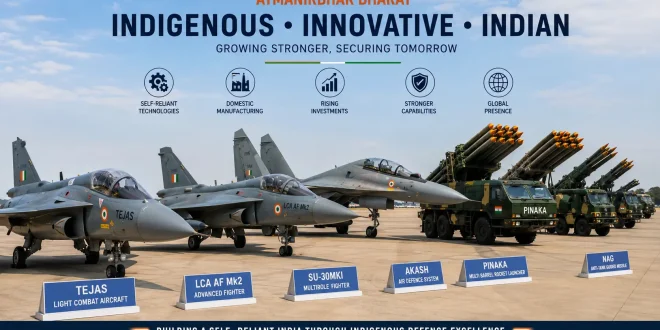
India’s domestic weapons portfolio now addresses complex operational requirements across land, air, space, and maritime domains. Some of the premier platforms headlining this engineering surge include:
| Platform Category | Leading Indigenous System Examples |
| Aviation & Aerospace | Tejas Light Combat Aircraft, Prachand Light Combat Helicopter |
| Missiles & Air Defence | BrahMos Supersonic Cruise Missile, Akash Air Defence System, Pinaka MBRL |
| Naval Capabilities | INS Vikrant Aircraft Carrier, INS Arihant Nuclear Submarine, Nilgiri-class Frigates |
These platforms confirm that domestic manufacturing pipelines have evolved successfully from license-building basic equipment to delivering ultra-sophisticated, technology-intensive weapon systems.
The Next Frontiers: Drone Warfare and Layered Air Defence
Modern regional conflicts have highlighted the critical nature of autonomous battlefield solutions. Following the tactical lessons extracted from Operation Sindoor, Indian startups are receiving significant capital infusions via programs like the Innovations for Defence Excellence (iDEX) platform to master advanced unmanned platforms.
The immediate domestic product focus spans:
-
Loitering Munitions & Counter-Drone Interceptors: Developing soft-kill electronic jamming tech alongside hard-kill kinetic lasers.
-
Autonomous Battlefield Systems: Integrating AI algorithms directly onto edge-computing chips for navigation in GPS-denied border environments.
-
Multi-Layered Shields: Scaling comprehensive protective networks under high-priority initiatives such as Project Kusha, MR-SAM, and V-SHORADS.
Resolving Strategic Bottlenecks for Global Leadership
Despite these historic breakthroughs, entering the top tier of global exporters requires overcoming several remaining manufacturing challenges:
-
Semiconductor Component Independence: Overcoming vulnerabilities tied to imported integrated circuits and sub-components.
-
Advanced Engine Propulsion Gaps: Securing completely localized turbine and jet engine tech to achieve total structural self-reliance.
-
Longer Development Cycles: Streamlining regulatory certification processes to accelerate hardware transition from early prototype phases straight to the frontlines.
Relevant Defence Architecture Resources
To better explore the specific technical and policy shifts reshaping this industry, review these deep-dive resources from Matribhumi Samachar:
-
Read about the policy frameworks modifying domestic military hardware acquisition protocols via India’s Draft DAP 2026: Revolutionizing Military Procurement and Domestic Manufacturing.
-
Discover how cutting-edge automation is replacing legacy hardware pipelines by exploring The Rise of Indigenous Defence Drones: How India Is Engineering Its New Era of Military Self-Reliance.
-
Review historical milestones that laid the groundwork for this growth phase through India’s Defence Sector: Paving the Way for Global Manufacturing Excellence : Raksha Mantri Rajnath Singh.
Frequently Asked Questions (FAQ)
Q1: What was the historic milestone reached by India’s defence production in FY 2025–26?
India’s indigenous defence production achieved a record-breaking valuation of ₹1.78 lakh crore in FY 2025–26, marking the highest performance metric in the nation’s history.
Q2: How did Operation Sindoor impact India’s indigenous defence ecosystem?
Operation Sindoor served as an active operational validator for domestically produced missile networks, surveillance radars, and electronic warfare suites. By executing successfully under live conditions, it accelerated military self-confidence, boosting larger domestic orders and global trust.
Q3: What are the primary technological challenges India still needs to solve?
The primary industrial bottlenecks include reliance on foreign semiconductor foundries, scaling up domestic R&D for advanced jet engine propulsion technology, and shortening development-to-deployment timelines.
Disclaimer
The information provided in this article is compiled from recent industry data, historical policy briefings, and defense sector news updates. It is intended strictly for informational and educational purposes. Operational metrics, project timelines, and defense procurement figures can vary dynamically based on updated government publications and geopolitical shifts.