 Matribhumi Samachar English


Mumbai. Friday, 10 July 2026
The Government of India has granted official regulatory approval for a historic joint venture (JV) between domestic electronics giant Dixon Technologies and Vivo Mobile India. This development serves as a major milestone in India’s quest to solidify its position as a dominant global smartphone manufacturing hub.
Under the newly approved corporate architecture, Dixon Technologies will command a majority stake of 51%, while Vivo Mobile India will retain the remaining 49%. By establishing a definitive domestic majority, this structural alignment represents a significant evolution in how India balances international capital with strategic self-reliance.
Why the Dixon-Vivo Approval Redefines India’s Tech Policy
The clearance resolves intense regulatory scrutiny, unlocking immediate plans for a dedicated, high-capacity manufacturing framework inside the country.
Historically, foreign direct investment (FDI) in high-tech sectors faced severe systemic delays, especially under geopolitical protective frameworks like Press Note 3. This regulation strictly reviews investment inflows from nations sharing land borders with India. The approval of this partnership indicates that Indian policymakers are adopting a highly pragmatic approach: rather than blocking international technical capacity, they are routing it through domestic-led legal entities.
This collaborative blueprint allows India to absorb critical, proprietary manufacturing technologies and supply chain logistics while preserving local sovereignty over corporate governance and capital asset movement. The joint venture directly supports the central government’s targeted economic frameworks, specifically the “Make in India” initiative and its long-term export maximization policies.
Accelerating the Indian Smartphone Manufacturing Hub
India has rapidly transformed from a purely consumption-driven retail market into one of the largest physical producers of mobile hardware globally. The industrial synergy engineered by the Dixon-Vivo partnership is projected to accelerate this trajectory through several vital channels:
-
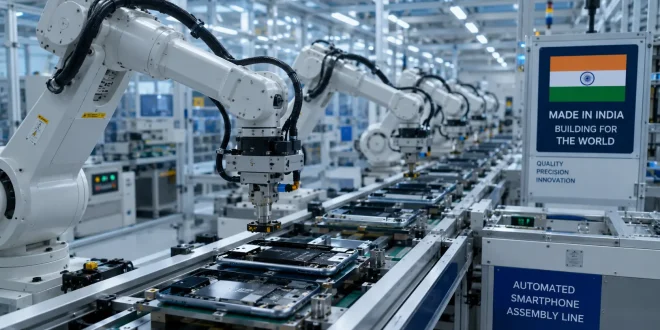
Massive Production Scalability: The joint venture will aggressively expand localized electronic assembly lines, preparing the country to meet skyrocketing domestic demand while servicing global consumer markets.
-
Deepening Supply Chain Localization: Rather than focusing purely on final-stage assembly, the partnership aims to anchor the tier-1 and tier-2 component supply chains locally. This reduces industrial vulnerability to sudden oceanic freight disruptions.
-
Technological Inoculation: Dixon will directly integrate advanced, automated precision-production methods pioneered by Vivo, elevating the baseline operational efficiency of India’s broader Electronics Manufacturing Services (EMS) industry.
-
Deficit Mitigation via Import Substitution: By manufacturing advanced, 5G-enabled premium smartphone units domestically, the country structurally limits its dependence on imported finished electronics.
A Generational Catalyst for Local Employment
Beyond immediate fiscal revenue, the manufacturing venture acts as a vital job multiplier across several layers of the Indian economy. While precise institutional hiring numbers remain under wraps as factories scale up, independent industry analysts project the creation of thousands of direct and indirect jobs.
The employment footprint spans multiple clear avenues:
-
Direct Blue-Collar Assembly: High-capacity factory floor roles specializing in mechanical smartphone assembly, surface-mount technology (SMT), and cleanroom operations.
-
Advanced Engineering Roles: Immediate recruitment demands for automation engineers, localized quality-control professionals, hardware technicians, and supply chain analysts.
-
Logistics and Ancillary Ecosystems: Broad-spectrum jobs created across localized industrial warehousing, high-security regional transport, component packaging, and technical equipment maintenance.
-
SME Integration: New business-to-business contracts for domestic small and medium enterprises (SMEs) capable of fabricating plastic molds, localized packaging materials, and custom circuitry.
Shifting Focus Toward Domestic-Led Collaborations
The structural reality of this agreement sends a powerful, positive signal to the global investment landscape. Indian EMS firms are proving they can successfully integrate with elite international brands without surrendering domestic ownership or administrative control.
For Dixon Technologies, this joint venture cements its reputation as India’s leading indigenous contract manufacturer, significantly expanding its top-line revenue potential. For Vivo, the transaction ensures a highly compliant, stable, and federally supported base to service its substantial Indian consumer market without facing continuous regulatory friction.
This trend underscores a deliberate economic shift toward selective partnerships. Policymakers are actively favoring joint ventures where Indian companies retain a minimum 51% stake. This strategic template protects domestic financial interests while ensuring that the highest levels of global manufacturing tech are systematically transferred to Indian soil.
Frequently Asked Questions (FAQ)
What is the ownership structure of the Dixon-Vivo joint venture?
Dixon Technologies holds a majority stake of 51%, giving the Indian company corporate control, while Vivo Mobile India owns the remaining 49%.
How does this joint venture impact India’s broader economy?
The partnership directly boosts domestic manufacturing capacity, scales up smartphone exports, reduces reliance on imported electronics, and helps build a mature network of local component suppliers.
Will the Dixon-Vivo partnership create new jobs?
Yes. The venture is expected to generate thousands of direct and indirect jobs spanning factory floor assembly, high-end electronics engineering, logistics, warehousing, and local ancillary supply businesses.
What policy framework influenced this specific approval?
The deal faced careful evaluation under strategic investment frameworks, particularly those tracking foreign investment in technology sectors. The 51% domestic majority layout serves as a template for clearing strict national regulatory thresholds.
Disclaimer
The information provided in this article is for informational and educational purposes only. Business strategies, regulatory policies, and corporate market shares are subject to rapid updates based on shifting government mandates and macroeconomic factors. Readers should consult official financial and regulatory disclosures before making investment decisions based on this corporate partnership.
Explore More on Indian Innovation and Economic Trends
To track how these manufacturing shifts connect to broader developments in Indian technology, global strategic alignments, and regional industrial growth, explore these in-depth reports from Matribhumi Samachar English:
-
Discover how macro policy transformations are positioning India as an export powerhouse in India’s Roadmap to a $1 Trillion Export Powerhouse: Sectors, Strategies, and Structural Shifts.
-
Learn about India’s concurrent push into the foundational layer of hardware production via India’s Silicon Boom: Top Semiconductor Career Opportunities and How to Prepare.
-
Read up on how international high-tech collaborations are shifting under new trilateral partnerships in Understanding the ACITI Partnership: A New Strategic Tech Alliance.