 Matribhumi Samachar English


New Delhi. Tuesday, 14 July 2026
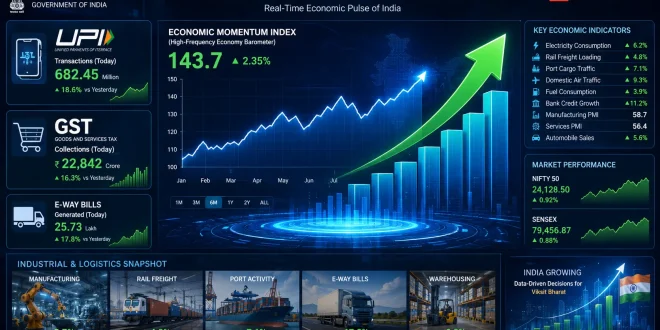
In a massive push toward modernizing how we view economic growth, India has introduced a cutting-edge High-Frequency Economy Barometer (HFEB). Developed under the Ministry of Statistics and Programme Implementation (MoSPI), this new composite indicator is designed to provide a timely, real-time snapshot of the country’s economic health.
For years, policymakers, investors, and business owners had to wait months for traditional quarterly Gross Domestic Product (GDP) reports to understand which way the wind was blowing. The HFEB completely shifts the timeline by combining weekly and monthly datasets, allowing everyone to assess the direction of economic activity much earlier.
What Exactly Is the High-Frequency Economy Barometer?
Think of the HFEB as a real-time fitness tracker for India’s economy. Unlike quarterly GDP figures—which reflect past output and arrive with a significant lag—the barometer captures immediate economic momentum. By pulling together data from digital infrastructure, consumer spending, and logistics, the index flags changing economic conditions almost as they happen.
The 14 High-Frequency Pillars
Instead of relying on a single data point, the HFEB blends fourteen distinct, high-frequency datasets spanning multiple sectors:
-
Consumer & Digital Demand: Goods and Services Tax (GST) collections, E-way bills, and Unified Payments Interface (UPI) transaction volumes.
-
Production & Sentiment: Manufacturing and Services Purchasing Managers’ Index (PMI) data.
-
Logistics & Core Movement: Railway freight loading, port cargo traffic, fuel consumption, and automobile sales.
-
Macro Stability: Bank credit growth, air passenger traffic, export/import values, employment metrics, and financial market indices.
HFEB vs. GDP: How Do They Compare?
| Feature | Gross Domestic Product (GDP) | High-Frequency Economy Barometer (HFEB) |
| Release Schedule | Quarterly (Significant reporting lag) | Weekly or Monthly updates |
| Primary Focus | Total national economic output | Near real-time economic momentum |
| Data Source | Comprehensive national accounts | 14 composite high-frequency data indicators |
Note: The HFEB does not replace traditional GDP reporting; instead, it serves as an early-signal complement to refine macro nowcasting models.
Why the Barometer is a Massive Win for Everyone
-
Smarter, Quoter Business Operations: Companies can track shifts in consumer behavior immediately. This helps teams plan inventory levels, monitor regional industrial shifts, and safely time expansion choices.
-
Swift Policy Adjustments: In times of global market volatility, central authorities can use the barometer as an early-warning radar system to address microeconomic stress before it hurts broader national metrics.
-
Optimized Investment Flows: Banks, institutional investors, and equity analysts gain an objective, high-velocity view of sector-by-sector performance to evaluate credit risks and allocate capital more precisely.
As India expands its digital infrastructure, the introduction of the HFEB marks a permanent shift toward data-driven governance. It provides a clearer window into the everyday choices of Indian consumers and enterprises.
Frequently Asked Questions (FAQ)
Q1: Will the High-Frequency Economy Barometer replace GDP data?
No. The barometer is designed to complement GDP. While GDP remains the definitive measure of overall economic output, the HFEB provides rapid insights into short-term momentum between quarterly announcements.
Q2: How often is the HFEB updated?
The underlying composite parameters are gathered on a weekly and monthly basis, providing a near real-time tracking dashboard.
Q3: Who benefits most from this tool?
Policymakers, business owners, MSMEs, stock market investors, and economic researchers all benefit from having immediate access to economic trend signals.
Disclaimer: The information provided in this article is for educational and general informational purposes only. Economic indicators are subject to revisions by statistical agencies, and historical trends do not guarantee future performance. Consult with certified financial experts or policy specialists before making major commercial or investment decisions.