

New Delhi. Updated on : Wednesday, 24 June 2026
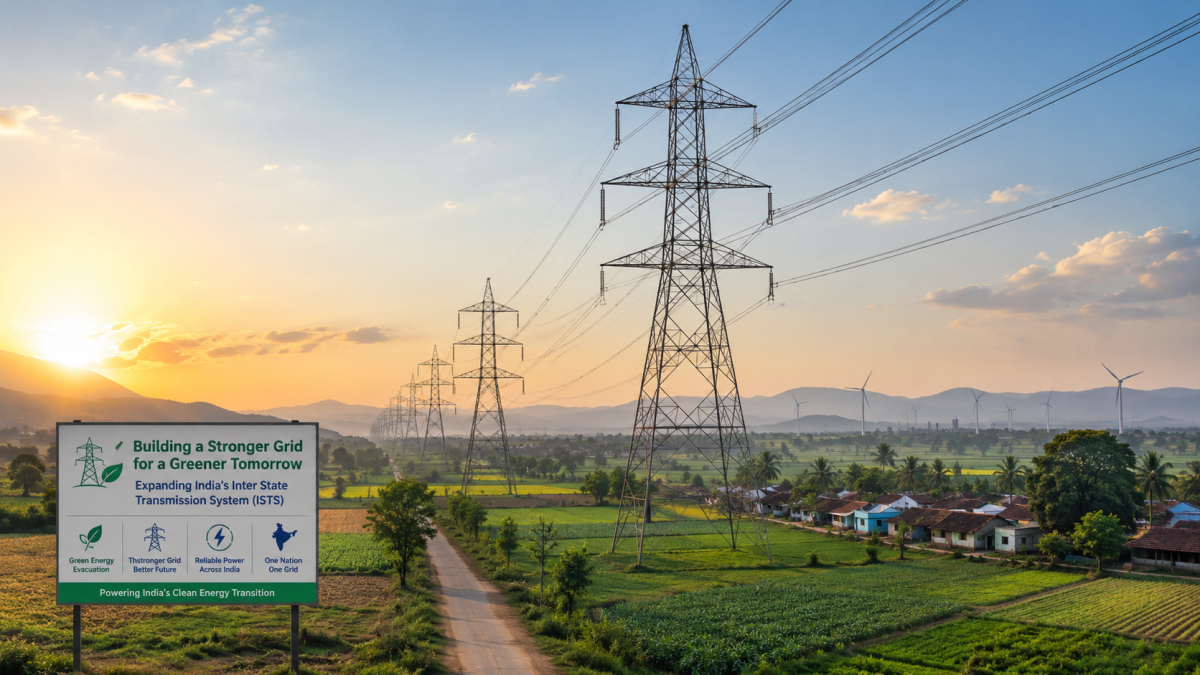
The Government of India has taken a monumental step forward in its clean energy journey by approving new Inter State Transmission System (ISTS) schemes. Aimed at scaling up the country’s green power infrastructure, these schemes are designed to evacuate a massive 9 GW of Renewable Energy (RE) from the resource-rich states of Rajasthan and Karnataka.
This massive infrastructure push involves a total financial investment of approximately ₹13,595 crore. To guarantee absolute transparency, cost-efficiency, and private sector participation, these projects will be implemented via the Tariff Based Competitive Bidding (TBCB) mode.
Part of a Grand Vision: The Road to 500 GW by 2030
These new transmission corridors are not isolated projects; they are foundational pillars supporting India’s ambitious climate pledge. The nation aims to establish 500 GW of non-fossil fuel capacity by 2030.
With over 200 GW of renewable energy capacity already successfully integrated and connected to the national grid, these new networks are systematically targeting major generation hotspots to prevent transmission bottlenecks.
Detailed Breakdown of the Approved Transmission Schemes
The initiative is evenly split between the northern and southern regions, handling 4.5 GW of power evacuation in each of the two targeted states. However, due to geographical distances and regional requirements, the scope and structural investments of the two projects vary considerably.
1. Rajasthan Renewable Energy Zone (REZ) Evacuation Scheme
Evacuation Capacity: 4.5 GW
Estimated Investment: ₹12,241 crore
Target Completion Timeline: 2 Years
The Transmission Mapping: This extensive cross-state corridor will tap into three primary generation complexes in Rajasthan and route the clean energy directly to high-consumption centers in Uttar Pradesh:
Barmer Complex: 2.5 GW
Fatehgarh Complex: 1.0 GW
Nagaur (Merta) Complex: 1.0 GW
Recipient Nodes: Mainpuri Region, Fatehpur, and Orai (Uttar Pradesh).
2. Karnataka System Strengthening Scheme
Evacuation Capacity: 4.5 GW
Estimated Investment: ₹1,354 crore
Target Completion Timeline: June 2027
The Transmission Mapping: Instead of building a long-distance cross-country line, this project focuses heavily on strengthening and reinforcing the local grid infrastructure in the high-yield southern zones:
Source Hubs: Koppal area and Gadag area.
Recipient Nodes: Integration into the regional pooling stations of the National Grid.
Comparative Matrix: Rajasthan vs. Karnataka Projects
| Scheme Feature | Rajasthan REZ Power Evacuation | Karnataka System Strengthening |
| Evacuation Potential | 4.5 GW | 4.5 GW |
| Financial Allocation | ₹12,241 crore | ₹1,354 crore |
| Primary Project Scope | Cross-regional long-haul transmission lines | Local grid infrastructure upgrades & reinforcement |
| Key Generation Hubs | Barmer, Fatehgarh, Nagaur | Koppal, Gadag |
| Primary Delivery Points | Uttar Pradesh (Mainpuri, Fatehpur, Orai) | National Grid regional pooling nodes |
| Expected Finish | 2 Years from execution launch | By June 2027 |
Frequently Asked Questions (FAQs)
What is an Inter State Transmission System (ISTS)?
An Inter State Transmission System (ISTS) is a network of high-voltage transmission lines and substations that facilitates the transfer of electrical energy across state boundaries. It ensures that power generated in resource-rich states can easily reach high-demand consumption centers across India.
What is the Tariff Based Competitive Bidding (TBCB) mode?
TBCB is a procurement process where developer firms compete to build, own, and operate transmission infrastructure based on the lowest tariff offered to consumers. This encourages fair market competition, drastically reduces overall project costs, and ensures timely project completion.
Why is the Rajasthan scheme so much more expensive than the Karnataka scheme?
The Rajasthan scheme requires long-distance transmission lines to move power across state boundaries into Uttar Pradesh, requiring extensive right-of-way permissions, towers, and heavy cabling. The Karnataka project is a system-strengthening initiative that upgrades nodes close to existing infrastructure, resulting in lower structural overhead.
Disclaimer
The information provided in this article is based on official government notifications and press statements from the Ministry of Power, Government of India. While every effort has been made to ensure accuracy, project timelines, exact costs, and bidding allocations are subject to changes based on administrative mandates and regulatory updates.
For real-time local updates and further insights into India’s national infrastructure advancements, visit Matribhumi Samachar.
