 Matribhumi Samachar English


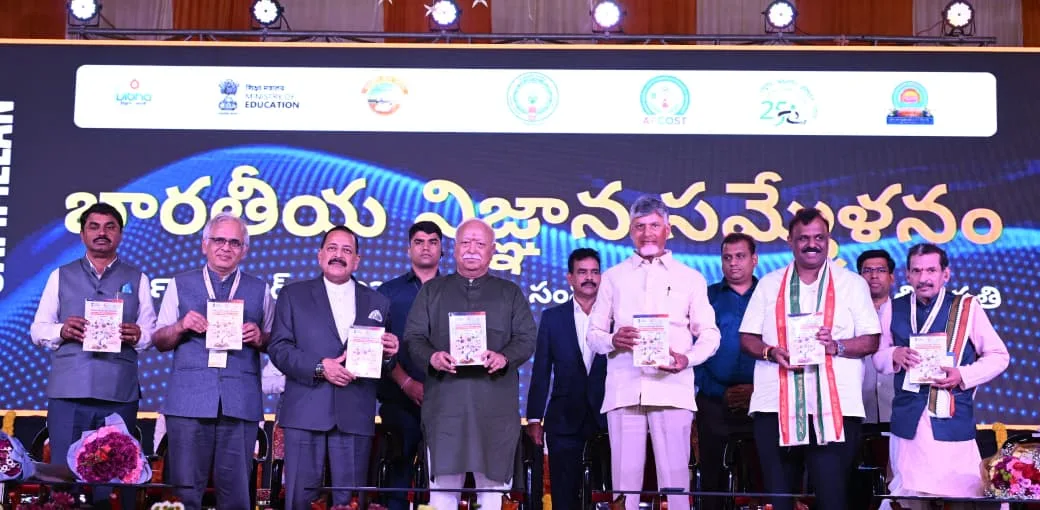
Tirupati: The “Bharatiya Vigyan Sammelan 2025”, organised under the aegis of Vijnana Bharati, was inaugurated at the National Sanskrit University in Tirupati. The programme was jointly inaugurated by Rashtriya Swayamsevak Sangh (RSS) Sarsanghchalak Dr Mohan Bhagwat, Union Minister for Science and Technology Jitendra Singh, and Andhra Pradesh Chief Minister N. Chandrababu Naidu.
Addressing the gathering, RSS Sarsanghchalak Dr Mohan Bhagwat said that Bharat will certainly move forward and that it also has a responsibility to give something meaningful to the world. “Development comes with its own challenges. Everyone seeks happiness. The real question is—why do we need to learn science?” he said.
He cited the example of measuring the distance of the sun, stating that such achievements are possible through science. However, he cautioned that development must be linked to a deeper understanding of happiness. “It is often said that happiness is materialistic. But what exactly is happiness? Development depends on that understanding,” he observed.
Quoting the Sanskrit maxim “आहारनिद्राभयमैथुनं च”, he said these basic instincts are common to animals as well. “Only human beings commit suicide; animals do not. This itself shows that human unhappiness has deeper causes,” he remarked.
Explaining the human constitution, he referred to शरीरं, मनः, बुद्धिः, noting that the brain is formed through molecular processes inside the head, while the mind performs its own functions. “We know that the body is not permanent. We must think about that which is eternal,” he said.
Dr Bhagwat pointed out that development in many countries is confined to material pleasure. “Bharat does not think like that. We know that जगत् मिथ्या. Food, shelter, clothing and health are necessary for everyone, but we must not stop there, because happiness lies inside, not outside,” he said.
Using a simple analogy, he said, “We can eat a few rasagullas and enjoy them, but overeating creates aversion. Even if one possesses all the wealth in the world, happiness will still remain elusive. True happiness also includes the happiness of others.”
He stressed that while opportunities should be equal for all, utilisation differs. “There are ‘haves’ and ‘have-nots’, but the Indian view of development is different,” he said, referring to विकास की भारतीय अवधारणा. “Development, according to Indian thought, is not a struggle for existence or survival of the fittest. I want to be happy, but at the same time, I want others to be happy too.”
He underlined that Indian thinking goes beyond “maximum good of the maximum people” to “सर्वेऽपि सुखिनः सन्तु”—let everyone be happy. “In the West, it is said that means are limited and wants are endless. Our thought is प्रजानां योगक्षेमशास्त्रम् – अर्थशास्त्रम्. If society is happy, we are happy. That itself is Dharma,” he said.
Clarifying the concept of Dharma, Dr Bhagwat stated, “धारणात् धर्म इत्याहुः.” “Dharma is not religion. The West did not include Dharma in science, and that is where the basic thought went wrong,” he remarked.
He noted that modern science is now engaging with the study of consciousness. “Consciousness is not limited to the individual; it is universal. Our ancient Bharatiya rishis had already realised this—सर्वं खल्विदं ब्रह्म, प्रज्ञानं ब्रह्म,” he said.
“The difference lies in the method,” he explained. “Spirituality (अध्यात्म) speaks of the same truth. Experience has to be conveyed to others.” He cited the example of Ramakrishna Paramahamsa and Swami Vivekananda, recalling the exchange where Vivekananda asked whether God had been seen, and the reply was, “I have experienced Him more clearly than I see you. You too can experience Him if you follow the method.”
Dr Bhagwat said science looks outward, while spirituality looks inward. Referring to a 1971 Reader’s Digest article titled ‘The Starry Universe’, he said modern instruments had reached their limits. “Whether it is particle or energy, they said, we do not know. We cannot travel at or beyond the speed of light,” he noted, adding that even American authors had suggested the possible use of the human mind.
“This has already been achieved by our ancient rishis,” he said, citing the Patanjali Yoga Sutras and Yoga Vasishta, which deal with these concepts. He referred to the distinction between विद्या and अविद्या, quoting, “अविद्यया मृत्युं तीर्त्वा विद्ययाऽमृतमश्नुते.”
He observed that modern science often rejects claims without experimental proof, a principle echoed in Sanskrit subhashitas. “Yet, the vast knowledge base of the Vedas, Puranas, Upanishads, Ramayana, Mahabharata, the Gita and the Shad Darshanas was set aside,” he said.
Drawing everyday examples, he said people consume tablets without knowing their contents and accept changing narratives about food like ghee without critical inquiry. “We often accept everything blindly. Language has become a barrier,” he cautioned.
Dr Bhagwat recalled that traditional practices in every household had scientific reasoning, such as not cutting trees in the evening. “Foreign invasions disrupted our research traditions. We were forced to focus on survival,” he said.
Highlighting the role of Vijnana Bharati, he said the organisation’s objective is to make meaningful use of existing knowledge. Illustrating the spirit of scientific thinking, he narrated an example where students found multiple ways to deliver an instrument to the second floor, unlike the single method suggested by a teacher. “That is the power of science,” he said.
He emphasised that nothing should be accepted blindly and that conclusions must be drawn only after experimentation. “Knowledge must be disseminated in one’s own language,” he said, citing Finland, where subjects are taught in the mother tongue up to Class 8.
Concluding, Dr Bhagwat spoke about the unity of existence. “Everything is interconnected. Science must be guided by discretion; otherwise, destruction is certain,” he warned. He noted that agriculture had continued for thousands of years without poisoning the land, whereas modern practices have led to diseases such as cancer.
“We need power, but not for destruction,” he said. “Our vision is to move the world forward with Dharma. Our ultimate goal is to build a happy society.”
Andhra Pradesh Chief Minister N Chandrababu Naidu emphasised the need for connecting the younger generation with India’s rich cultural heritage. He urged parents, teachers and to share the stories of our Puranic heroes – Ram, Krishna, Arjuna and Hanuman with children, highlighting their virtues, courage and wisdom. He pointed out that understanding these epics helps the youth to differentiate between good and evil, instills moral values and fosters pride in India’s timeless contributions to philosophy, ethics and governance.
Delighted to join RSS Sarsanghchalak Shri Mohan Bhagwat Ji, Union Minister of State Shri Jitendra Singh Ji, and distinguished dignitaries and scientists at the inaugural session of the Bharatiya Vigyan Sammelan in Tirupati. Spoke on the importance of preserving India’s knowledge… pic.twitter.com/0T2ze89wEI
— N Chandrababu Naidu (@ncbn) December 26, 2025
The CM underscored the importance of preserving India’s knowledge systems while advancing science and technology for the future. He stressed the need to protect and revive India’s ancient knowledge traditions and expressed confidence that India would restore its historic scientific glory and continue to contribute meaningfully to global scientific progress.
The CM noted that platforms like the Bharatiya Vijnan Sammelan provide an important space to reflect on Indian identity, culture, and intellectual heritage. He said the Sammelan is playing a vital role in presenting Indian knowledge traditions to the world and expanding their global understanding. He expressed happiness that the seventh edition of the Sammelan in South India was being organised in Tirupati, describing it as a sacred place blessed by Bhagwan Venkateswara.
Addressing the BVS 2025, Union Minister of State (Independent Charge) for Science & Technology, Dr Jitendra Singh said that India has successfully bridged tradition with modernity by preserving core civilisational values while simultaneously embracing cutting-edge technologies, with the ultimate aim to ensure ease of living for common citizen.
Dr Jitendra Singh said that over the last one decade, science, technology, and innovation have received unprecedented policy focus and budgetary support since 2014, removing long-standing bottlenecks that earlier constrained India’s scientific potential. He said that the talent pool in the country was never lacking, but enabling ecosystems and political will were missing, which have now been decisively addressed.
Addressed the inaugural session of the 3-day #Tirupati Conclave “Bharatiya Vigyan Sammelan 2025”:
Takeaways:
“India’s transformation into a global science and technology leader over the last decade under PM @NarendraModi has been enabled by decisive policy support from… pic.twitter.com/qMAN3D05B7
— Dr Jitendra Singh (@DrJitendraSingh) December 26, 2025
The Minister emphasised that science in India is no longer confined to laboratories but is being used to enhance ease of living through initiatives such as smart cities, telemedicine, satellite-based communication, geotagging, and digital governance platforms. He said major national missions, including space, nuclear energy, deep ocean exploration, Himalayan research and the Aroma Mission, are opening new frontiers for economic growth and youth entrepreneurship.
The Minister announced that large-scale translation of science textbooks and curricula into regional languages has been undertaken over the last decade to democratise scientific knowledge and education, ensuring that every citizen can participate in India’s journey towards becoming a developed nation by 2047.
The national event is being jointly organised by the Union Ministry of Education, Vijnana Bharati, Indian Knowledge Systems, Andhra Pradesh Council of Science and Technology (APCOST), National Innovation Foundation, and National Sanskrit University, Tirupati.
Over 900 delegates from across the country are participating in the event. The Sammelan was attended by Union Minister of State for Science and Technology Dr. Jitendra Singh, Revenue Minister Anagani Satya Prasad, President of Vijnana Bharati Sekhar C. Mande, Vice Chancellor of National Sanskrit University Professor G. S. R. Krishna Murty, former DRDO Chairman Dr. G. Satheesh Reddy, along with distinguished scientists and dignitaries.
Credit : Organiser Weekly