 Matribhumi Samachar English


Mumbai. Updated on : Tuesday, 23 June 2026
As Indian financial markets navigate a pivotal transition in mid-2026, savers and investors alike are facing a brand-new playbook. The implementation of the New Income Tax Act 2025, which officially took effect on April 1, 2026, combined with interest rates reaching a multi-year plateau, has completely changed what it means to make a “safe” financial choice.
If you are trying to decide where to park your hard-earned money right now, evaluating Fixed Deposits vs Mutual Funds 2026 requires looking past traditional assumptions. True safety in 2026 isn’t just about protecting your principal from market dips; it is also about protecting your purchasing power from being quietly eroded by inflation.
🔐 Fixed Deposits: The “Guaranteed” Fortress in 2026
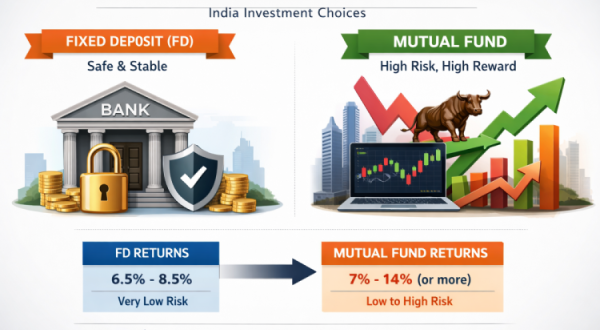
For decades, the humble Fixed Deposit (FD) has been the absolute bedrock of Indian household savings. In the current economic climate, FDs look incredibly attractive on paper. With the Reserve Bank of India (RBI) holding rates at a multi-year peak, major commercial banks like SBI and HDFC are offering robust yields of up to 7.0% to 7.5% for senior citizens. Meanwhile, select Small Finance Banks and reputable Non-Banking Financial Companies (NBFCs) like Shriram Finance are pushing boundaries with yields touching the 8.10% to 8.50% mark.
Why FDs Remain a Safe Haven:
-
Zero Market Volatility: Your principal amount is entirely insulated from stock market crashes, global supply chain disruptions, or sectoral corrections.
-
DICGC Protection: The Deposit Insurance and Credit Guarantee Corporation (DICGC) guarantees safety up to ₹5 lakh per depositor, per bank, encompassing both principal and interest.
-
Predictable Cash Flow: Investors can opt for monthly or quarterly interest payouts, making them an excellent tool for regular expense management, particularly for retirees.
The 2026 Catch: While your capital is safe from nominal loss, it faces significant Inflation Risk. With consumer inflation averaging around 5% to 6%, an FD’s real rate of return is marginal at best once you factor in the new tax realities.
📈 Mutual Funds: Beating Inflation in a Volatile Year
If Fixed Deposits offer peace of mind, Mutual Funds (MFs) serve as the primary engine for compounding wealth over the long term. The financial landscape of FY26 has thrown an extreme divergence at investors. While a handful of high-performing sectoral funds delivered staggering returns exceeding 50%, nearly 300 mainstream equity funds faced short-term negative fluctuations due to market corrections.
Despite short-term turbulence, mutual funds possess a distinct edge under the updated financial frameworks of 2026:
The 2026 Mutual Fund Edge:
-
The Ultimate Inflation Hedge: Unlike fixed-income instruments, equity-linked mutual funds aim for a long-term Compound Annual Growth Rate (CAGR) of 12% to 15%, allowing your capital outpace the rising cost of living.
-
Dynamic Professional Management: Fund managers actively rebalance portfolios to navigate macroeconomic shifts, shielding everyday investors from having to time the market themselves.
-
Superior Tax Efficiency: Under the latest tax guidelines established by the New Income Tax Act 2025, Long-Term Capital Gains (LTCG) on equity investments above ₹1.25 lakh are taxed at a flat rate of 12.5%. For individuals in high tax brackets, this is significantly lower than what they would pay on FD interest.
⚖️ At a Glance: Fixed Deposit vs Mutual Funds (2026 Comparison)
To simplify your decision-making, here is a quick overview of how both asset classes compare in the current fiscal year:
| Feature | Fixed Deposits (FD) | Mutual Funds (Equity/Hybrid) |
| Risk Profile | Extremely Low | Moderate to High |
| Current Gross Returns | 6.5% – 8.5% (Fixed and predictable) | 10% – 18% (Variable and market-linked) |
| Taxation Rules (FY 2026-27) | Added to total income; taxed as per your Income Slab | LTCG: 12.5% (on gains exceeding ₹1.25 Lakh) |
| Liquidity & Access | Subject to a penalty on premature withdrawal | High liquidity (T+1 or T+2 settlement cycles) |
| Ideal For | Emergency reserves, short-term needs, senior citizens | Retirement planning, child’s education, long-term wealth |
🛠 The New Income Tax Act 2025: A Pivotal Transition
The financial boundary line has shifted. Income generated up to March 31, 2026, was processed under the legacy income tax frameworks. However, all earnings, interest payouts, and capital gains recorded from April 1, 2026 onward fall strictly under the new tax codes.
Because FD interest is fully taxable under your specific income tax slab, individuals sitting in the 30% tax bracket see an 8% gross FD yield shrink to a net post-tax return of just 5.6%. When compared to a flat 12.5% LTCG tax on mutual funds, high-net-worth individuals are finding fixed deposits increasingly inefficient for growing wealth.
🏁 Final Verdict: Adopting the Barbell Strategy
In 2026, financial safety isn’t a zero-sum game where you must pick one asset over the other. The most resilient portfolios utilize a Hybrid Barbell Strategy:
-
The Short-Term Anchor (1–3 Years): Allocate funds required for immediate expenses, upcoming milestones, or emergency cash cushions entirely into Fixed Deposits to guarantee absolute liquidity and capital preservation.
-
The Long-Term Engine (5+ Years): Channel growth capital meant for retirement or long-term financial security into diversified Mutual Funds to benefit from compounding equity returns and lower capital gains taxation.
For deeper insights into regional financial updates, banking rate shifts, and local economic policy transitions across the country, check out the comprehensive coverage available via Matribhumi Samachar.
🙋♂️ Frequently Asked Questions (FAQ)
1. Is it safe to invest in Small Finance Bank FDs offering 8.5% interest?
Yes, provided your total deposit (principal plus accrued interest) stays within the ₹5 lakh threshold per bank. All Scheduled Commercial Banks and Small Finance Banks are regulated by the RBI and covered equally under the DICGC insurance framework.
2. How has the New Income Tax Act 2025 changed mutual fund taxation?
Long-Term Capital Gains (LTCG) realized on equity-oriented mutual funds are now taxed at a flat rate of 12.5% for gains that exceed the threshold of ₹1.25 lakh in a single financial year. Short-Term Capital Gains (STCG) are taxed at 20%.
3. Can I lose money in a mutual fund?
In the short term, yes. Mutual funds are market-linked instruments, meaning their value fluctuates based on the performance of underlying stocks or bonds. However, historical data shows that holding diversified equity mutual funds for a period exceeding 5 to 7 years drastically reduces the probability of capital loss.
Disclaimer: This report is compiled strictly for informational and educational purposes and does not constitute formal financial advice or a direct recommendation to invest. Interest rates, banking terms, and market yields cited are current as of mid-2026 and remain subject to adjustments by commercial banks and the Reserve Bank of India (RBI). Past performance indicators do not guarantee future market returns. Investors are urged to verify all slab-based tax computations and DICGC safety parameters directly with their financial institutions or a certified financial planner prior to deploying capital.