
Mumbai. Updated on : Tuesday, 23 June 2026
In today’s fast-moving economic landscape, financial planning is no longer a luxury—it is an absolute shield for your survival. Among the most critical tools for securing your future are life insurance and health insurance.
While many people mistakenly assume that having one type of insurance is enough to get by, the reality of 2026 tells a completely different story. These two policies serve entirely unique, non-overlapping functions. Relying on just one leaves a massive vulnerability in your financial armor.
The Real Role of Life Insurance in 2026
Life insurance is fundamentally designed to provide long-term financial security to your family in the event of your untimely passing. It acts as an income replacement tool, ensuring that your loved ones are not forced to compromise their lifestyle or abandon long-term goals like a child’s education or mortgage payments.
Key Pillars of Modern Life Insurance:
The Lump Sum Payout: Known as the sum assured, this is delivered directly to your nominees to clear out outstanding debts or invest for future living expenses.
Affordable Term Plans: High-value term insurance remains the absolute gold standard, giving you massive coverage (e.g., 10x to 15x your annual income) at highly affordable premiums.
Enhanced Reporting: Under the fully integrated financial reporting standards active in 2026, life insurance companies provide unprecedented transparency, making it easy to track their actual claim-settlement speed and stability before you buy.
The Urgent Reality of Health Insurance in 2026
While life insurance looks after your family when you are gone, health insurance is entirely about protecting your wealth while you are alive. With medical inflation hovering at a staggering 14% in India, a single unexpected hospital stay for a critical illness can instantly wipe out five to ten years of your hard-earned equity savings.
Regulatory Game-Changers You Must Know:
0% GST on Retail Policies: Thanks to systemic tax updates, individual health covers, senior citizen plans, and family floaters are fully exempt from GST (0%). This removes a heavy cost barrier, making it incredibly affordable to scale up your coverage.
Inclusivity by Law: The IRDAI has completely banned age caps on purchasing health insurance. Seniors over 65 can secure fresh, comprehensive health coverage without bureaucratic denial.
Capped Waiting Periods: The legal maximum waiting period for pre-existing diseases (PED) like diabetes or hypertension has been tightly capped at 3 years (36 months).
Why You Absolutely Need Both: A Side-by-Side Reality Check
One cannot replace the other because they safeguard against entirely different financial risks.
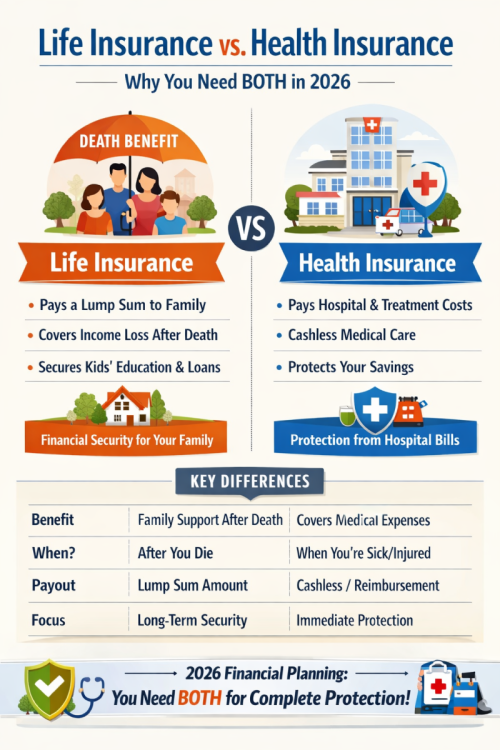
| Feature | Health Insurance | Life Insurance (Term Cover) |
| The Primary Objective | To pay medical bills and prevent your savings from hitting zero during an illness. | To replace your income and maintain your family’s lifestyle after you pass. |
| When It Triggers | During medical treatments, surgeries, or unexpected hospitalizations. | Solely upon the death of the policyholder (or maturity in specific savings plans). |
| Tax Status (2026) | 0% GST on individual retail and family plans. | Standard 18% GST applies to term cover premiums. |
| Payout Style | Cashless handling directly with network hospitals or raw reimbursement. | Direct lump-sum financial transfer to your designated beneficiaries. |
The “Super Top-Up” Strategy for Smart Protection
Instead of buying a massive, ultra-expensive primary health policy, financial planners in 2026 widely recommend a smarter, tiered structure:
For Life: Secure a robust term plan with a payout equal to roughly 10 to 15 times your annual salary.
For Health: Purchase a manageable base health plan (₹5 Lakh to ₹10 Lakh) to take advantage of immediate cashless network access.
The Multiplier: Anchor it with a Super Top-Up plan of ₹20 Lakh or higher. This triggers seamlessly once your base cover threshold is crossed, granting you massive medical security at a fraction of the cost of a single high-end policy.
Alternative Learning & Context
For deeper hyper-local insights, grassroots updates on regional schemes, and broader societal impacts of changing financial policies, you can explore the official coverage on regional news platforms like Matribhumi Samachar. (Note: Please navigate to their dedicated English directory on the main site to explore active policy updates and local consumer defense forums).
Frequently Asked Questions (FAQ)
1. Can I just buy a critical illness rider on my life insurance instead of health insurance?
No. A critical illness rider gives a one-time lump-sum payout upon diagnosis of a specific, pre-defined terminal disease. It does not cover regular hospitalizations, accident recovery, day-care procedures, or pre/post-medical evaluations, which form the bulk of real-world healthcare costs.
2. Is corporate health insurance provided by my employer enough?
Relying solely on corporate insurance is highly risky. Corporate plans typically have lower coverage limits and end instantly the moment you change jobs, face layoffs, or retire—precisely the times when setting up a fresh personal health cover is most expensive or difficult due to age.
3. Does the 0% GST apply to corporate health plans?
No. The 0% GST exemption specifically targets individual retail policies, family floaters, and senior citizen insurance covers to protect individual taxpayers. Corporate/group health insurance covers managed by companies still attract the standard 18% GST.
Disclaimer: The information contained in this article—including references to a 14% medical inflation benchmark, recent IRDAI structural updates, and evolving GST frameworks—is meant exclusively for educational and informational purposes. Insurance policies are highly binding legal contracts; always read the official policy terms, inclusions, and exclusions carefully before investing.
