

New Delhi. Thursday, 16 April 2026
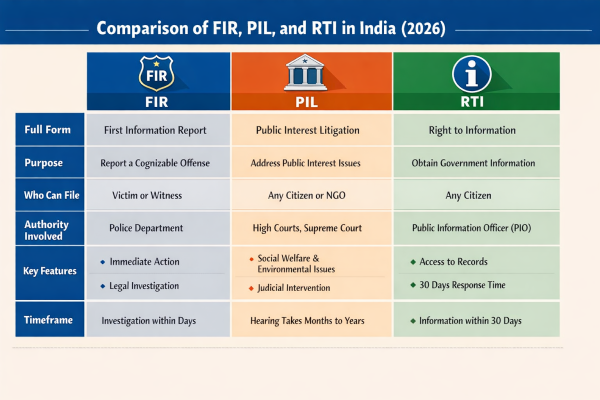
India’s legal landscape has undergone a seismic shift as of April 2026. While the core concepts of citizen empowerment remain, the “rules of engagement” for filing an FIR, seeking information via RTI, or moving a PIL have been modernized—and in some cases, significantly restricted.
1. The FIR: Now under the Bharatiya Nagarik Suraksha Sanhita (BNSS)
As of July 1, 2024, the colonial-era Code of Criminal Procedure (CrPC) was replaced by the BNSS. This changed how FIRs are handled:
e-FIR Evolution: You can now register an FIR digitally from anywhere. However, the law requires the informant to visit the police station within three days to sign the physical document for it to be officially taken on record.
Preliminary Inquiry: For certain offenses punishable by 3 to 7 years, the police can now conduct a “preliminary inquiry” within 14 days before registering a formal FIR, a move intended to prevent frivolous cases but criticized for potentially delaying justice.
Latest Judicial Reforms in India 2026
2. PIL: The “Publicity Interest” Crackdown
In early 2026, the Supreme Court of India began taking a stricter stance on Public Interest Litigations.
The “Publicity” Fine: In January 2026, the Court dismissed several petitions, labeling them “Publicity Interest Litigations.” The Bench emphasized that PILs should not be used as a platform for media attention.
Focus on marginalized groups: The Court reiterated that PILs must primarily serve those who cannot access the courts themselves (the poor or disabled), rather than general policy debates that can be handled by the legislature.
3. RTI: The “Body Blow” from DPDP Act 2023
The Right to Information is currently facing its biggest challenge.
Personal Information Ban: Under the Digital Personal Data Protection (DPDP) Act, Section 8(1)(j) of the RTI Act was amended. This effectively created a “blanket ban” on the disclosure of any personal information of government officials.
Constitutional Challenge: In February 2026, the Supreme Court referred petitions challenging this amendment to a Constitution Bench. Critics argue that the government can now deny information regarding public spending or recruitment by labeling it “personal data.”
Note: While the original text suggests an FIR is always the “first step,” under the new BNSS (2024), a preliminary inquiry by police is now legally permitted in specific categories of crime before the FIR is even registered. Ensure you check the offense category if a police officer requests time for a “preliminary probe.”
Disclaimer
The information provided in this article regarding the FIR (under BNSS 2024), PIL, and RTI Act is for educational and general informational purposes only. It does not constitute legal, professional, or official advice.
