

New Delhi. Thursday, 23 April 2026
The landscape of Indian taxation has undergone a transformative shift in 2026. As the government continues its push toward a simplified, “exemption-free” tax structure, salaried individuals find themselves at a crossroads between traditional wealth-building through deductions and the streamlined efficiency of the New Tax Regime. Whether you are a conservative saver or an aggressive wealth-seeker, understanding the nuances of the current fiscal year is vital for maximizing your take-home pay.
1. The Strategic Divide: New vs. Old Tax Regime
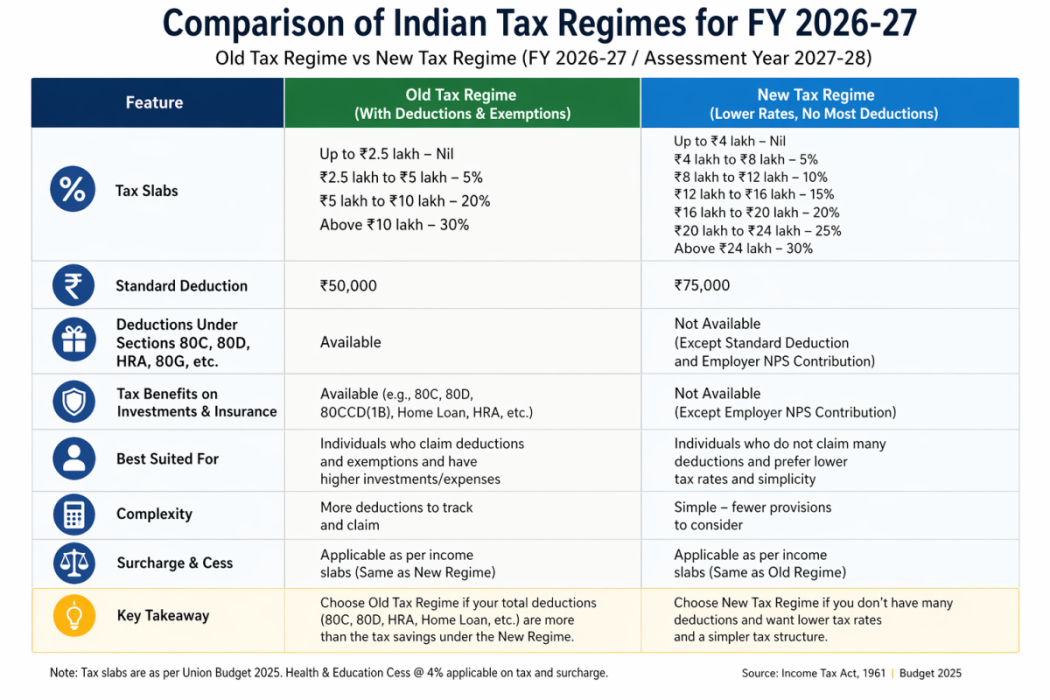
In 2026, the New Tax Regime has been reinforced as the primary choice for the majority of taxpayers. With the standard deduction increased to ₹75,000 and wider tax slabs, individuals earning up to ₹12.75 Lakh can effectively reach a zero-tax liability through a combination of the Section 87A rebate and standard deductions.
However, for the “High Savers”—those with home loans, substantial insurance premiums, and aggressive retirement contributions—the Old Tax Regime still holds significant power. If your total exemptions (HRA, 80C, 80D, and Interest on Home Loan) exceed ₹4,25,000, the Old Regime often remains the mathematically superior choice.
2. Top-Tier Investment Avenues for 2026
A. The High-Growth Engine: ELSS (Equity Linked Saving Schemes)
ELSS remains the only tax-saving instrument that offers the dual benefit of capital appreciation through equity markets and a tax deduction under Section 80C.
Lock-in: 3 Years (The shortest in the 80C category).
Strategy: Experts recommend starting a SIP (Systematic Investment Plan) in April rather than a lump sum in March to mitigate market volatility.
B. The Retirement Powerhouse: National Pension System (NPS)
The NPS has become the “darling” of tax planning in 2026 due to its unique tiered benefits:
Section 80CCD(1B): An exclusive deduction of ₹50,000 available only for NPS, which acts as a “bonus” over the ₹1.5 Lakh 80C limit.
Corporate NPS: Under Section 80CCD(2), employer contributions up to 10% of your basic salary are tax-exempt, providing a massive shield for high-income earners.
C. The Risk-Free Anchor: Public Provident Fund (PPF)
For those prioritizing capital preservation, the PPF continues to be a cornerstone. In 2026, with interest rates stabilizing, the EEE (Exempt-Exempt-Exempt) status—where the investment, interest earned, and maturity amount are all tax-free—remains its most attractive feature.
3. Beyond Section 80C: Health and Housing
Tax planning is incomplete without addressing the rising costs of healthcare and urban living:
Section 80D: With the 2026 updates, premiums for senior citizen parents (up to ₹50,000) have become a crucial tool for protecting family wealth while reducing taxable income.
HRA Optimization: In 2026, more cities have been classified as “Metros.” If you reside in cities like Hyderabad or Bengaluru, you can now claim 50% of your basic salary as HRA exemption, providing a significant boost to your monthly savings.
Expert Insight: The “April Rule”
Financial advisors are increasingly advocating for the “April Rule” in 2026. Instead of treating tax planning as a year-end chore, salaried employees are encouraged to declare their regime and start their 80C/80D investments in the first month of the financial year. This ensures that TDS (Tax Deducted at Source) is evenly spread throughout the year, preventing a massive salary dip in the final quarter.
Latest Information : It is a common misconception that the New Tax Regime removes all benefits. While it removes 80C and 80D, it still allows for the Standard Deduction of ₹75,000 and the Employer’s contribution to NPS, which are often overlooked by taxpayers.
Related Link
Ready-to-Move vs Under-Construction Property: 2026 Homebuyer’s Guide
Disclaimer
The information provided in this article is for educational and informational purposes only and does not constitute professional financial, tax, or investment advice. While we strive to provide the most accurate and up-to-date details regarding the Income Tax Act and the Financial Year 2026-27, tax laws in India are subject to frequent amendments by the Ministry of Finance and the Central Board of Direct Taxes (CBDT).
