


New Delhi. Tuesday, 28 April 2026
In an era defined by digital saturation and “hustle culture,” the ancient psychological frameworks of Hindu philosophy offer more than just spiritual solace—they provide a biological and cognitive toolkit for survival. These practices, refined over millennia, align remarkably well with modern neuroscience and behavioral psychology.
1. The Biological Edge: Brahma Muhurta
Waking up during Brahma Muhurta (approx. 4:00 AM to 6:00 AM) is not merely a disciplinary ritual; it is a synchronization with the Earth’s circadian rhythm.
The Science: During these hours, the atmosphere is rich in Nascent Oxygen, which easily bonds with hemoglobin, boosting brain function.
Mental Impact: This “Creator’s Hour” allows for cognitive processing without the “cortisol spikes” caused by immediate morning emails or social media.
2. Neurological Rewiring through Dhyana (Meditation)
Meditation in the Hindu tradition is often categorized as Savitarka (focused) or Nirvitarka (silent awareness).
Modern Correction: Many believe meditation is about “emptying the mind.” Ancient texts clarify it is about Ekagrata (one-pointedness).
Benefit: Consistent practice thickens the prefrontal cortex—the area of the brain responsible for decision-making and impulse control—while shrinking the amygdala, the brain’s “fear center.”
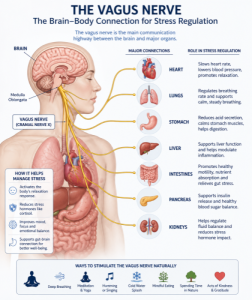
3. The Vagus Nerve Hack: Pranayama
Breathing is the only autonomic function humans can consciously control. Practices like Anulom Vilom (Alternate Nostril Breathing) and Bhramari (Humming Bee Breath) are sophisticated tools for nervous system regulation.
The Mechanism: These techniques stimulate the Vagus Nerve, moving the body from a “Sympathetic” (Stress) state to a “Parasympathetic” (Relaxation) state.
4. Cognitive Reframing: Nishkama Karma
The Bhagavad Gita’s core teaching—focusing on the effort (Karma) rather than the result (Phala)—is the ultimate antidote to Performance Anxiety.
Psychological Insight: When we attach our self-worth to outcomes we cannot control, we experience chronic stress. By shifting focus to the process, we enter a “Flow State,” where productivity increases and anxiety diminishes.
5. The Power of Mauna (Restorative Silence)
Modern life is a constant assault of “noise”—both literal and digital. The practice of Mauna (intentional silence) conserves Ojas (vital energy).
Today’s Application: A “Digital Mauna” or a 30-minute window of no speaking per day can significantly lower mental fatigue and improve the quality of one’s speech and thoughts.
Ancient Habits vs. Modern Challenges
| Ancient Habit | Modern Challenge | Outcome |
| Svadhyaya (Self-Study) | Identity Crisis / Peer Pressure | Core Confidence |
| Mitahara (Moderate Diet) | Emotional Eating / Brain Fog | Sustained Focus |
| Ishvara Pranidhana (Surrender) | Overthinking / Need for Control | Inner Peace |
| Tapas (Disciplined Grit) | Instant Gratification | Long-term Success |
Insights from Matribhumi Samachar
To deepen your understanding of how these ancient practices are applied in modern settings, explore these relevant articles:
Symbolic Traditions: Understand the deeper significance behind daily rituals that foster focus and identity.
Ancient Values in Daily Life: For broader news on how Indian heritage influences contemporary society, visit their main portal:
Myth vs. Reality
A common misconception is that these habits require one to renounce worldly life. On the contrary, the Grihastha (householder) stage of life in Hindu philosophy explicitly encourages using these tools to navigate career, family, and social responsibilities with a “warrior mindset.”
Disclaimer
While the ancient Hindu practices discussed—such as meditation, yoga, and pranayama—have been traditionally used for centuries to enhance mental and physical well-being, their effects can vary from person to person.
