

New Delhi. Thursday, 14 May 2026
In an era where our lives are inextricably linked to the digital realm, Cyber Security has evolved from a technical niche into a fundamental pillar of modern survival. From the smartphones in our pockets to the complex power grids that light our cities, every connection is a potential gateway for cyber threats. Understanding how to fortify these gateways is no longer just for IT experts—it is a mandatory skill for everyone.
What is Cyber Security? (The Expanded Definition)
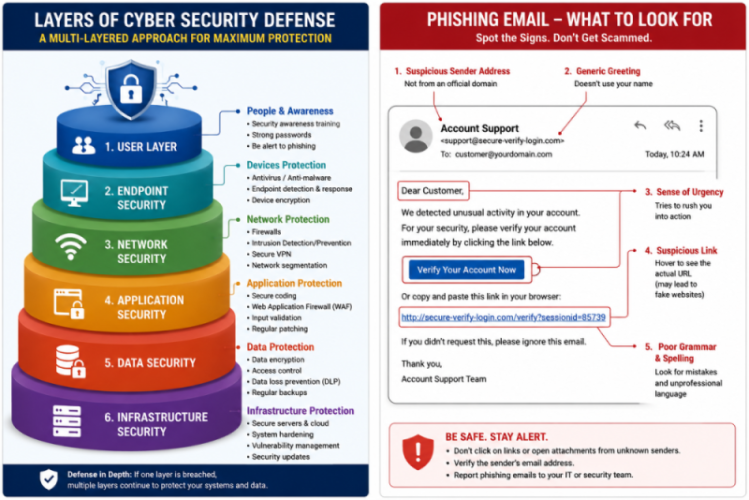
Cyber security is the multi-layered practice of defending computers, servers, mobile devices, electronic systems, networks, and sensitive data from malicious attacks. It is often categorized into several sub-domains:
Network Security: Securing a computer network from intruders, whether targeted attackers or opportunistic malware.
Application Security: Focusing on keeping software and devices free of threats. A compromised app could provide access to the data it is designed to protect.
Information Security: Protecting the integrity and privacy of data, both in storage and in transit.
Operational Security (OPSEC): The processes and decisions for handling and protecting data assets (e.g., the permissions users have when accessing a network).
Why Cyber Security is More Critical Than Ever
Sophistication of AI-Driven Attacks: In 2026, hackers are increasingly using generative AI to create highly convincing phishing emails and automated malware that can adapt to security software in real-time.
Protection of Digital Identities: With the rise of national digital IDs (like the Aadhaar system in India, RRN in South Korea, or MyNumber in Japan), a single breach can lead to total identity theft. Protecting these identifiers—though the numbers themselves should never be shared—is the cornerstone of personal security.
The Internet of Things (IoT) Vulnerability: Your smart fridge, thermostat, and security cameras are often the weakest links in a home network. Without proper security, these “smart” devices become “spy” devices.
Economic and National Stability: Cyber warfare is the new frontline. Attacks on healthcare systems or financial institutions can paralyze a nation’s economy and put lives at risk.
Common and Emerging Cyber Threats
Social Engineering: The psychological manipulation of people into performing actions or divulging confidential information.
Zero-Day Exploits: Attacks that take place on the same day a vulnerability is discovered in software, before a patch can be created.
Man-in-the-Middle (MitM) Attacks: Where attackers insert themselves into a two-party transaction to steal data.
Supply Chain Attacks: Targeting a third-party vendor to gain access to a larger organization’s network.
Pro-Tips for 2026
Passwords: Length is now more important than complexity. A long “passphrase” (e.g.,
Blue-Running-Pizza-1995!) is often harder for a computer to crack than a short, complex one (P@ssw0rd!).Update on 2FA: Move away from SMS-based codes. If your phone’s SIM is hijacked, your accounts are gone. Use hardware security keys or authenticator apps.
Public Wi-Fi: Never conduct banking or sensitive work on public Wi-Fi without a reputable VPN (Virtual Private Network).
Stay Informed with Matribhumi Samachar
To keep up with the latest trends in technology, digital safety, and global security news, explore these resources:
- National News and Infrastructure: matribhumisamachar.com/en/category/india
Disclaimer
Although the details provided are based on current data available in 2026, cyber threats and security technologies evolve daily. Matribhumi Samachar does not guarantee the absolute completeness or reliability of all external technological developments mentioned.
