

New Delhi. Friday, 15 May 2026
In the rapidly shifting digital landscape of 2026, terms like Artificial Intelligence (AI), Machine Learning (ML), and Deep Learning (DL) have moved from laboratory jargon to household names. While often used interchangeably, they represent distinct layers of a technological hierarchy that is fundamentally reshaping global industries—from the fashion runways of India to high-end medical labs in Europe.
Understanding these distinctions is no longer just for data scientists; it is essential for navigating a world where AI is projected to add over $15.7 trillion to the global economy by 2030.
1. Artificial Intelligence (AI): The Grand Vision
Artificial Intelligence is the broadest category. It refers to the simulation of human intelligence in machines. The goal of AI is to create systems capable of performing cognitive tasks such as reasoning, problem-solving, and decision-making.
In 2026, AI has evolved into two primary forms:
Narrow AI: Systems designed for a specific task (like Siri or a chess computer).
General AI (AGI): The theoretical “holy grail” where a machine can perform any intellectual task a human can. While we haven’t fully reached AGI, the gap is narrowing through hybrid models.
Matribhumi Insight: India is leveraging AI in governance and industry. For instance, the VisioNxt initiative by NIFT uses AI and Emotional Intelligence (EI) to forecast fashion trends specifically for the Indian market.
2. Machine Learning (ML): The Engine of Prediction
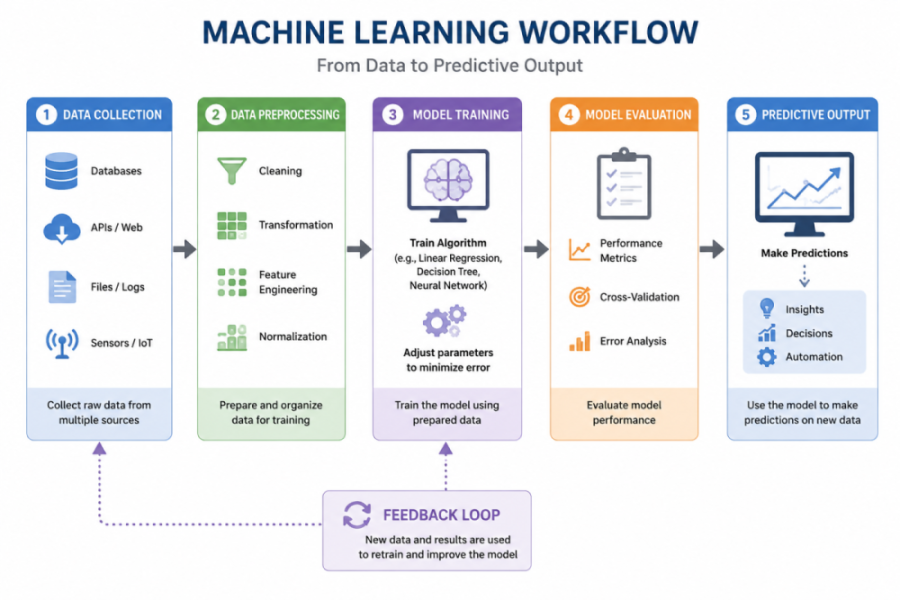
Machine Learning is a subset of AI. Instead of being explicitly programmed with thousands of “if-then” rules, ML systems use statistical algorithms to “learn” patterns directly from data.
As we move through 2026, ML has become the backbone of:
Fraud Detection: Real-time analysis of banking transactions.
Predictive Maintenance: Manufacturers now use ML to predict when a factory machine will fail before it actually breaks down.
Hyper-Personalization: E-commerce platforms like Amazon use ML to boost sales by up to 35% through personalized “suggested for you” algorithms.
3. Deep Learning (DL): Mimicking the Human Brain
Deep Learning is a specialized subset of Machine Learning that utilizes Artificial Neural Networks. These networks are inspired by the biological structure of the human brain, consisting of many layers (hence the term “Deep”) that process data in a complex, non-linear way.
Why is Deep Learning special in 2026?
Deep Learning thrives on “unstructured data”—things like raw images, audio files, and human speech. Unlike standard ML, DL does not need a human to tell it what features to look for; it discovers them automatically.
Healthcare: DL models are now achieving 95%+ accuracy in medical diagnostics, such as spotting eye diseases or early-stage cancers from scans.
Autonomous Tech: Self-driving cars rely almost exclusively on DL to interpret road signs, pedestrians, and obstacles in real-time.
Key Differences at a Glance (2026 Update)
| Feature | Artificial Intelligence | Machine Learning | Deep Learning |
| Scope | The overarching field. | A subset of AI. | A subset of ML. |
| Logic | Rule-based or learned. | Data-driven algorithms. | Multi-layered neural networks. |
| Data Needs | Low to High. | Moderate (Structured). | Massive (Unstructured). |
| Hardware | Basic CPUs to Cloud. | Standard CPUs/GPUs. | High-end GPUs/TPUs. |
| Human Effort | High (Initial Logic). | Moderate (Feature Engineering). | Low (Auto-Feature Discovery). |
Latest Trends: Beyond the Basics
By mid-2026, the conversation has shifted toward three major advancements:
Explainable AI (XAI): Solving the “Black Box” problem of Deep Learning by making AI decisions transparent and understandable to humans.
Emotional AI: Systems that can detect, interpret, and respond to human emotions via facial expressions and voice tone.
Green Computing: As DL requires massive power, 2026 has seen a surge in “TinyML”—efficient algorithms designed to run on low-power wearable devices.
Fact Check
Myth: “AI and ML are the same.”
Reality : AI is the goal, ML is a method to reach that goal. All ML is AI, but not all AI (like old rule-based systems) is ML.
Myth: “Deep Learning will replace Machine Learning.”
Note: Not necessarily. ML is far more efficient for small, structured datasets and is easier to explain (interpretability), making it better for legal and financial applications.
Relevant Resources & Further Reading
For those looking to dive deeper into how these technologies are applied in the real world, explore these recent features from Matribhumi Samachar:
- Dharma in the Modern Home: Lessons in Learning and Adaptability – An exploration of how human “un-learning” and resilience parallel the evolution of modern systems.
Disclaimer
Market projections (such as the 2030 global economy impact) and performance statistics (such as diagnostic accuracy percentages) are based on current 2026 industry reports and historical data. Actual results may vary based on specific use cases, dataset quality, and hardware limitations.
