

New Delhi. Updated : Thursday, 4 June 2026
The global professional landscape is accelerating at a dizzying pace. Driven by automation, continuous cloud integration, and autonomous artificial intelligence, the baseline requirements for entering both technical and non-technical industries have been fundamentally rewritten.
We have entered a “Skills-First” economy. The defining career question is no longer whether your role requires digital tools, but how deeply you can integrate into complex computational architectures. For both corporate professionals climbing the ladder and micro, small, and medium enterprises (MSMEs) establishing an online presence, navigating this evolution requires moving past basic software usage and mastering high-value, future-ready digital competencies.
Part 1: The High-Value Tech Pillars Reshaping Careers
To remain competitive, professionals must transition from passive “digital literacy” to active “computing literacy.” This means moving past simple tool usage to harness raw logic, automation, and system integration across five core domains.
1. Beyond Prompts: Advanced AI & Agentic Engineering
While basic prompt engineering was the breakout skill of recent years, the market has rapidly matured. Organizations have shifted from simple conversational bots to building Agentic AI systems—autonomous ecosystems capable of multi-step reasoning, executing external software tools, and independently processing complex operational workflows.
[Basic Prompting: Single Response]
               │
               ▼
[Agentic AI: Multi-step Execution ──> Tool Access ──> Autonomous Decision]
Agentic Frameworks: Designing self-correcting AI pipelines using tools like LangChain, Semantic Kernel, and AutoGen.
Model Context Protocol (MCP): Implementing open-source standards that securely connect large language models (LLMs) to enterprise data repositories and localized applications without exposing sensitive source code.
AI Ethics and Risk Mitigation: Navigating algorithmic bias, ensuring strict data privacy, and implementing immutable audit trails for compliance.
2. Transitioning from “Digital Literacy” to “Computing Literacy”
True career resilience relies on using a computer’s raw logic to automate your own professional workflows. Instead of jumping directly into difficult syntax, modern learning frameworks prove that foundational coding logic can be learned via everyday tools like advanced spreadsheets. Moving from basic calculation tables to automated, multi-tiered logical formulas sets the vital groundwork for structural programming.
The S-D-R-S Model: Standardizing corporate problem-solving through systematic Scenario – Data – Requirement – Solution mapping.
Logic Automation: Transitioning from manual spreadsheet updates to advanced computational comparisons and automated macros.
Low-Code/No-Code Integrations: Connecting multi-department platforms using automated middleware engines like Power Automate and Zapier to eliminate operational bottlenecks.
3. Advanced Cybersecurity: Guarding the Zero-Trust Perimeter
In a decentralized world where operations are distributed across multi-cloud environments and remote teams, perimeter-based security systems are obsolete. The modern security paradigm is rooted firmly in Zero Trust Architecture—the absolute requirement to “never trust, always verify” every user, device, and API call.
AI-Driven Threat Intelligence: Utilizing machine learning models to detect anomalies, analyze behavioral patterns, and flag zero-day exploits in real-time.
Cloud Security Posture Management (CSPM): Monitoring and securing distributed assets across highly complex, hybrid public/private cloud environments.
Identity and Access Management (IAM): Architecting secure, cryptographic token-based authentications for users and machine-to-machine integrations.
4. Cloud Engineering and Platform DevOps
Basic cloud administration has largely been replaced by continuous automation. Today’s high-value tech professionals are stepping into Platform Engineering roles, building internal developer platforms (IDPs) that optimize deployment pipelines and lower resource footprints.
+-------------------------------------------------------+
|              Internal Developer Platform              |
|  +-------------------+      +-------------------+     |
|  | Infrastructure    |      | Container         |     |
|  | as Code (IaC)     |      | Orchestration     |     |
|  +-------------------+      +-------------------+     |
+-------------------------------------------------------+
                           │
                           ▼
               Optimized, Cost-Effective Deployments
Infrastructure as Code (IaC): Managing automated data-center provisioning and environment replication using declarative tools like Terraform.
Container Orchestration: Scaling microservices globally, managing state, and ensuring high availability using Kubernetes ecosystems.
FinOps (Cloud Financial Management): Analyzing cloud telemetry data to optimize operational spending across AWS, Microsoft Azure, and Google Cloud.
5. Industrial Data Engineering over Basic Analytics
Data visualization and fundamental SQL queries remain excellent starting points, but data pipelines are scaling far beyond human manual intervention. Advanced AI models depend entirely on structured, pristine, and continuous data streams, placing a premium on Data Engineers over standard analysts.
Pipeline Architecture: Designing real-time data ingestion streams with tools like Apache Kafka and dbt (data build tool).
Cloud Warehousing Mastery: Engineering enterprise schemas within modern data platforms like Snowflake or Databricks.
Data Quality Automation: Writing validation checkpoints that automatically quarantine corrupted or non-compliant data before it trains machine learning models.
Part 2: The “T-Shaped” Career Strategy
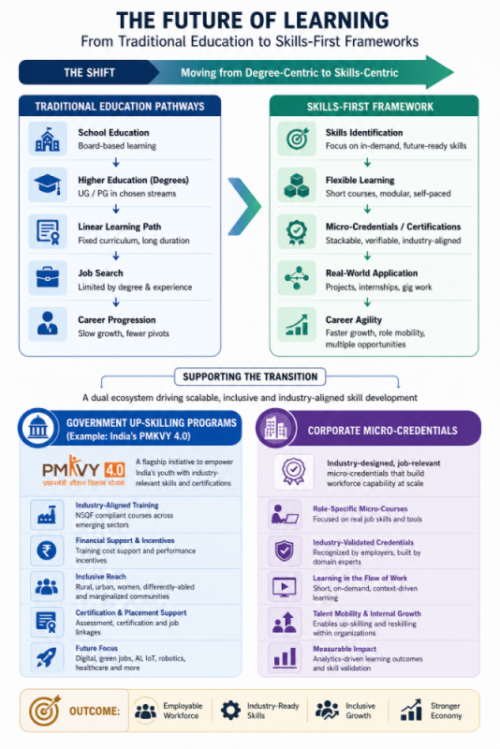
The structural transition in the global tech ecosystem has caused major national pivots. For example, India’s public and private sectors have largely transitioned toward practical skill architectures. Programs like the revamped PMKVY 4.0 (Pradhan Mantri Kaushal Vikas Yojana) and specialized MeitY (Ministry of Electronics and Information Technology) initiatives have turned away from teaching legacy operations to focus directly on advanced technical niches, including data modeling, drone electronics, and automated cyber defense frameworks.
To survive this rapid market transition, professionals should adopt a “T-Shaped” development strategy: develop a broad understanding of multiple emerging tech disciplines while specializing heavily in one core operational area.
| Core Discipline | Next-Generation Up-Skill | Strategic Impact |
| Software Engineer | DevSecOps & Cloud IaC | Ensures secure code delivery pipelines and continuous infrastructure automation. |
| Data Analyst | Automated Pipeline Engineering | Transitions from retrospective data visualization to building automated, predictive engines. |
| UI/UX Designer | Conversational Workflows & AI Interaction | Moves past static app layouts to craft complex, dynamic human-to-agent interface designs. |
| Business Operations | Low-Code Enterprise Automation | Enables the building of deep, cross-departmental tool dependencies without engineering bottlenecks. |
Part 3: Protecting the Backbone—Cybersecurity Audit for Rural MSMEs
While enterprise professionals navigate cloud architectures, Micro, Small, and Medium Enterprises (MSMEs) are undergoing their own rapid digital transformation. MSMEs are the backbone of rural economies, generating employment, supporting local supply chains, and promoting grassroots entrepreneurship.
As digital UPI payments, e-commerce platforms, and online customer engagement become standard, rural MSMEs are rapidly moving online. However, this shift exposes small businesses to severe cybersecurity risks due to limited digital literacy. A simple, low-cost technical audit can help rural MSMEs identify vulnerabilities, improve online safety, and build customer trust without requiring significant financial investment.
Five Common Digital Literacy Gaps & Quick Audit Checks
1. Weak Password Practices
The Risk: Many business owners use simple, easily guessable passwords such as business names, birth dates, or mobile numbers, frequently reusing them across multiple platforms. This leads to unauthorized account access, financial fraud, and identity theft.
Quick Audit Check: Review all business accounts. Ensure passwords contain at least 12 characters with a robust mix of uppercase letters, lowercase letters, numbers, and symbols.
2. Lack of Multi-Factor Authentication (MFA)
The Risk: Relying solely on a password leaves critical channels vulnerable to account hijacking and unauthorized financial transactions.
Quick Audit Check: Verify that Multi-Factor Authentication (MFA) or two-step verification is enabled on critical access points:
[ ] Business email accounts
[ ] UPI and digital wallet applications
[ ] Net banking portals
[ ] Social media business accounts (Facebook, Instagram, WhatsApp Business)
3. Unsecured Mobile Devices
The Risk: In rural areas, smartphones often serve as the single primary business tool for communication, payments, and inventory management. Unsecured devices face malware infections, physical theft, and confidential data exposure.
Quick Audit Check: Ensure screen lock protection (PIN, pattern, or biometrics) is enabled. Update operating systems regularly, remove unused applications, and install software only from official stores like the Google Play Store or Apple App Store.
4. Inadequate Backup Practices
The Risk: Business records, invoices, customer information, and transaction data are frequently stored on a single local device. Physical damage, ransomware, or loss of the device causes permanent data loss and operational disruptions.
Quick Audit Check: Maintain strict weekly backups. Store copies in secure, affordable cloud storage (like Google Drive or Microsoft OneDrive) and separate offline physical drives. Periodically test restoring the data to ensure the backup works.
5. Phishing and Scam Vulnerability
The Risk: Business owners and rural staff are frequently targeted by fraudulent messages, fake lottery alerts, or malicious links impersonating banks, government agencies, or electricity boards.
Quick Audit Check: Establish a strict internal rule: Never share One-Time Passwords (OTPs), PINs, or banking credentials with anyone over the phone or text. Train staff to verify suspicious links before clicking.
Part 4: Step-by-Step Online Presence & Payment Review
If your small business operates a website, online storefront, or social media pages, use this targeted framework to run a quick quarterly check.
Website & Social Media Integrity
HTTPS Encryption: Look for the padlock icon in the browser address bar. Ensure your website URL begins with
https://rather thanhttp://to encrypt customer data entries.Plugin & Software Updates: Outdated website themes and plugins are the number one entry point for hackers. Run pending updates on platforms like WordPress or Shopify weekly.
Access Control: Restrict administrative accounts. Ensure that former employees or temporary web developers have their login access immediately revoked.
Digital Payment Security Review
Digital transactions are essential for modern retail growth, but they require active physical and digital vigilance:
Low-Cost Security Tools & Next Steps
Securing an MSME does not require an enterprise IT budget. Business owners can achieve high operational resilience using highly affordable or free tools:
Credential Protection: Open-source or free-tier password managers (like Bitwarden or Google Password Manager).
Cloud Continuity: Free baseline cloud tiers from Google Workspace or Microsoft 365 for Business.
Endpoint Security: Built-in tools like Windows Defender or highly rated free antivirus software for mobile devices.
A brief 15–20 minute security awareness session conducted with your employees every month can reduce cyber risks by over 80%. By balancing continuous technological adaptability with strict local cybersecurity hygiene, both modern professionals and rural entrepreneurs can thrive securely in this rapidly evolving digital economy.
External Resources & Further Reading
To stay updated with the latest regional updates, policy shifts, and local economic strategies, check out the following analytical resources:
For localized news, regional developmental frameworks, and policy announcements in northern India, visit Matribhumi Samachar English.
