

Mumbai. Monday, 25 May 2026
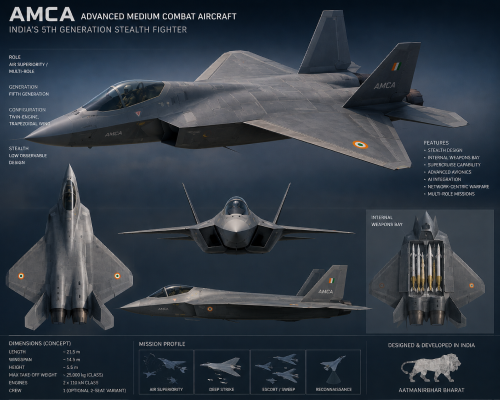
In what defense analysts are calling the most consequential defense procurement decision of 2026, the Indian Ministry of Defence (MoD) is preparing to officially issue a Request for Proposal (RFP) and tenders to three private sector industrial heavyweights for the Advanced Medium Combat Aircraft (AMCA) development phase.
The technical and legal frameworks for the ambitious program have been completely finalized. Commercial bids are expected to be formally requested by the end of this month from the three entities previously shortlisted based on technical competency:
Tata Advanced Systems Limited (TASL) (Bidding independently)
Larsen & Toubro (L&T) Consortium (Partnering with Bharat Electronics Limited and Dynamatic Technologies)
Bharat Forge Consortium (Partnering with BEML and Data Patterns)
Timeline: Fast-Tracking the Fleet
Initial public speculation suggested a long delay for the aircraft’s debut, but official project directives from the Aeronautical Development Agency (ADA) clarify a far more aggressive timeline. While full serial assembly and deliveries to the Indian Air Force (IAF) are slated for 2035, the physical rollout of the first operational AMCA prototype is targeted much earlier—between late 2026 and early 2027—with a maiden test flight planned for 2028. The newly established core integration facility in Andhra Pradesh will spend the years leading up to 2032 strictly executing flight certifications and fine-tuning stealth capabilities.
The Strategic Shift: Why HAL is Out of the Initial Race
The total exclusion of state-owned aerospace monopoly Hindustan Aeronautics Limited (HAL) from the initial prototype shortlist caused shockwaves in the industry. However, the decision stems from strategic capacity management rather than a lack of capability.
The Expression of Interest (EoI) rules issued by the ADA specifically docked points from companies whose existing order books exceed three times their annual turnover. Because HAL is currently processing a massive 8X order-book-to-turnover backlog—primarily driven by fast-tracking the Tejas Light Combat Aircraft (LCA) Mk1A and scaling up for the upcoming Tejas Mk2—the government structured the AMCA project to de-risk India’s aviation pipeline. By steering the prototype phase to private players, India establishes a vital second domestic aircraft manufacturing ecosystem.
High Stakes: A ₹15,000 Crore Starting Line
The Ministry of Defence has backed the prototype development phase with a approved budget of approximately ₹15,803 crore, dedicated entirely to manufacturing five flying prototypes and one structural test specimen.
While HAL reserves the contractual right to re-enter the arena during the high-volume serial production phase in the mid-2030s, defense experts emphasize that the private firm winning the prototype assembly contract this month will secure a massive, decades-long strategic advantage for the final production order of 120 stealth jets.
