

Mumbai. Tuesday, 26 May 2026
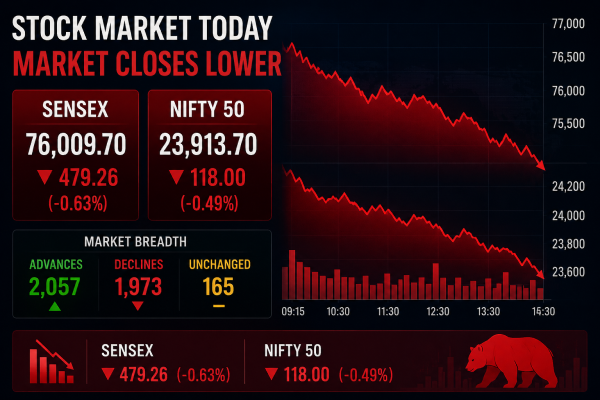
The Indian equities market experienced a turbulent trading session on Tuesday, reversing earlier gains as sudden global and domestic triggers weighed heavily on investor sentiment. The benchmark BSE Sensex plunged 479.26 points (0.63%) to close at 76,009.70, while the broader NSE Nifty 50 slipped below the psychological mark of 24,000, finishing 118 points (0.49%) lower at 23,913.70.
While early intraday momentum showed signs of strength, the markets ultimately succumbed to intense selling pressure. Below is a comprehensive look at the key elements driving this downturn, along with crucial technical boundaries to keep an eye on.
1. Sudden Geopolitical Pivot Triggers Profit Booking
The primary driver behind Tuesday’s market reversal was a shift in global geopolitical dynamics. Initially, Indian indices rallied on growing investor optimism surrounding a potential diplomatic peace agreement between the United States and Iran.
However, sentiment soured quickly following fresh US military action, which dimmed hopes of an immediate resolution. The uncertainty was further compounded when US Secretary of State Marco Rubio noted that finalizing an agreement could still take several days. Fearing prolonged instability, investors aggressively booked profits to protect capital, erasing early gains.
2. Technical Support Levels Breached
Technical analysts highlight that the Nifty 50 is currently caught in a crucial tug-of-war between key psychological boundaries:
The Downside Risk: By closing at 23,913.70, the index has slipped below its immediate support at 24,000. If the market fails to reclaim this zone quickly, intensified selling pressure could drag the index down toward its next solid floor at 23,800.
The Upward Target: To regain structural bullish momentum, the Nifty needs to decisively cross and hold above the 24,100–24,200 range. A strong breakout past 24,200 is expected to trigger short covering, potentially fueling a rapid “gamma-driven rally” toward 24,400.
3. Systemic Volatility via Monthly F&O Expiry
Tuesday’s session coincided with the monthly Futures & Options (F&O) expiry for the Nifty, a recurring monthly event known for injecting structural volatility into the markets.
Data revealed that the May series rollover stood at 59.8%. While this is marginally lower than the previous month’s expiry of 61.5%, it remains comfortably above historical benchmarks:
3-Month Average: 59.6%
6-Month Average: 58.5%
This higher-than-average rollover percentage suggests that market participants are not entirely liquidating their exposures, but are instead rolling their leveraged positions over into the June series with a tone of clear caution.
4. Currency Devaluation Puts Added Pressure
The domestic stock market pain was mirrored closely in the currency market. The Indian rupee fell sharply by 47 paise, closing provisionally at 95.73 against the US dollar.
When international tensions flare up, global institutional investors pull capital away from emerging markets and seek refuge in safer havens like the greenback. While the weakening rupee adds immense pressure to foreign portfolio flows, market participants anticipate potential liquidity interventions from the Reserve Bank of India (RBI) to contain excessive exchange rate volatility in the sessions ahead.
