

New Delhi. Friday, 12 June 2026
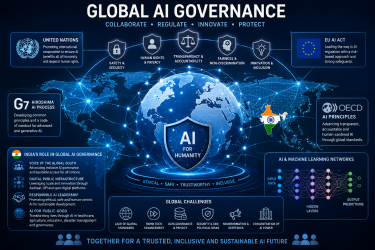
Artificial Intelligence (AI) has officially crossed the threshold from a localized corporate asset to a critical pillar of global economics, national security, and societal architecture. As generative AI models and automated decision systems scale globally, international bodies are rushing to erect regulatory guardrails. This paradigm shift has created an urgent imperative for global AI governance initiatives—a unified web of policies, safety standards, and ethical codes designed to steer automated systems toward human benefit while checking systemic risks.
🏛️ The Three Dominant Global Regulatory Philosophies
The current landscape of global AI governance is divided into three prominent geographic frameworks, each reflecting the political and economic values of its originating region.
| Governance Model | Core Philosophy | Regulatory Style | Primary Implementation |
| Rights-Based / Regulatory-First (European Union) | Protection of citizen rights and data privacy above commercial advancement. | Stringent, legally binding risk-categorizations with heavy financial penalties. | The European Union AI Act |
| Market-Driven / Strategic Acceleration (United States) | Ensuring global technological leadership and commercial innovation backed by national security. | Decentralized, sector-specific guidelines and voluntary industry commitments. | White House Executive Orders & NIST Frameworks |
| State-Integrated / Centralized (State-Led Economies) | Complete alignment of algorithmic systems with national socio-political stability and industrial targets. | Strict algorithm registries, mandatory content moderation, and centralized government licensing. | State Internet Information Regulations |
🇪🇺 Decoding the EU AI Act: A Risk-Based Blueprint
As a foundational benchmark for international frameworks for artificial intelligence, the European Union’s AI Act categorizes automated systems based on their potential to cause harm. Rather than banning the technology wholesale, it implements tiered compliance:
Unacceptable Risk: AI systems that manipulate human behavior to cause psychological harm, deploy real-time biometric identification in public spaces (with strict law enforcement exceptions), or score social behavior by states are strictly prohibited.
High Risk: Applications utilized in critical infrastructure, medical devices, educational grading, and employment recruitment. These require mandatory conformity assessments, rigorous data logs, high cybersecurity thresholds, and clear human oversight.
Limited/Minimal Risk: Consumer-facing tools such as chatbots or AI-generated entertainment. These have minimal regulatory requirements, focusing primarily on transparency (e.g., notifying a user that they are interacting with an AI).
🇮🇳 India’s Unique Strategic Pivot: The “Techno-Legal” Alternative
While the Global North builds defensive regulatory walls, India has established a distinct fourth pathway. Championed by the Ministry of Electronics and Information Technology (MeitY), India’s responsible AI strategy prioritizes “Innovation Over Restraint”—asserting that over-regulation in developing economies can inadvertently freeze digital transformation and exacerbate the digital divide.
The 6 Foundational Pillars of Indian AI Architecture
Rather than forcing complex, rigid legal compliance on early-stage startups, Indian policymakers focus on building an elastic, principle-based techno-legal framework across six operational vectors:
Infrastructure Acceleration: Operating through the IndiaAI Mission, the state actively funds the acquisition of domestic compute infrastructure (targeting thousands of high-performance GPUs) and curates open-source data repositories via platforms like AIKosh.
Digital Public Infrastructure (DPI) Integration: India is uniquely blending AI directly into its foundational digital layers—including identity systems, unified open payments, and secure data exchange rails. This enables population-scale deployment of AI in rural healthcare diagnostics, localized agricultural forecasting, and digital banking access.
Risk-Centric Policy Analysis: Utilizing existing legal instruments to penalize algorithmic harms (such as synthetic media, deepfakes, and identity theft) rather than establishing extensive, slow-moving bureaucratic regulatory boards.
Capacity and Sovereign Skilling: Establishing widespread vocational training programs to upskill developers, administrative officials, and judicial personnel on AI safety mechanics.
Voluntary Accountability and Audits: Motivating domestic enterprises to engage in self-regulation, transparent model lineage reporting, and voluntary algorithmic bias testing.
Institutional Safeguards: Formulating designated bodies, including an AI Governance Group (AIGG) and dedicated safety testbeds, to systematically investigate emerging vectors of machine learning risk.
🌍 The Voice of the Global South and Inclusive Governance
A major fault line in global AI governance initiatives is the representation gap. During its G20 Presidency, India successfully advocated for a more democratic approach to rule-setting, highlighting that developing nations must not merely be “rule-takers” of frameworks drafted exclusively by advanced economies.
The strategy emphasizes localized, multilingual AI models capable of processing content across dozens of regional languages, ensuring technological equity. By providing affordable, open-source access to foundational models, this framework works to prevent global technological monopolies and ensures that resource-constrained regions have an active hand in shaping international tech policies.
🚧 Persistent Roadblocks to International Alignment
Despite multilateral efforts by the UN Advisory Body, the G7 Hiroshima AI Process, and the OECD, several core challenges hinder global policy consensus:
Velocity Asymmetry: The exponential pace of machine learning breakthroughs vastly outstrips the timeline required to draft, pass, and ratify formal international treaties.
Data Sovereignty Conundrums: Cross-border data governance remains highly fragmented as nations enforce conflicting local storage laws, directly complicating the training of comprehensive global models.
The Compute Monopolization Risk: High-performance computing power remains deeply concentrated within a small handful of multinational corporations and well-funded nations, leaving emerging markets vulnerable to infrastructure dependencies.
🔮 The Path Forward
The future of AI governance will depend heavily on international interoperability. Systems must be designed to allow different regulatory models—whether the EU’s compliance-heavy system or India’s infrastructure-first strategy—to securely communicate and share safety standards. As AI integrates deeper into global society, establishing fair, balanced, and highly resilient governance frameworks will determine whether this technology serves as a universal equalizer or a tool for further economic divergence.
External References
To find local insights, real-time regional updates, and contextual media coverage on governance, security, and technological transformations within South Asia, review the official regional reports directly via Matribhumi Samachar.
