

New Delhi. Friday, 12 June 2026
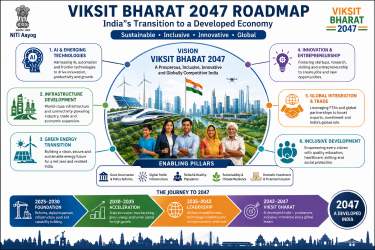
India’s ambition to transform into a developed nation by 2047—marking 100 years of independence—is rapidly moving from a high-level policy vision into a concrete, data-driven operational blueprint. Spearheaded by NITI Aayog, the strategy fundamentally shifts India’s growth engine from basic digital inclusion to massive, productivity-driven economic expansion.
At the heart of this transformation is a dual approach: leveraging advanced Artificial Intelligence (AI) and deploying next-generation Digital Public Infrastructure (DPI) to fuel a targeted $30 trillion economy.
The Strategic Blueprint: Human Capital and State-Led Growth
The recent NITI Aayog Governing Council meetings, chaired by Prime Minister Narendra Modi, established a critical baseline: national development is impossible without regional acceleration. This has given rise to the operational mantra “Viksit Rajya for Viksit Bharat” (Developed States for a Developed India).
Rather than applying a top-down, one-size-fits-all policy, states are actively designing customized blueprints tailored to their local industrial strengths, agricultural capacities, and demographic advantages. This decentralized approach is structurally anchored on four foundational pillars:
Foundational Human Capital: Revamping the workforce through massive upskilling initiatives in emerging fields like AI, drone technology, green hydrogen, and electric vehicle (EV) maintenance.
Productive Employment: Creating decentralized economic hubs to stimulate local entrepreneurship and prevent hyper-migration to tier-1 cities.
Health and Nutrition: Elevating preventative public healthcare systems to sustain long-term economic labor productivity.
Equity and Dignity: Developing institutional mechanisms that guarantee equal access to credit, technology, and wealth creation for historically marginalized or rural populations.
The DPI Evolution: Moving from Identity to Livelihood (DPI 2.0 & 3.0)
While India’s initial digital revolution focused heavily on identity verification (Aadhaar) and unified financial transactions (UPI), NITI Aayog’s DPI@2047 roadmap introduces a massive paradigm shift. In collaboration with global technology and economic strategy partners, India’s digital public infrastructure has been broken down into two distinct, sequential horizons:
| Phase | Core Timeline | Strategic Objective & Operational Focus |
| DPI 2.0 | 2025–2035 | Livelihood-Led Growth: Dismantling structural bottlenecks across 8 critical sectors, including MSMEs, agriculture, health, education, credit access, and decentralized energy. The goal shifts from transactions to actively scaling business operations and boosting bottom-line efficiency. |
| DPI 3.0 | 2035–2047 | Hyper-Local Innovation: Achieving broad-based national prosperity by empowering grassroots tech ecosystems, facilitating decentralized governance, and cementing India’s position as a global technology powerhouse. |
The AI Multiplier Effect
By pairing DPI 2.0 with aggressive AI adoption, the Indian government plans to democratize high-value services. In agriculture, predictive AI models built atop open-data frameworks will offer real-time crop advisory services directly to smallholders. In healthcare, AI-driven diagnostics integrated with national digital health accounts will make specialized medical screening affordable in remote villages.
Fact-Check
As public discourse around the Viksit Bharat vision grows, it is vital to correct common misconceptions regarding the actual framework:
Not Just a Financial Target: Many analysts conflate Viksit Bharat entirely with achieving a specific GDP milestone (e.g., $30 trillion). NITI Aayog’s documentation emphasizes that macro-economic growth is secondary to human development indexes, structural sustainability, and the closing of the rural-urban economic divide.
DPI is No Longer Just Fintech: A frequent point of confusion is viewing DPI purely through the lens of banking and payments. The current iteration explicitly transitions DPI into a logistical, educational, and legal framework designed to let small enterprises compete globally.
Sustainability is Mandatory, Not Secondary: Economic expansion is tightly bound to climate resilience. With intensive investments in renewable energy infrastructure, water conservation, and green manufacturing, India’s strategy relies on decoupled growth—expanding the economy while actively driving down carbon intensity.
Connecting the Vision: Further Reading
To understand the ideological and socio-economic foundations driving this shift away from historic post-colonial economic constraints, explore how these national frameworks are designed to empower the populace. You can read more about how leaders view this cultural and economic transition on Matribhumi Samachar, which highlights how self-reliance (Atmanirbhar Bharat) acts as the baseline catalyst for the broader Viksit Bharat mission.
