 Matribhumi Samachar English


New Delhi. Sunday, 14 June 2026
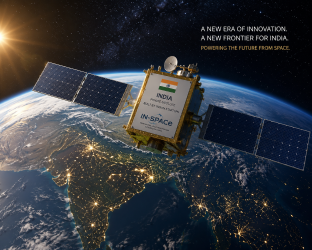
The India space tech ecosystem is witnessing an unprecedented era of growth. Driven by the proactive mandate of the Indian National Space Promotion and Authorisation Centre (IN-SPACe) and landmark policy overhauls, the nation has rapidly evolved into one of the world’s most dynamic private space startup hubs.
By opening infrastructure previously reserved exclusively for the Indian Space Research Organisation (ISRO), the government has successfully enabled hundreds of private enterprises to develop disruptive solutions. These span across satellite manufacturing, advanced launch systems, Earth observation (EO) data analytics, and space situational awareness.
The Catalytic Role of Policy and Financial Backing
A major driver behind this entrepreneurial surge is structured financial and regulatory clarity. The implementation of the Indian Space Policy 2023 alongside the liberalization of Foreign Direct Investment (FDI) norms—allowing up to 100% automatic FDI for certain space sub-sectors—has dramatically lowered entry barriers. Furthermore, the central government’s operationalization of a dedicated ₹1,000-crore Venture Capital (VC) fund specifically for space-tech has injected crucial early-stage and growth capital into the market.
Transforming Prototype to Market: The Technology Adoption Fund (TAF)
Bridging the gap between conceptual research and commercial viability is a historic bottleneck for deep-tech startups. To solve this, IN-SPACe introduced the Technology Adoption Fund (TAF). This strategic fund offers financial grants targeting startups looking to scale indigenous space technologies into market-ready products.
Among the initial cohort of trailblazing startups selected under competitive evaluation are:
-
SatSure Analytics: Merging advanced artificial intelligence with Earth observation data to deliver scalable geospatial intelligence for agriculture, climate risk management, infrastructure tracking, and insurance.
-
Astrobase Space Technologies & TM2SPACE Technologies: Diversifying into high-utility niches like specialized satellite navigation subsystems, orbital hardware components, and next-generation data downlinking capabilities.
Private Launch Vehicles and Satellite Constellations Redefining Capabilities
India’s private sector is no longer just a vendor base for components; it is building entirely integrated mission platforms and heavy-infrastructure systems.
Launch Vehicles Reaching the Karman Line
-
Skyroot Aerospace: Etched its name in history by executing Prarambh, launching Vikram-S—the first privately developed suborbital rocket from India.
-
Agnikul Cosmos: Captured global attention by successfully testing its Agnibaan SOrTeD suborbital vehicle, powered entirely by the Agnilet engine—the world’s first single-piece, fully 3D-printed semi-cryogenic rocket engine.
Advanced Earth Observation and Upstream Infrastructure
-
Pixxel: Actively deploying a commercial constellation of cutting-edge hyperspectral imaging satellites. Unlike traditional multispectral imagery, hyperspectral sensors capture hundreds of narrow, continuous bands of light, revealing the unique chemical and physical “signatures” of targets on Earth. This provides unprecedented analytical fidelity for monitoring crop health, methane leaks, and environmental degradation.
-
Dhruva Space: Providing comprehensive, end-to-end space engineering platforms. By designing modular satellite buses, launch deployers, and ground station units, they are fostering a resilient, domestic, commercial supply chain for global clients.
Prioritizing Orbital Sustainability
As international deployment schedules accelerate and low Earth orbit (LEO) grows heavily congested, the risk of orbital collisions escalates.
-
Digantara: Emerging as an international leader in space safety by engineering data-driven Space Situational Awareness (SSA) systems. By building space-based sensors and predictive space-traffic data suites, the startup maps space debris and tracks hazardous objects, ensuring long-term orbital sustainability for future global space missions.
Strategic Structural Correction: Understanding IN-SPACe vs. ISRO
While ISRO continues to pioneer the country’s deep-space exploration programs (such as the Chandrayaan, Mangalyaan, and Gaganyaan human spaceflight missions), IN-SPACe acts as the single-window autonomous regulatory authority. It exists explicitly to license, authorize, handhold, and share public space infrastructure with private entities on equal footing.
With strong regulatory security, world-class engineering talent, and a robust framework for indigenous manufacturing under the “Make in India” initiative, the private space sector is firmly on track to capture a significantly higher share of the multi-billion-dollar global space economy by the end of the decade.
External References
For more insights on regional technological growth, industrial policies, and administrative frameworks driving societal advancements in India, visit the official coverage available on Matribhumi Samachar English Edition.