

Mumbai. Sunday, 14 June 2026
The Indian deep-tech ecosystem has officially crossed a major threshold. Skyroot Aerospace, a pioneering private aerospace manufacturer based in Hyderabad, has raised approximately $60 million (roughly ₹570 crore) in its latest funding round, pushing its market valuation to a historic $1.1 billion. This milestone cements Skyroot as India’s very first dedicated space-technology unicorn.
The funding round was co-led by major global entities, including Sherpalo Ventures (founded by early Google investor Ram Shriram, who will join Skyroot’s board) and Singapore’s sovereign wealth fund, GIC. High-profile capital managers like BlackRock, Playbook Partners, and the Shanghvi Family Office also joined the cap table alongside existing early backers such as Arkam Ventures and the founders of Greenko Group.
Fact-Checking & Key Notes to the Baseline Report
To maintain strict industry accuracy, a few contextual elements from initial reports require precise adjustments based on current operational realities:
The Valuation Metric: The baseline text mentions a generic valuation “over $1 billion.” To be exact, Skyroot’s valuation sits specifically at $1.1 billion, representing a near-doubling of its valuation from its late-2023 funding run.
The Funding Horizon: While initial reports frequently label space-tech funding as general research capital, this specific $60 million injection is tied directly to scaling high-rate manufacturing at their “Infinity Campus” facility and executing the multi-launch manifest for the Vikram rocket series.
The Revenue Shift: It is critical to note that Skyroot has achieved unicorn status as a pre-revenue space launch startup. This underscores a monumental shift in investor psychology away from short-term consumer internet models and toward capital-intensive, long-gestation “hard tech” infrastructure.
Technical Blueprint: The Vikram Rocket Fleet
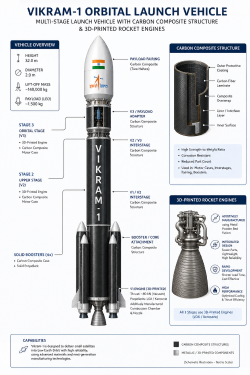
Skyroot’s commercial viability relies on a highly modular, carbon-composite launch architecture designed to provide affordable, customizable “on-demand” transit windows for global small-satellite operators.
| Feature / Specification | Vikram-1 (Orbital Class) | Vikram-2 (Next-Gen Upgrade) |
| Development Status | Final integration & testing phases completed | Early stage engineering & design |
| Target Launch Target | Scheduled mid-2026 | Planned 2027 |
| Max Payload (LEO) | Up to 350 kg to Low Earth Orbit | Up to 900 kg to Low Earth Orbit |
| Max Payload (SSO) | Up to 260 kg to Sun-Synchronous Orbit | Up to 600 kg to Sun-Synchronous Orbit |
| Propulsion Type | Multi-stage solid fuels + liquid upper stage | Solid/Liquid base + Advanced Cryogenic upper stage |
| Primary Structural Tech | 3D-printed components & carbon-fiber wrap | Extended carbon composite & structural alloy builds |
Alt Image Text: Labeled schematic diagram of the multi-stage Vikram-1 orbital launch vehicle highlighting the carbon composite structure and 3D-printed rocket engines.
Policy Catalysts: How IN-SPACe Changed the Equation
The rise of Skyroot from an ambitious 2018 startup—founded by former Indian Space Research Organisation (ISRO) scientists Pawan Kumar Chandana and Naga Bharath Daka—to a $1.1 billion business is deeply tied to institutional reforms.
The turning point occurred with the implementation of the Indian National Space Promotion and Authorization Center (IN-SPACe). Rather than forcing startups to build multi-million dollar launchpads and test benches from scratch, the framework allows private entities to tap directly into ISRO’s legacy infrastructure.
The Infrastructure Pipeline: Skyroot successfully completed its Phase 3 Integrated Electrical Test Campaign—which safely unified the vehicle hardware, ground software, and electrical interfaces into a single operating matrix—by using state-controlled integration hubs. The upcoming maiden flight of the full-scale Vikram-1 will launch directly from India’s primary state spaceport at the Satish Dhawan Space Centre in Sriharikota.
Looking Ahead: Commercial Scale vs. Execution Risks
With local peers like Chennai-based Agnikul Cosmos also raising significant capital (targeting a $500 million valuation boundary), India is quickly forming a hyper-competitive, privately-backed launch corridor. The immediate challenge for Skyroot is moving past the psychological triumph of its 2022 sub-orbital Vikram-S demonstration and proving regular, repeatable orbital insertion reliability with Vikram-1.
If the upcoming mid-2026 orbital launch achieves its precise deployment parameters, Skyroot will establish itself not just as an Indian business success story, but as a major international alternative in the global small-satellite launch market.
For broader breaking developments on regional infrastructure, tech policies, and commercial industrial updates, stay tuned via the English edition portal at Matribhumi Samachar.
