

Mumbai. Sunday, 14 June 2026
Artificial intelligence has officially evolved past software, code, and chat interfaces. The ultimate technology race now centers entirely on physical compute capacity. As global generative AI models expand and intelligent automation scales across every sector, India has rapidly transitioned into one of the world’s premier destinations for physical hardware and high-performance computing development.
Building out local systems is no longer an optional upgrade; it is an urgent economic priority. The traditional server farms that once powered the basic cloud are being fundamentally dismantled and replaced by AI-enabled data centers—often referred to as the “AI Factories” of the digital age.
What is an AI-Enabled Data Center?
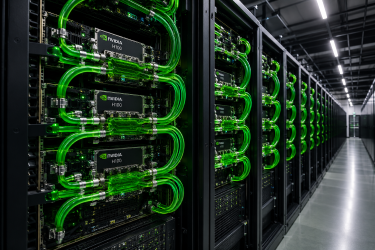
Unlike conventional data centers designed primarily to store text files, manage databases, or run standard web applications, AI-enabled data centers are specifically architected to support relentless, parallel-processing deep learning workloads. These facilities utilize a drastically different technical layout:
High-Performance GPU Clusters: Instead of relying strictly on sequential Central Processing Units (CPUs), these facilities pack thousands of tightly integrated Graphics Processing Units (GPUs) and specialized AI accelerators working simultaneously.
Advanced Thermal Demands: Conventional air conditioning is completely insufficient for modern computing architectures. Because deep learning processes depend on heavy matrix calculations that run non-stop, these servers generate massive heat. Operators must rapidly implement direct-to-chip liquid cooling and immersion systems to prevent processing nodes from overheating.
Ultra-Fast Networking Infrastructure: AI clusters require specialized high-speed networking fabric (such as InfiniBand or ultra-low-latency Ethernet solutions) to ensure that data flows seamlessly between nodes without causing an algorithmic bottleneck.
Massive 2026 Milestones: Global Tech Giants Investing in India
The scale of capital flowing into the subcontinent highlights India’s strategic position in the global AI economy. A monumental shift occurred when global tech leader Meta announced a historic partnership with Reliance Industries to build its first built-to-suit, AI-enabled data center in India.
Located in Jamnagar, Gujarat, this massive facility features a planned capacity of 168 megawatts (MW) and is being fully developed by Reliance to handle Meta’s future large-scale generative processing workloads. To make this massive operational load sustainable, the project aims to leverage nearly 1 gigawatt (GW) of renewable energy resources.
This infrastructure explosion is a broader, cross-industry phenomenon:
Microsoft & Amazon: Both hyperscale titans have committed billions of dollars toward expanding cloud, AI, and sovereign digital infrastructure capabilities across India.
OpenAI: Has launched collaborative initiatives focused on building next-generation AI infrastructure and cloud computing capabilities tailored to the Indian ecosystem.
The Policy Shift: Maharashtra’s Ambitious AI Blueprint
Recognizing that raw computing capacity is the ultimate bottleneck in the global AI race, local governments are stepping up with aggressive regulatory frameworks. The state government of Maharashtra recently unveiled its landmark Artificial Intelligence (AI) and Data Centre Policy.
This forward-thinking policy targets over ₹10,000 crore in direct infrastructure investments while looking to mobilize upwards of 1.5 lakh direct and indirect tech jobs by 2031. Crucially, the policy addresses the single largest constraint facing modern facilities: continuous, heavy-duty energy consumption. It mandates and incentivizes the creation of Green Integrated Data Centre Parks, providing capital subsidies and stamp-duty exemptions to operators who utilize renewable energy grids and eco-friendly liquid cooling systems.
Furthermore, the state is decentralizing its tech footprint by establishing five “AI Innovation Cities” and six Centres of Excellence (CoE) to transition secondary and tertiary regions into active participants in the high-performance computing landscape.
Regional Decentralization: The Rise of Secondary Hubs
While tier-1 cities like Mumbai, Chennai, and Bengaluru remain central digital gateways, high-density computing is rapidly moving inland where power and land are more abundant.
Chhattisgarh’s Surprise Pivot to Deep Tech
In a massive diversification move, the Government of Chhattisgarh secured investment commitments worth ₹9,580 crore at its Hyderabad Investors Connect event. Over half of this capital is targeted directly at digital infrastructure. Notably, Hypernext Data Center Ltd. committed ₹4,200 crore to build advanced data infrastructure, while Nivai Labs Pvt. Ltd. announced a ₹1,000 crore investment targeting semiconductor and GPU-related infrastructure—positioning the power-surplus state as an unexpected but vital player on India’s technology hardware map.
Jaipur’s Deep-Tech Transformation
Even traditional, tourism-driven economies like Jaipur, Rajasthan, are reshaping their landscapes. Backed by the state’s proactive AI and Machine Learning Policy and academic engines like MNIT Jaipur, the “Pink City” is setting up an advanced AI Laboratory and localized high-performance data centers to serve as the computing backbones for regional agritech, healthcare, and public sector startups.
Essential Verifications and Reality Checks
When assessing the rapid rise of sustainable high performance computing infrastructure, it is vital to balance market enthusiasm with engineering and administrative realities:
MoU Conversion Rates: Large-scale investment announcements (like those in Central India) rely heavily on Memorandums of Understanding (MoUs). The true economic impact hinges entirely on how fast these documents convert into active, brick-and-mortar operations.
Grid Continuity vs. Clean Energy: AI clusters require an uncompromised, clean, and uninterrupted electricity supply. Any drop in line quality can cause catastrophic hardware failures. The true timeline for upcoming regional AI data centers depends directly on how fast municipal authorities can deploy stable, high-capacity green grids.
By combining an expansive digital consumer base, aggressive data center expansion, and massive renewable energy initiatives, India is anchoring itself at the absolute center of the international technology map, transitioning from a back-office software hub into the primary global computing engine of the future.
Authentic References from Matribhumi Samachar
For deeper journalistic breakdowns, verify the official regional policy rollouts and tech partnerships through these direct coverages:
The Blueprint for National AI Infrastructure: To understand the macro-economic shift driving this investment wave, read The Backbone of the Digital Revolution: Why India is the Next Frontier for AI Infrastructure Investment – Matribhumisamachar.
The Meta-Reliance Partnership: For the complete corporate breakdown of the landmark Jamnagar project, explore Meta Partners with Reliance to Build Its First AI-Enabled Data Center in India at Jamnagar.
State-Level Policy Details: To view the specifics regarding green incentives and regional tech parks, review Shaping the Tech Landscape: Inside Maharashtra’s New Ambitious AI and Data Centre Policy – Matribhumisamachar.
Emerging Regional Deep Tech Investments: Read about Central India’s infrastructural shift in Chhattisgarh Industrial Investment: State Bags ₹9,580 Crore Deals for Tech, Data Centers in Hyderabad – Matribhumisamachar.
Northern India’s Architecture Boom: Track the technological transition of traditional markets in Inside Jaipur’s Bold Leap into AI, Semiconductors, and Quantum Computing.
