

New Delhi. Tuesday, 16 June 2026
India’s space ecosystem is undergoing a profound paradigm shift. What was once an arena exclusively funded and operated by the government via the Indian Space Research Organisation (ISRO) has rapidly transformed into a hotbed for private enterprise, high-stakes venture capital, and cutting-edge artificial intelligence (AI).
Driven by strategic policy changes like the Indian Space Policy 2023, the country is targeting a major chunk of the multi-billion-dollar global space economy by 2030 (Kumar, 2024). This transition relies heavily on an intricate web of domestic innovation that merges financial muscle with breakthrough engineering.
The Financial Fuel: How Venture Capital Unlocked Deep-Tech
Historically, space-tech was deemed “un-investable” by traditional venture funds due to multi-year development timelines, high failure risks, and enormous initial capital expenditure. However, the operationalization of IN-SPACe (Indian National Space Promotion and Authorisation Centre) combined with a series of successful milestones has created a highly favorable environment for investor sentiment.
Surging Private Investment: Equity funding in Indian space startups recently scaled beyond $170 million, displaying a massive 143% year-on-year growth trajectory. Cumulatively, private space startups have captured more than $530 million from international and domestic backers.
Government De-risking: The state has stepped in with a highly anticipated ₹1,000 crore government-backed venture capital fund engineered to support early and growth-stage deep-tech companies. Furthermore, the IN-SPACe ₹500 crore Technology Adoption Fund (TAF) is actively subsidizing up to 60% of advanced technology development costs for qualifying private players.
Breaking Manufacturing Records: 3D-Printed Rockets & Rapid Deployment
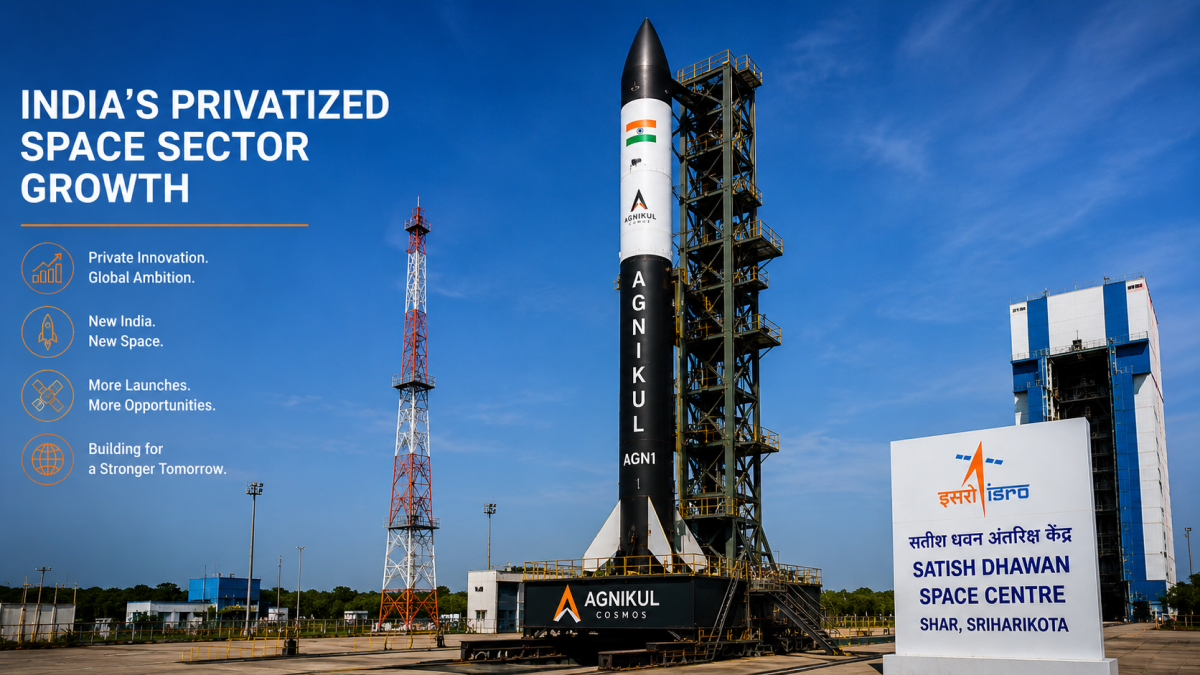
The most visible indicators of India’s privatized space sector growth are visible in the private launch pad installations at the Satish Dhawan Space Centre (SDSC SHAR). Private entities are no longer just component suppliers; they are building entire standalone launch architectures.
AgniKul Cosmos: Single-Piece 3D Printing
Following the historic flight of their Agnibaan SOrTeD (Suborbital Technological Demonstrator) vehicle, AgniKul Cosmos proved that advanced aerospace hardware can be rapidly localized. By utilizing advanced additive manufacturing to 3D-print their Agnilet and Agnite semi-cryogenic engines out of Inconel alloy in just 7 days, they collapsed traditional sub-assembly fabrication timelines by nearly 97%. These platforms utilize software-defined throttling managed via automated electric-motor-driven fuel pumps to ensure ultra-precise orbital insertion.
Skyroot Aerospace: Industrialized Orbital Ingress
As India’s first private space-tech unicorn, Skyroot Aerospace gained international prominence following the launch of its Vikram-S rocket (Apte, 2025). The firm has systematically built out complex, large-scale in-house manufacturing facilities—such as custom filament winding machinery for composite motor casings, massive hot-air curing autoclaves, and multi-axis CNC units—to mass-produce their Vikram-1 orbital transport vehicles (Apte, 2025).
Downstream Dominance: The AI and Big Data Paradigm
While hardware like rockets and satellites captures public attention, the real financial margin in the modern space market sits in downstream data applications (Andrade, 2023). Satellites generate petabytes of raw imagery, and Indian tech companies are uniquely positioned to translate this data into actionable intelligence through machine learning models (Andrade, 2023).
[Raw Sensor Sat Data] ➔ [Orbital AI Edge Computing] ➔ [Real-Time Geospatial Intelligence]
Indigenous startups like Pixxel and SatSure are bypassing pure imagery delivery by deploying neural networks right onto satellite payloads—a process known as orbital edge computing. Instead of beaming down massive, unfiltered data files, the satellite computes the data in orbit and transmits immediate analytical insights.
These specialized space-data analytics platforms are finding intensive commercial usage across:
Precision Agriculture: Tracking crop health, soil moisture indices, and yield forecasts.
Climate & Disaster Monitoring: Real-time prediction of Glacial Lake Outburst Floods (GLOFs), wildfire spreads, and coastal erosion patterns.
Defense & Logistics: Providing high-frequency, space-based Intelligence, Surveillance, and Reconnaissance (ISR) data to secure maritime corridors and terrestrial frontiers (Talukdar, 2026).
Breaking Down India’s Unified Space Value Chain
The entire commercial space architecture in India is structurally divided into three interconnected layers, allowing startups to capture value across multiple touchpoints:
| Value Chain Segment | Engineering Core | Active Indian Innovations |
| Upstream | • Multi-stage launch systems • Automated 3D engine printing • Custom satellite bus fabrication | Skyroot Aerospace, AgniKul Cosmos, Dhruva Space |
| Midstream | • High-frequency ground stations • In-orbit positioning sensors • Space Situational Awareness (SSA) | Digantara (SCOT tracking constellation), TM2SPACE (AI Star Trackers) |
| Downstream | • Geospatial AI data models • Climate risk predictive software • On-demand commercial imagery | SatSure (Dhaarini Foundation Model), Pixxel, Vassar Labs |
The Hurdles: Challenges on the Horizon
Despite the monumental progress, India’s journey to becoming a dominant global hub requires solving key structural roadblocks:
The Late-Stage Funding Chasm: While early seed capital is abundant, transitioning to large-scale mass manufacturing of heavy constellations demands billions in continuous, late-stage growth rounds.
Global Cost Pressures: International competitors like SpaceX’s reusable architecture and heavily subsidized international copycats put immense pressure on pricing margins per kilogram (Andrade, 2023).
Bureaucratic Throughput: For the high-frequency launch cadences required by the global commercial market, the regulatory clearance pathways handled by IN-SPACe must remain agile and automated, completely isolating private operators from legacy bureaucratic red tape.
FAQ: Understanding India’s Private Space Sector
What is IN-SPACe and what role does it play?
IN-SPACe is an autonomous, single-window nodal agency created by the government to authorize, promote, and regulate private space activities in India. It acts as the primary intermediary between private entities and state-owned infrastructure.
Why is AI so critical to the space economy?
Satellites gather massive streams of Earth observation data. AI and machine learning algorithms are needed to clean, parse, and analyze this data at scale, turning raw images into real-time solutions for industries like agriculture, defense, insurance, and urban planning.
How does 3D printing reduce rocket manufacturing costs?
Traditional rocket engines require assembling hundreds of individual casted and machined parts, which takes months and increases points of potential mechanical failure. 3D printing allows companies to construct a single-piece engine in days, radically cutting down labor, material waste, and lead times.
Disclaimer
This article is curated for educational and informational purposes based on current industry developments, regulatory announcements, and market research up to 2026. Space tech investments carry inherent technical and financial risks.
References
Andrade, J. A. N. (2023). Intelligent Systems in Space Transportation Industry (Master’s thesis, Iscte – Instituto Universitário de Lisboa).
Apte, P. (2025). Engineering and manufacturing successes: India’s push toward Viksit Bharat. ASME Mechanical Engineering Magazine, 147(10), 1–5.
Kumar, G. (2024). Strengthening the Space Innovation System through Military Civil Fusion. Journal of Polity and Society, 16(1), 45–62.
Talukdar, I. (2026). Civil military fusion for naval operations – a perspective. Center for Joint Warfare Studies (CENJOWS).
(For additional perspectives, real-time localized announcements, and regional deep-dives on national technological growth, explore current report coverages over at Matribhumi Samachar.)
