

New Delhi. Wednesday, 17 June 2026
India is rapidly transforming from a digital consumer into an architect of its own technological destiny. At the heart of this shift is the concept of Sovereign AI—a nation’s structural capability to design, train, and deploy artificial intelligence using its own domestic infrastructure, localized datasets, home-grown talent, and native regulatory frameworks.
Rather than remaining tethered to foreign AI conglomerates and external cloud architectures, India is systematically engineering a self-reliant tech ecosystem. This strategy ensures data sovereignty, mitigates national security risks, and builds digital solutions fundamentally aligned with the country’s diverse linguistic, economic, and geographic realities.
What Does Sovereign AI Mean for India?
For a country with over 1.4 billion people, technological independence cannot rely on generalized, western-centric AI models. India’s localized execution of sovereign AI centers on five fundamental pillars:
Indigenous Foundation Models: Building large multimodal and small language models optimized for regional realities.
Domestic Compute Infrastructure: Establishing massive, state-backed GPU supercomputing clusters.
Linguistic Inclusivity: Preserving India’s unique multilingual identity by creating AI that natively processes regional scripts.
Grassroots Ecosystem Support: Funding domestic AI startups and academic research institutions to prevent brain drain.
Public Utility Applications: Developing targeted AI tools specifically engineered for public governance, remote healthcare, precision agriculture, and disaster mitigation.
The IndiaAI Mission: The Strategic Backbone
The operational blueprint fueling this transformation is the government-backed IndiaAI Mission. Operating with a targeted budget framework, the mission prioritizes immediate resource accessibility for local builders over simple institutional expansion.
┌────────────────────────────────────────────────────────┐
│                   INDIAAI MISSION                      │
└───────────────────────────┬────────────────────────────┘
                            │
         ┌──────────────────┼──────────────────┐
         ▼                  ▼                  ▼
  [Compute Pillar]      [AIKosh]        [Talent Pipeline]
  38k+ GPUs & TPUs    7,500+ Datasets    PhD Fellowships &
  Subsidized Access   270+ Local Models    AI Edge Labs
The execution relies on three highly interconnected pillars:
1. The IndiaAI Compute Pillar
To address the critical global shortage of advanced AI chips, the government has onboarded massive compute clusters, integrating over 38,000 high-end GPUs and 1,000+ TPUs. Rather than gating this power behind enterprise paywalls, the infrastructure is made accessible to domestic startups and researchers at deeply subsidized rates—democratizing the development of high-tier neural networks.
2. The AIKosh Data Platform
AI requires clean, compliant, and contextually rich data. The AIKosh initiative acts as a secure, national repository, cataloging thousands of datasets and hundreds of foundational models across dozens of distinct sectors. This gives local engineers a compliant baseline to train models safely without needing to scrape western data environments.
3. FutureSkills and Localized Talent Pipelines
To sustain this growth, India is treating AI literacy as a foundational educational tier. By embedding data science and machine learning concepts directly into academic curricula, funding specialized PhD fellowships, and establishing local AI edge labs in Tier-2 and Tier-3 cities, the nation is actively building a diverse, distributed talent pool.
Breaking the Western Data Monopoly with Indigenous Models
Standard global Large Language Models (LLMs) are historically constrained by Western training biases. They struggle with the grammatical nuances of Indic scripts and require high token-to-word translation costs, making them expensive and inefficient for local deployment.
To bypass this barrier, Indian innovators are taking a two-pronged approach:
Custom Tokenization for Regional Languages
Homegrown initiatives like Krutrim are trained on trillions of tokens specifically optimized for Indic languages. This directly addresses the severe digital data disparity, as regional Indian languages traditionally account for less than 1% of standard global web crawls.
The Rise of Small Language Models (SLMs)
While massive LLMs dominate global headlines, Indian technology strategists are heavily prioritizing Small Language Models (SLMs). These highly specialized, domain-specific networks require significantly less computational power to run. This lower energy footprint allows them to operate efficiently on local edge devices, handheld mobiles, and lightweight government portals, making AI implementation cost-effective at a mass scale.
Earth Intelligence: Merging AI with Satellite Analytics
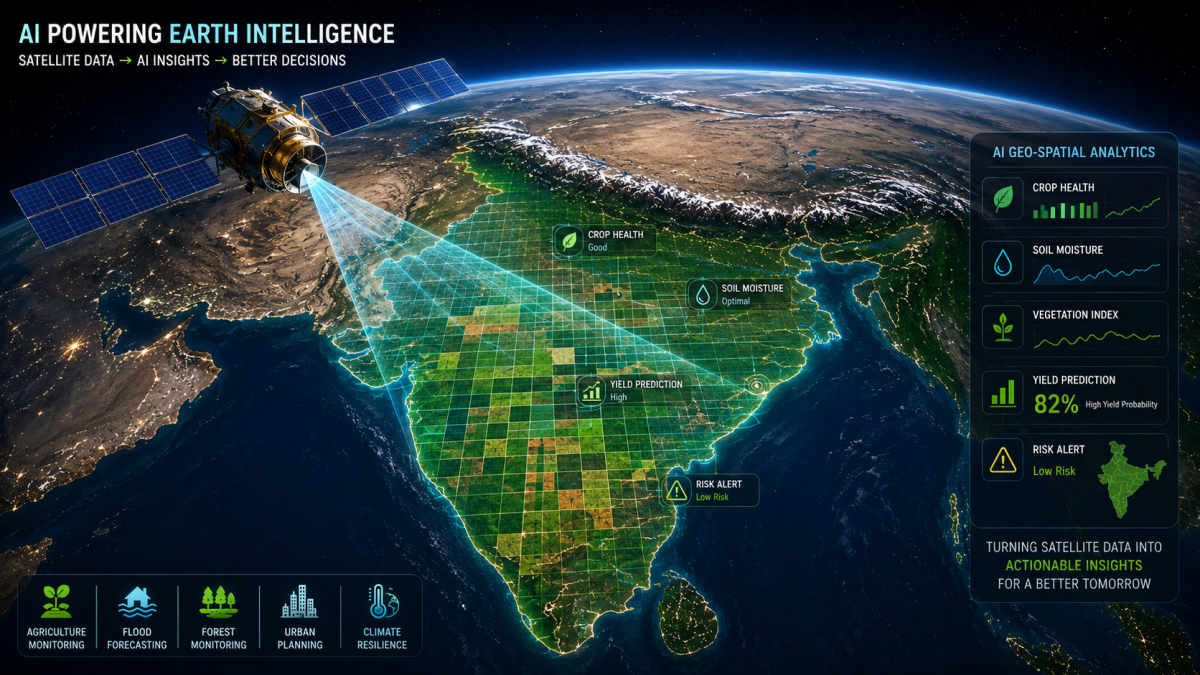
India’s sovereign AI ambitions reach far beyond text-based applications. By combining cutting-edge machine learning with the massive streams of raw remote sensing data generated by organizations like the Indian Space Research Organisation (ISRO), India is pioneering a domain known as Earth Intelligence.
[Raw ISRO Satellite Data & Imagery]
                 │
                 ▼
    [Automated AI Interpretation]
                 │
      ┌──────────┴──────────┐
      ▼                     ▼
[Precision Agriculture]  [Disaster Mitigation]
 ↳ Yield Forecasting     ↳ Flood Inundation Models
 ↳ Disease Detection     ↳ Landslide Risk Maps
Transforming Precision Agriculture
Instead of relying on slow, manual field assessments, AI-driven Earth Intelligence automates crop health monitoring, identifies localized pest infestations, and maps soil moisture variations. This gives millions of farmers access to real-time predictive yield metrics and precise irrigation schedules, building systemic resilience against unpredictable weather patterns.
Scalable Disaster Management
Climate challenges demand rapid response times. Earth Intelligence models process millions of satellite images in real-time to generate automated flood forecasting maps, track cyclonic trajectories, and evaluate landslide risks along vulnerable mountainous corridors. Turning raw visual data into immediate actionable insights allows civic agencies to execute life-saving evacuations long before an emergency peaks.
Bottlenecks on the Road to Technological Autonomy
Despite a rapid upward trajectory, India’s sovereign AI roadmap must successfully navigate critical structural bottlenecks to reach its full potential:
Hardware Supply Chain Dependencies: Building sovereign infrastructure requires a reliable supply of advanced semiconductors. True independence is fundamentally linked to the success of the India Semiconductor Mission (ISM 2.0), which aims to secure domestic fabrication, packaging, and supply chain loops.
Energy and Power Constraints: Scaling massive, high-compute data centers strains national power grids. Expanding this footprint sustainably means directly integrating future data clusters with India’s expanding renewable and green energy grids.
Continuous Data Curation: While platforms like AIKosh bridge initial gaps, creating highly structured, clean, and digitally cataloged datasets for obscure regional dialects and highly specific local soil types remains a continuous, labor-intensive effort.
The transition from an AI consumer to an AI creator is no longer a futuristic ambition—it is an active, infrastructure-led evolution. By anchoring its digital strategy in sovereign computing, localized language models, and satellite-driven Earth Intelligence, India is creating a scalable blueprint for self-reliance in the global technology landscape.
Frequently Asked Questions (FAQ)
What is Sovereign AI and why does India need it?
Sovereign AI is a nation’s capability to build, host, and regulate its own artificial intelligence using domestic infrastructure, datasets, and talent. India needs it to secure its citizen data, eliminate reliance on foreign tech monopolies, lower operational costs for regional languages, and build tools optimized for its unique socio-economic realities.
How does the IndiaAI Mission support local startups?
The IndiaAI Mission provides startups with subsidized access to high-performance GPU and TPU compute clusters through the IndiaAI Compute Pillar. It also grants access to clean, secure training data via the AIKosh platform and provides targeted development funding for indigenous foundation models.
What is “Earth Intelligence” in the context of Indian AI?
Earth Intelligence refers to the integration of AI algorithms with satellite imagery and remote sensing data (sourced from organizations like ISRO). It automates the analysis of massive geographic datasets to provide real-time solutions for precision agriculture, infrastructure tracking, and disaster forecasting.
Why are Small Language Models (SLMs) important for India?
Small Language Models are domain-specific AI models that require far less computational power and energy to operate than massive global LLMs. They are vital for India because they can be deployed affordably on standard edge devices, mobile phones, and localized public service portals without requiring expensive cloud infrastructure.
Disclaimer: This article is intended for informational and educational purposes only. The development of AI infrastructure, government allocations, and technological deployments are subject to evolving national policies, global supply chain dynamics, and ongoing infrastructure rollouts.
For more regional news, localized insights, and verified updates on national technological developments, explore the latest English coverage directly via Matribhumi Samachar English.
