

New Delhi. Updated : Updated on : Wednesday, 24 June 2026
Thousands of medical aspirants across India are eagerly waiting for the release of the official NEET UG 2026 answer key. The answer key is arguably the most critical document issued after the examination because it allows candidates to calculate their raw scores, predict national ranks, and map out realistic admissions strategies for MBBS, BDS, AYUSH, and other premium medical courses.
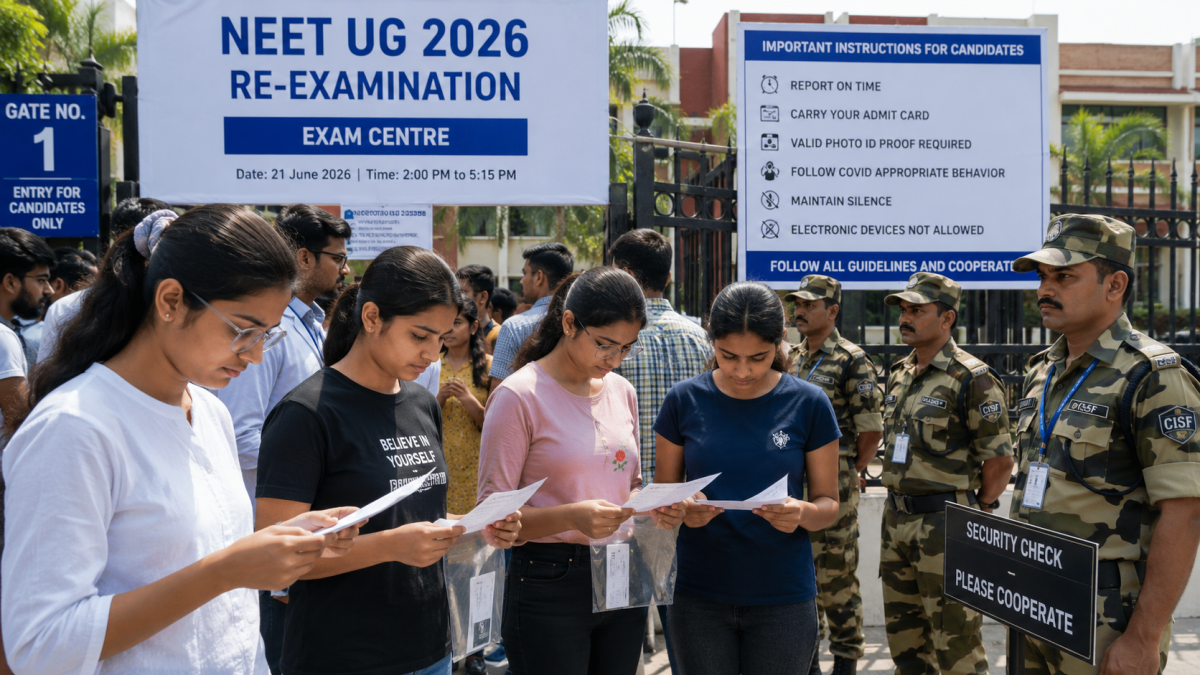
Following the highly regulated NEET-UG re-examination held on June 21, 2026, the National Testing Agency (NTA) is moving quickly through its post-exam evaluation blocks. The provisional answer key is expected to drop online shortly, opening up a brief, intense window for candidates to challenge disputed answers.
This comprehensive guide breaks down the exact 2026 timeline, marking rules, rank mapping, and registration steps you must take to secure your medical seat.
NEET UG 2026 Provisional Answer Key Expected Date & Timeline
Based on immediate patterns from previous cycles and the specific logistical accelerations implemented by the Ministry of Education this year, the NTA is running on an optimized post-exam calendar:
| Event | Expected Timeline | Details & Candidate Actions |
| Provisional Answer Key | Last week of June 2026 | Initial official solution set released on the NTA server. |
| OMR Response Sheet Release | Along with the Answer Key | Scanned copies of your physical bubble sheets are uploaded to student dashboards. |
| Objection Window | 2–3 days after release | Period to challenge anomalies online with a non-refundable fee of ₹200 per question. |
| Final Answer Key | Mid-July 2026 | Culmination of expert verification; the absolute framework used to compute official ranks. |
| NEET UG 2026 Result | Second week of July 2026 | Digital scorecards showing marks, percentile, and All India Rank (AIR) become live. |
How to Calculate NEET UG 2026 Score Using Answer Key
To accurately estimate your position prior to the official result declarations, you must follow the precise penalization structures mandated in the official prospectus.
Official NEET Score Calculation Formula 2026
Correct Answer: +4 marks
Incorrect Answer: -1 mark
Unanswered/Skipped Question: 0 marks
Simple Numerical Example
Suppose you cross-reference your uploaded OMR sheet with the provisional key and verify that you have 150 correct responses and 20 incorrect answers (with 10 left blank):
Positive Marks: 150 X 4 = 600
Negative Marks: 20 X 1 = 20
Estimated Raw Score: 600 – 20 = 580 marks
Candidate Warning: While cross-checking your scanned OMR response, ensure you flag any multi-bubbled answers, faded ink impressions, or smudges. The NTA optical readers evaluate multi-bubbled questions as automated incorrect answers (-1 mark), so do not assume full marks for ambiguous markings.
Score vs. Expected Rank Range Mapping
While exact rank thresholds experience variations yearly based on the overall difficulty index and candidate population metrics, the estimated benchmarks for the 2026 cohort align with the following ranges:
700+ Marks: Top 500 Rank (In contention for elite centers such as AIIMS New Delhi)
680–699 Marks: Top 3,000 Rank
650–679 Marks: Top 10,000 Rank
620–649 Marks: Top 25,000 Rank
580–619 Marks: Top 50,000 Rank
Below 550 Marks: Admissions rely heavily on state domicile cutoffs, institutional quotas, and reservation relaxation rules.
The Medical Counselling Landscape (AIQ vs. State Quota)
The declaration of results marks the transition into the counselling phases. Medical seating distributions follow a strict structural split:
1. All India Quota (AIQ) – 15% Seats
Managed globally by the Medical Counselling Committee (MCC). This track distributes 15% of total MBBS/BDS seats in state government colleges across state lines. It also governs 100% of seats within Central Universities, AIIMS institutions, and JIPMER campuses.
2. State Quota Counselling – 85% Seats
Conducted individualistically by your specific home state’s designated medical admission authorities. This covers 85% of standard government medical college seats and 100% of local private medical colleges, where regional domicile verification acts as a defining eligibility filter.
NEET UG Counselling Registration Process 2026
To avoid losing your seat due to procedural timelines or documentation errors, prepare for the automated counselling cycle using this structured progression:
NTA Security Advisory: Spotting Post-Exam Disinformation
With heightened online activity following the recent exam phases, students and families must prioritize extreme data vigilance. The Ministry of Electronics and Information Technology (MeitY) recently had to execute emergency structural blocks under Section 69A of the IT Act on major platforms like Telegram due to widespread syndicates deploying message-editing loopholes to fake question paper leaks post-examination.
To maintain total data safety and safeguard your mental peace:
Verify the Domain: Ignore unofficial links circulating on messaging networks. Rely exclusively on portals ending in
.nic.inor.gov.in(such asexams.nta.ac.in/NEETormcc.nic.in).For context on how security platforms manage digital exam protections in India, check the underlying regulatory landscape explained in the Digital Lockdown & Exam Controversy Article on Matribhumi Samachar.
Get Your Paperwork Sorted Early: Do not wait for your rank card to look for domicile, category, or sub-category certificates. Keep your state-approved documentation ready ahead of the July windows to avoid last-minute disqualifications.
Frequently Asked Questions (FAQ)
Q1: Can I challenge the NTA NEET UG 2026 answer key online?
Yes, once the provisional key goes live, candidates can log into the NTA web portal, pick specific question IDs, upload academic evidence to support their claims, and challenge the key by paying a non-refundable fee of ₹200 per challenged question.
Q2: What happens if an answer key challenge is accepted by the NTA?
If subject experts confirm a mistake in the provisional key, the answer key is updated. The corrected final answer key applies to all students uniformly, and the NTA adjusts scores accordingly before preparing the final merit list.
Q3: Is the security deposit paid during counselling registration refundable?
Yes. The security deposit is fully refundable if you are not allocated a seat throughout the rounds or if you successfully join your assigned college according to the rules. However, it can be forfeited if you fail to report to an assigned college in specific advanced rounds.
Q4: Can I participate in both AIQ and State Quota counselling simultaneously?
Absolutely. Qualified candidates can register for the 15% AIQ counselling via the MCC portal while independently applying for their respective 85% state quota allocations via local state admission portals.
Disclaimer
This guide is prepared strictly for immediate informational and benchmark reference based on scheduling updates, public notices, and previous evaluation trends available in June 2026. Aspiring medical candidates are urged to refer to official notifications and instructions published exclusively on the NTA (exams.nta.ac.in) and MCC (mcc.nic.in) web portals before submitting final choice lockings, payments, or claims.
