 Matribhumi Samachar English


Mumbai. Wednesday, 1 July 2026
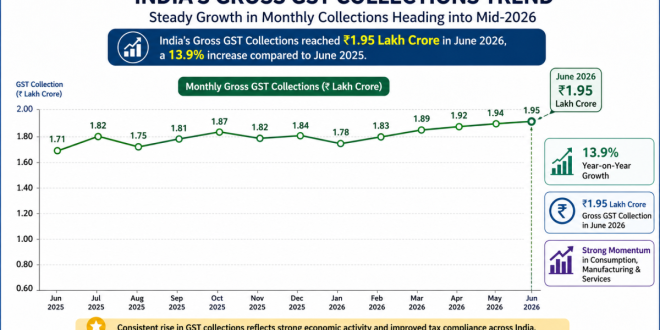
India’s economic engine is firing on all cylinders. The Goods and Services Tax (GST) collections for June 2026 have continued their stellar upward trajectory, yielding a massive ₹1.95 lakh crore in gross revenue. This represents a robust 13.9% year-on-year (YoY) growth compared to the same period last year, signalling strong domestic resilience in the face of erratic global economic conditions.
For policymakers and investors alike, these numbers are more than just fiscal data—they are a real-time health checkup showing that India’s domestic consumption, formalization, and industrial sectors are thriving.
The June 2026 GST Dashboard at a Glance
| Particular | Data / Trend |
| Gross GST Collection | ₹1.95 Lakh Crore |
| Year-on-Year (YoY) Growth | 13.9% |
| Current Economic Trend | Strong Positive Momentum |
| Primary Growth Drivers | Urban Consumption, Manufacturing Output, Tech-Driven Compliance |
Five Key Pillars Driving India’s Indirect Tax Collections Higher
The persistent rise in revenue isn’t an accident. It is the result of a compounding effect across five major economic segments:
1. Robust Domestic Consumption
Consumer demand across urban and semi-urban hubs remains incredibly healthy. Spending on big-ticket items like automobiles and consumer electronics, alongside experiences like travel, hospitality, and retail, heavily padded the indirect tax pool this month.
2. Sustained Manufacturing Expansion
India’s factories are staying busy. The steady growth in purchasing managers’ indices (PMI) and localized factory outputs translated directly into higher GST collections along complex industrial supply chains.
3. Expansion of the Services Sector
From banking and telecom to IT services, logistics, and professional consulting, the services ecosystem saw extensive billing expansions in the first quarter of the fiscal year, feeding directly into the national exchequer.
4. Advanced Tech-Driven Compliance
The government’s hard stance on tax leakage is paying off. By leveraging sophisticated backend technologies, tax authorities have effectively plugged traditional evasion gaps. Key systems include:
-
E-Invoicing & E-Way Bills: Real-time tracking of business transactions and physical freight.
-
AI-Driven Analytics: Deep-learning algorithms that flag anomalies and mismatches between input tax credits and final returns instantly.
5. Rapid Formalisation of the Economy
Thanks to the digital payments boom and strict digital trail mandates, more micro and small businesses are stepping out of the shadow economy and registering under the formal tax net than ever before.
What This Economic Windfall Means for India’s Future
Strengthening Government Finances
Higher tax revenues grant the government exceptional fiscal flexibility. Instead of relying on heavy market borrowings, which can pressure fiscal deficits, these funds can be directly pumped back into public assets:
-
High-speed rail corridors and national highway expansions.
-
Next-generation digital public infrastructure (DPI).
-
Social welfare schemes, rural development, healthcare, and defense.
Boosting Investor Confidence
For both domestic institutional investors (DIIs) and foreign portfolio investors (FPIs), consistent double-digit GST growth is a green flag. It visualizes verifiable corporate turnover, steady consumption habits, and transparent revenue visibility, making India a premier destination for medium-to-long-term capital.
Navigating Immediate Headwinds
While the celebratory mood is justified, economists note that the coming quarters require careful monitoring. External factors like global supply chain disruptions, volatile crude oil prices, localized inflationary pressures, and muted export demand from cooling Western economies could still influence corporate tax outlays.
Frequently Asked Questions (FAQs)
Q1: Exactly how much GST did India collect in June 2026?
India’s gross GST collection reached ₹1.95 lakh crore, registering an impressive 13.9% year-on-year growth rate over the previous year’s matching month.
Q2: How does Artificial Intelligence help in increasing GST revenue?
The government employs AI and data analytics to run automated cross-verifications across filings. This flags tax leakage, catches fake input tax credit (ITC) claims, and ensures high compliance without manual inspector intervention.
Q3: Does high GST collection mean inflation is driving the numbers?
While inflation can naturally inflate nominal transaction values, the 13.9% jump significantly outpaces the core inflation rate, proving that real volume growth in manufacturing, services, and physical consumption is the primary driver.
Disclaimer
This article is compiled for informational and educational purposes based on preliminary fiscal data releases for June 2026. Financial markets and economic landscapes are subject to rapid shifts; readers should consult certified economic analysts or official press releases from the Ministry of Finance before making targeted investment decisions.