 Matribhumi Samachar English


Mumbai. Wednesday, 1 July 2026
The landscape of India’s financial markets just took a massive leap forward. On June 25, 2026, the Reserve Bank of India (RBI) officially implemented its highly anticipated Master Direction – Reserve Bank of India (Credit Derivatives) Directions, 2026.
Replacing the older 2022 framework, these new guidelines are specifically designed to inject liquidity into the corporate bond market, introduce cutting-edge financial instruments, and bring India’s regulatory ecosystem shoulder-to-shoulder with global financial hubs.
But what exactly does this mean for institutional investors, lenders, and the broader Indian economy? Let’s break it down in plain English.
What are Credit Derivatives?
At their core, credit derivatives are financial contracts that allow lenders or investors to transfer or hedge the risk of a borrower defaulting without needing to sell the underlying bond itself.
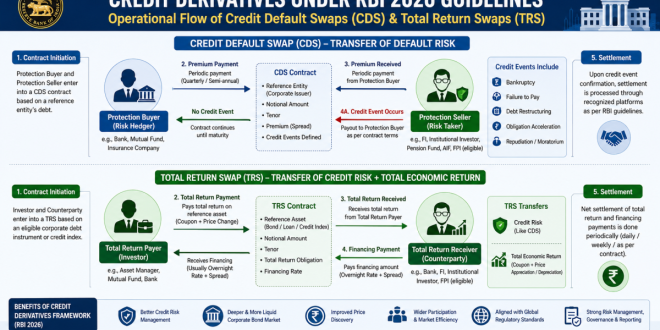
Imagine a commercial bank that has lent a massive sum to a manufacturing corporation. If the bank is worried about the company’s financial health but wants to maintain the relationship, it can buy a credit derivative from a protection seller (like an insurance company). If the borrower defaults, the protection seller steps in to compensate the bank. This mechanism ensures that credit risk is distributed smoothly across the financial system rather than piling up on a single lender’s balance sheet.
The New Financial Weapons: TRS and Credit Indices
The 2026 RBI framework goes far beyond basic risk management by introducing sophisticated instruments that completely change how traders interact with corporate debt.
1. Total Return Swaps (TRS)
While a traditional Credit Default Swap (CDS) only transfers default risk, a Total Return Swap (TRS) transfers the entire economic experience of a corporate bond.
-
The protection buyer transfers both the credit risk and the total economic return (including interest coupon payments and any price changes).
-
This allows investors to gain synthetic exposure to India’s corporate bonds—meaning they can profit from a bond’s performance without actually buying or holding the asset.
2. Credit Index Derivatives
Instead of being tied to a single corporate entity, these derivatives are linked to an entire basket or index of corporate bonds. This allows large funds to:
-
Hedge entire portfolios against broad economic downturns in one transaction.
-
Diversify credit risk instantly.
-
Trade broad macroeconomic trends in the credit market.
Who Can Participate Under the 2026 Rules?
The RBI has significantly widened the gates for market participation to ensure healthy trading volumes:
-
Resident Indian Non-Retail Participants: Can trade eligible credit derivatives freely without having to prove a specific hedging purpose.
-
Non-Resident Participants: Permitted to enter the market primarily for hedging purposes.
-
Institutional Protection Sellers: Certain highly regulated entities—including Mutual Funds, Insurance Companies, Pension Funds, Alternative Investment Funds (AIFs), and Foreign Portfolio Investors (FPIs)—can now act as protection sellers, unlocking massive pools of capital.
The Broader Impact on the Indian Economy
[Deeper Credit Derivatives Market]
       │
       ├─► Greater Liquidity (More buying/selling of corporate debt)
       ├─► Lower Borrowing Costs (Companies can raise capital cheaper)
       └─► Better Price Discovery (Accurate market-driven risk pricing)
Historically, India’s corporate bond market has lagged behind developed economies because investors lacked flexible risk-management tools. By allowing institutions to trade risk efficiently, corporate bonds become much more attractive. Over time, this will drive down borrowing costs for Indian companies, making it easier for them to fund infrastructure and expansion.
Frequently Asked Questions (FAQs)
1. When did the new RBI Credit Derivatives framework take effect?
The Master Direction became legally effective on June 25, 2026, completely replacing the previous regulatory framework established in 2022.
2. How does a Total Return Swap (TRS) differ from a Credit Default Swap (CDS)?
A CDS only pays out if a specific negative credit event (like a default) occurs. A TRS, however, transfers the entire financial performance of the underlying bond, including coupon payments, price appreciation, or price depreciation, regardless of whether a default happens.
3. Can retail investors trade these credit derivatives?
No. The RBI framework explicitly limits direct participation to non-retail institutional and corporate entities due to the highly complex and risky nature of these instruments. However, retail investors will benefit indirectly through safer, more liquid mutual funds and pension portfolios.
Disclaimer & External Links
-
Disclaimer: This article is for informational and educational purposes only and does not constitute formal financial or legal advice. Financial market trading involves substantial risk. For precise compliance and regulatory text, readers should consult official notifications from the Reserve Bank of India.
-
Reference Links: To explore broader localized news and ground-level coverage on regulatory shifts in India, please visit Matribhumi Samachar.