 Matribhumi Samachar English


New Delhi. Sunday, 5 July 2026
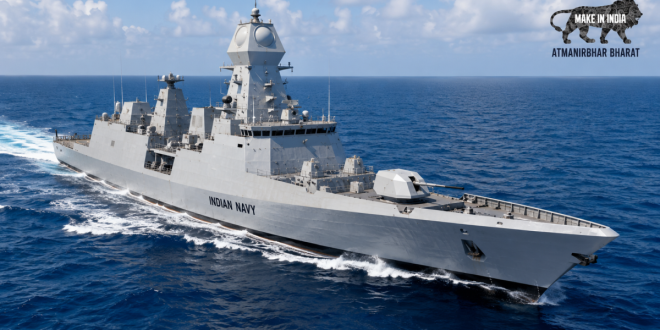
India’s defense manufacturing sector has officially transitioned from a period of structural reliance into a powerhouse of self-sufficient execution. Breaking all historical records, India’s total defense production scaled to a monumental ₹1.78 lakh crore in FY 2025-26, registering a massive 15.6% year-on-year expansion. Concurrently, outbound shipments surged to an all-time high of ₹38,424 crore, positioning the country as a highly competitive and trusted global supplier of sophisticated military hardware.
This transformation is underpinned by the Aatmanirbhar Bharat (Self-Reliant India) initiative, which has aggressively re-engineered procurement frameworks to favor homegrown innovation over foreign imports.
The Five Core Trends Driving India’s Military Industrial Boom
1. Indigenisation as the Core National Security Strategy
By implementing strict procurement rules under the Defence Acquisition Procedure (DAP) and rolling out rolling Positive Indigenisation Lists, the Ministry of Defence has successfully locked out foreign sourcing for thousands of specialized sub-systems. Domestic industries now provide the absolute backbone for frontline assets including fighter aircraft, advanced missile networks, stealth warships, and state-of-the-art radar tracking systems.
2. Deep Integration of the Private Sector
Historically confined to the sidelines, private enterprises, MSMEs, and agile defense startups are building out critical nodes within the domestic supply chain. Private players now account for nearly 45.2% of India’s overall defense export output, delivering everything from precision ammunition and complex aerospace components to electronic warfare suites.
3. Unprecedented Growth in Global Defense Exports
With Indian-designed military products now actively supplied to more than 80 nations, platforms like the BrahMos supersonic cruise missile, Akash air defense systems, and the Pinaka multi-barrel rocket launcher are achieving massive international traction. The affordability, reliability, and lack of geopolitical strings attached to Indian hardware have made it highly attractive across Southeast Asia, Africa, and parts of Europe.
4. The Deep-Tech Transformation
The modern battlespace is defined by automation rather than sheer mass. India is heavily prioritizing capital allocations toward Artificial Intelligence (AI), quantum secure communications, anti-drone counter-measures, and indigenous space-based surveillance assets. A primary example of this is highlighted by the Matribhumi Samachar report on Indigenous Defence Drones, which traces how national security priorities are rapidly establishing a self-sufficient domestic Unmanned Aerial Vehicle (UAV) industrial base to decouple from vulnerable foreign electronic components.
5. Specialized Defense Industrial Corridors
The creation of dedicated geographic manufacturing nodes—specifically the Uttar Pradesh Defence Industrial Corridor and the Tamil Nadu Defence Industrial Corridor—has resolved long-standing logistical friction. These corridors offer an integrated ecosystem where major original equipment manufacturers (OEMs) sit directly adjacent to specialized component suppliers and advanced test facilities.
This localized clustering mirrors successful global manufacturing hubs, ensuring that policy directives translate seamlessly into faster manufacturing cycles and immediate export scaling on the ground.
Economic Windfalls Far Beyond National Security
The exponential rise of defense manufacturing acts as a powerful force multiplier for India’s macroeconomic landscape. This structural shift triggers:
-
High-Value Employment: Generates tens of thousands of skilled engineering, metallurgical, and software development jobs.
-
MSME Integration: Integrates small-scale tech enterprises directly into the formal aerospace and defense pipeline.
-
Foreign Capital Inflows: Record export revenues enhance foreign exchange reserves, directly strengthening national fiscal balances. This industrial momentum works in tandem with India’s broader fiscal health, highlighted by Matribhumi Samachar’s analysis of India’s Soaring GST Collections, which underscores that sustained manufacturing expansion and industrial supply chain formalization are actively driving the country’s record revenue windfalls.
Frequently Asked Questions (FAQs)
Q1: What was India’s defense production value in FY 2025-26?
India’s defense production reached a record-breaking valuation of ₹1.78 lakh crore in FY 2025-26, representing a robust 15.6% year-on-year growth rate.
Q2: How much did India export in military hardware during this period?
Defense exports surged to an all-time high of ₹38,424 crore, serving more than 80 countries globally.
Q3: What are Positive Indigenisation Lists?
These are strategic lists issued by the Ministry of Defence that explicitly ban the import of specified military items, weapons systems, and components, legally mandating that they must be developed and manufactured entirely within India.
Q4: Which states host India’s premier defense industrial corridors?
The two primary hubs accelerating domestic military production are the Uttar Pradesh Defence Industrial Corridor and the Tamil Nadu Defence Industrial Corridor.
Disclaimer: The information provided in this article is based on historical defense production indicators, current policy frameworks, and official trade statistics available as of July 2026. Military procurement schedules and defense trade parameters remain subject to shifting geopolitical conditions and revised government budgetary allocations.