 Matribhumi Samachar English


New Delhi. Tuesday, 7 July 2026
As the global race for clean energy technologies, semiconductor manufacturing, and advanced defense systems intensifies, critical minerals have emerged as the most strategic resources of the 21st century.
For India, ensuring access to resources like lithium, cobalt, nickel, graphite, and rare earth elements is no longer just an economic objective—it has become a vital pillar of its national security and foreign policy. Through the Make in India initiative, New Delhi is actively working to transform the country into a global manufacturing hub. However, transitioning into a technological powerhouse requires an uninterrupted supply of these specialized raw materials.
To achieve this, India is looking outward, utilizing robust economic diplomacy to build resilient supply chains across the Indo-Pacific region while simultaneously scaling up domestic processing capabilities.
Why Critical Minerals Matter to India’s Green Transition
Critical minerals are natural resources that are essential for economic development and national security but face high supply disruption risks. Without them, the technology driving the modern world ground to a halt.
India’s long-term industrial goals depend heavily on five core sectors:
-
Electric Vehicle (EV) Expansion: India aims to electrify a massive portion of its transport network. Building high-performance EV batteries requires massive quantities of lithium, nickel, cobalt, and graphite.
-
Renewable Energy Infrastructure: Achieving aggressive solar and wind energy targets demands substantial amounts of copper and rare earth elements for turbines and power grids.
-
Semiconductor Manufacturing: Setting up domestic chip fabrication plants requires stable, specialized mineral inputs to feed advanced electronics supply chains.
-
National Security and Defense: Next-generation military hardware—including drones, communication satellites, guided missiles, and aerospace components—increasingly relies on rare earth elements.
The Indo-Pacific Connection: Diversifying Beyond Single Sources
One of India’s primary strategic vulnerabilities is overdependence on highly concentrated global supply chains. A single geopolitical disruption, trade embargo, or export restriction can stall entire manufacturing sectors.
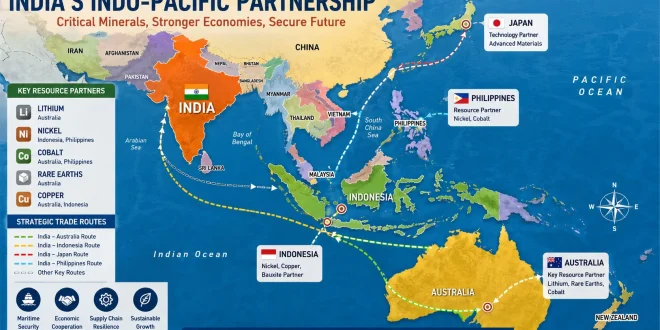
To mitigate this risk, India is strengthening bilateral ties with resource-rich nations across the Indo-Pacific to diversify its import portfolio:
1. Australia’s Strategic Mineral Reserves
Australia holds some of the world’s largest reserves of lithium, cobalt, and rare earth elements. India has expanded its cooperation with Canberra through dedicated investment frameworks, joint exploration initiatives, and technology-sharing agreements. This partnership ensures that Indian manufacturers have a direct pipeline to raw materials right from the source.
2. Indonesia’s Nickel Powerhouse
Indonesia is a global heavyweight in nickel production, a foundational element for lithium-ion energy storage. By deepening economic ties, India and Indonesia are exploring joint ventures in mineral processing, battery manufacturing ecosystems, and sustainable, responsible mining practices.
3. Broadening Regional Alliances
Beyond Australia and Indonesia, countries like Vietnam, the Philippines, and Malaysia play increasingly vital roles in global mineral processing. India’s economic diplomacy is actively tying resource security to broader maritime connectivity and trade agreements across Southeast Asia.
Overcoming Structural Bottlenecks at Home
While securing overseas mining rights is a massive step forward, India faces several structural challenges that must be addressed domestically:
-
Building Refining and Processing Capacity: Mining raw ore is only half the battle. True economic value is captured during the refining process. India is heavily investing in domestic processing plants so it can convert raw imports into manufacturing-ready materials internally.
-
Scaling Up Recycling Infrastructure: To minimize its import reliance, India is focusing heavily on a circular economy. Developing advanced recycling infrastructure allows the country to reclaim rare earths and cobalt directly from spent electronics and old batteries.
-
Balancing Environmental Sustainability: Critical mineral extraction is resource-intensive. India’s roadmap emphasizes balancing aggressive economic growth with responsible mining guidelines to minimize ecological damage.
Through a calculated mix of overseas joint ventures, domestic exploration, and aggressive recycling targets, India is systematically positioning itself as a reliable, secure tech anchor in a highly competitive global landscape.
Frequently Asked Questions (FAQ)
What are critical minerals and why are they important?
Critical minerals are elements like lithium, nickel, cobalt, and rare earths that are vital for high-tech manufacturing, defense, and green energy technologies. They are considered “critical” because they are difficult to substitute and carry a high risk of supply chain disruption.
Which countries are India’s main partners for critical minerals?
India is primarily collaborating with resource-rich Indo-Pacific nations, most notably Australia (for lithium and rare earths) and Indonesia (for nickel), alongside exploratory partnerships in South America and Southeast Asia.
How does the ‘Make in India’ initiative link to critical minerals?
The ‘Make in India’ initiative aims to boost domestic manufacturing in sectors like electric vehicles, electronics, and defense equipment. None of these industries can scale or remain competitive without a stable, secure supply of critical minerals.
Disclaimer
The information provided in this article is for informational and educational purposes only. While every effort has been made to ensure accuracy based on current geopolitical and industrial trends, readers should consult official government policies and market reports before making investment decisions related to critical minerals and manufacturing sectors.
External References
For the latest regional updates, breaking news on economic diplomacy, and bilateral trade developments between India and its neighboring countries, explore the English edition of Matribhumi Samachar.