 Matribhumi Samachar English


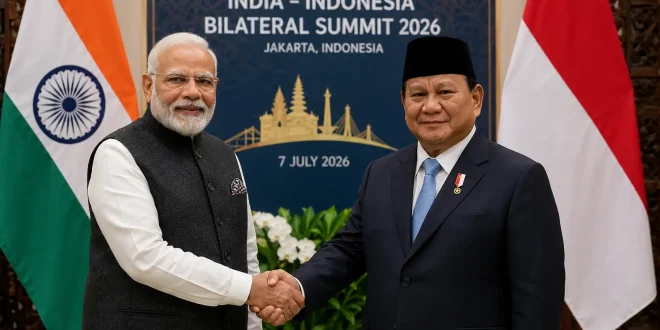
New Delhi. Updated on : Sunday, 16 August 2026
The geopolitical and economic landscape of the Indo-Pacific is undergoing a monumental shift. As global supply chains face unprecedented pressures, two of Asia’s largest democracies are stepping up to anchor regional stability. The 2026 India–Indonesia Summit has officially redefined bilateral ties, moving beyond standard diplomatic pleasantries into a deeply integrated roadmap for future technologies, secure resource management, and maritime defense.
With both nations rapidly scaling their domestic industries, this newly expanded strategic partnership positions India and Indonesia as the core architects of a self-reliant, resilient, and sustainable economic ecosystem in South and Southeast Asia. For deeper analysis on regional strategic frameworks, explore comprehensive coverage on Matribhumi Samachar International News.
Key Pillars of the 2026 Strategic Partnership
1. Driving Global Digital Transformation: The AI and Fintech Corridor
Artificial Intelligence and digital public infrastructure (DPI) emerged as the crown jewels of the summit discussions. India’s proven track record of creating massive, scalable platforms—such as unified payment interfaces—is blending seamlessly with Indonesia’s aggressive push toward cross-border governance and economic digitization.
The two nations have agreed to establish collaborative research frameworks targeting:
-
AI-Powered Public Services: Optimizing healthcare delivery networks and smart agricultural forecasting.
-
Smart Manufacturing & Automation: Upgrading factory floors across Jakarta and Mumbai using secure industrial AI networks.
-
Cross-Border Fintech Solutions: Simplifying retail and corporate trade through integrated digital payment mechanisms to streamline bilateral commerce.
2. Powering the Future: Securing the Critical Mineral Supply Chain
The global transition to clean energy, semiconductors, and electric vehicles (EVs) demands a stable supply of rare earth elements and critical minerals. Indonesia holds vast reserves of nickel—a core component in high-capacity lithium-ion batteries. Concurrently, India’s Make in India initiative drives an aggressive expansion into global semiconductor fabrication and advanced electronic manufacturing.
By aligning resource goals, both nations are co-developing sustainable mining, advanced mineral processing, and regional battery value chains. This alliance establishes a reliable alternative pipeline that heavily insulates both economies from concentrated global supply shocks.
3. Securing the Blue Economy: Enhanced Maritime Domain Awareness
The Indian Ocean and the critical straits surrounding the Indonesian archipelago serve as vital arteries for global maritime trade. Ensuring freedom of navigation and robust safety protocols remains a top-tier security imperative for both governments.
Building upon milestones established during joint regional initiatives—such as the Second India-Australia-Indonesia Trilateral Maritime Security Workshop—the 2026 summit cements deeper real-time information sharing, joint anti-piracy patrols, and rapid humanitarian disaster response systems.
4. Expanding Trade and Talent Mobility
The bilateral economic agenda outlines direct avenues for corporate investment spanning sectors like pharmaceuticals, renewable infrastructure, and logistics.
To sustain this high-tech industrial leap, academic and research bodies are stepping up collaboration. Enhanced student exchanges, joint engineering research programs, and shared talent mobility frameworks are being institutionalized to train the workforce driving the Indo-Pacific’s upcoming automated and green economies. Read more on educational initiatives at Matribhumi Samachar English Main Hub.
Frequently Asked Questions (FAQs)
What are the main outcomes of the 2026 India–Indonesia Summit?
The summit resulted in breakthrough bilateral frameworks centered on Artificial Intelligence development, critical mineral processing (specifically nickel for EV batteries), maritime domain awareness, and cross-border digital payment integrations.
How does this partnership impact global semiconductor and EV supply chains?
By pairing Indonesia’s raw mineral wealth with India’s rapidly growing semiconductor manufacturing ecosystem, the partnership creates an independent supply chain loop that lowers reliance on single-country manufacturing hubs.
Why is maritime security a major pillar of this summit?
The sea lanes connecting the Indian Ocean to the South China Sea carry a massive share of global commerce. Shared surveillance and joint security frameworks ensure trade routes stay open and protected against regional instability.
Disclaimer: This article is compiled based on strategic data, official summit announcements, and bilateral frameworks available as of July 2026. Readers seeking specific investment regulations or institutional details are advised to consult official governmental trade portals.