 Matribhumi Samachar English


Mumbai. Tuesday, 7 July 2026
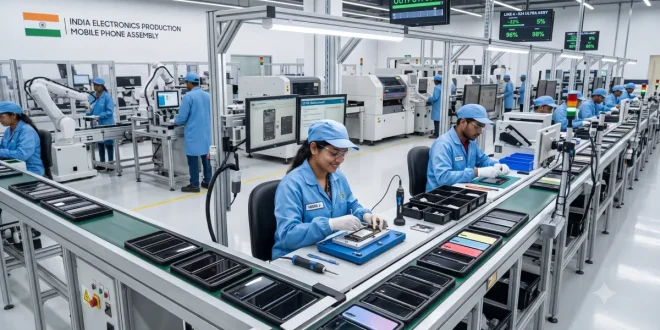
India has officially secured its position as the world’s second-largest mobile phone manufacturer, marking a historic turning point in its industrial journey. Over the past decade, a massive structural shift has transformed the nation from being heavily dependent on imported smartphones to becoming a primary production hub for global tech giants.
This dramatic rise reflects the success of targeted government initiatives, expanding domestic production capacity, and a massive influx of foreign direct investment (FDI). As global corporations look to diversify their supply chains away from a single-nation reliance, India is successfully positioning itself as the premier alternative manufacturing destination.
The Transformation: From Importer to Global Hub
A decade ago, the vast majority of mobile phones sold within India were imported as completely built units (CBUs). Today, that dynamic has completely flipped. Over 98% of the mobile devices purchased by Indian consumers are assembled or manufactured domestically.
This production capability has expanded far beyond serving the domestic market. Mobile phones have rapidly emerged as one of India’s fastest-growing export categories, shipping millions of locally assembled premium devices to competitive markets across Europe, the Middle East, Africa, and North America. In terms of sheer volume, India now trails only China on the global stage.
What Drove India’s Mobile Manufacturing Revolution?
A combination of aggressive local policy and shifts in global economics catalyzed this manufacturing boom:
-
The Production-Linked Incentive (PLI) Scheme: This flagship policy has been a game-changer. By offering performance-based financial incentives to global electronics manufacturers based on their incremental sales, the government successfully brought contract manufacturing giants like Foxconn, Pegatron, and Wistron to Indian shores.
-
The “Make in India” Initiative: This broad campaign focuses on improving the ease of doing business, cutting bureaucratic red tape, simplifying regulatory compliance, and heavily investing in industrial infrastructure.
-
An Explosive Domestic Market: India’s massive, tech-savvy population offers a reliable fallback for manufacturers. The guaranteed local demand lowers investment risks for foreign corporations establishing large-scale facilities.
-
Global Supply Chain Diversification: Geopolitical shifts have forced global hardware brands to look for a reliable “Plus One” strategy. India’s strategic location, regulatory stability, and abundant labor pool made it the natural fit.
Economic Ripple Effects: Beyond the Assembly Line
The impact of this milestone stretches far across the Indian economic landscape, offering significant benefits to the country’s macroeconomic health.
1. Surging Electronics Exports
The electronics sector is no longer just serving local needs; it has become a central pillar of India’s trade strategy. Increased production has led to a massive influx of foreign exchange earnings, significantly bolstering India’s trade balance and integrating local factories tightly into global supply chains.
2. Mass Employment Generation
The scale of modern mobile manufacturing plants has created millions of jobs across both direct and indirect lines of work:
-
Direct Roles: Factory production, precision electronics assembly, quality control testing, and technical engineering services.
-
Indirect Roles: Supply chain management, component packaging, industrial warehousing, logistics, and specialized infrastructure development.
3. Strengthening the Local Ecosystem
As assembly volumes scale, it triggers a secondary industrial wave: the localization of component manufacturing. Sub-assembly units, chargers, cables, and casing structures are increasingly sourced locally, reducing the overall cost of production over time.
Looking Ahead: The Challenges on the Horizon
While achieving the number two spot globally is a major victory, critical structural bottlenecks must be solved if India is to sustain long-term growth and challenge the top spot:
The Component Deficit: Despite assembling millions of phones, India still relies heavily on foreign imports for raw electronic components, sub-assemblies, and high-value internal parts.
-
Semiconductor Bottlenecks: The most expensive parts of a modern smartphone—the chipsets and memory modules—are not yet fabricated locally. Accelerating semiconductor fabrication and packaging units remains a top national priority.
-
Logistics Friction: Higher domestic logistics and transportation costs compared to regional competitors still bite into the profit margins of exporting companies.
-
The Skill Gap: As manufacturing moves from basic assembly to advanced, automated engineering and design, there is an urgent demand for rapid upskilling across the industrial workforce.
Future Horizons: Expanding the Electronic Footprint
Industry trajectories indicate that mobile phones are just the gateway. The infrastructure and supply chains built for smartphones are now being duplicated to scale up production in adjacent electronics sectors, including:
-
Semiconductor Assembly and Testing (OSAT)
-
Laptops, Tablets, and Personal Computers
-
Wearable Fitness Devices and Smart Audio
-
AI-Enabled Smart Devices and IoT Systems
-
Advanced Telecommunications and 5G/6G Equipment
Frequently Asked Questions (FAQs)
Q1: Which country remains the largest mobile phone manufacturer globally?
China continues to hold the position as the world’s largest manufacturer of mobile phones by volume.
Q2: How did the PLI Scheme help India’s mobile manufacturing sector?
The Production-Linked Incentive (PLI) scheme provided financial percentages on incremental sales to manufacturers, enticing global contract electronic giants to shift their large-scale production facilities to India.
Q3: Is India exporting the smartphones it builds?
Yes. India has transitioned from an import-dependent nation to a major exporter, regularly shipping premium and mid-range devices to Europe, North America, and the Middle East.
Q4: What is the biggest hurdle remaining for India’s tech manufacturing?
The primary challenge is the deep reliance on imported high-value components, particularly semiconductor chips, which are currently fabricated outside of the country.
Relevant References
To learn more about how India is scaling its tech dominance and rewriting its industrial narrative, explore these in-depth editorial coverages from Matribhumi Samachar:
-
Read about regional developments in high-tech industrial scaling: Silicon, Sovereignty, and Scale: How Uttar Pradesh is Rewriting Its High-Tech Manufacturing Story.
-
Explore India’s broader digital and technology ecosystem achievements: Mumbai to Set a New World Record for the World’s Largest Gen AI Hackathon.
Disclaimer: The insights, industrial statistics, and policy highlights detailed in this article are structured for informational and educational purposes based on prevailing market data and economic reports. Readers should consult specific trade ministries for active statutory data.