 Matribhumi Samachar English


New Delhi. Thursday, 9 July 2026
The global energy landscape is moving fast, and traditional fossil fuels are sharing the stage with a new class of powerful resources. India and Australia have stepped into an exciting new phase of their Comprehensive Strategic Partnership. At the absolute heart of this evolution are two critical pillars: strategic critical minerals and civilian uranium cooperation.
As both nations race toward a low-carbon future, their economic and security goals have become deeply intertwined. Australia holds some of the world’s largest natural mineral reserves, while India possesses massive industrial capacity and soaring clean energy ambitions. It is a natural fit, creating a resilient Indo-Pacific supply network.
Why Critical Minerals Form the Backbone of Next-Gen Tech
We cannot build tomorrow’s technology with yesterday’s resource frameworks. High-tech infrastructure, green energy systems, and military hardware rely completely on a specific group of minerals. These strategic assets include lithium, cobalt, nickel, graphite, copper, and rare earth elements.
These resources are vital for several core sectors:
-
Electric Mobility: High-capacity lithium-ion batteries require vast, steady flows of lithium, cobalt, and nickel.
-
Renewable Power Grid: Solar panels, wind turbine magnets, and advanced utility-scale storage batteries rely heavily on rare earth elements.
-
Digital Infrastructure: Semiconductors, telecommunications arrays, and advanced artificial intelligence (AI) data centers require precision refining of critical components.
India’s rapid industrialization means its domestic manufacturing goals are expanding fast. However, relying on concentrated foreign supply chains exposes the country to volatile market shocks and geopolitical stress. Partnering with a reliable exporter like Australia changes the math entirely.
Australia’s Mining Edge and India’s Growing Demand
India has rolled out aggressive manufacturing policies to achieve a target of net-zero carbon emissions by 2070. Programs like Make in India, the National Critical Minerals Mission, and robust Production Linked Incentive (PLI) schemes are driving this push. These programs depend heavily on securing raw material lines.
Australia is a powerhouse provider because it offers more than just raw resources in the ground. The nation provides a highly dependable environment characterized by:
-
Democratic governance and a transparent regulatory landscape.
-
Cutting-edge extraction and advanced refining technology.
-
Strong environmental, social, and governance (ESG) compliance framework.
-
Robust, highly reliable deepwater export infrastructure.
This resource depth allows Indian companies to safely invest directly in Australian mining assets, moving past simple transaction trading toward secure equity partnerships.
Uranium and the Baseload Power Challenge
Renewables like wind and solar are fantastic, but they require a steady baseline of electricity when the sun goes down or the wind stops. Nuclear energy provides that consistent, low-emission baseload power.
While India continues to build out its domestic civil nuclear program, local uranium reserves cannot sustainably support its long-term goals. Australia holds some of the world’s most extensive uranium deposits. Following their landmark Civil Nuclear Cooperation Agreement, bilateral uranium trade has become a fundamental element of their shared geopolitical vision.
Shifting From Simple Trade to Full Supply Chain Integration
What makes this new phase unique is that it avoids the traditional “dig and ship” model. Instead, both countries are actively co-developing comprehensive processing and manufacturing ecosystems.
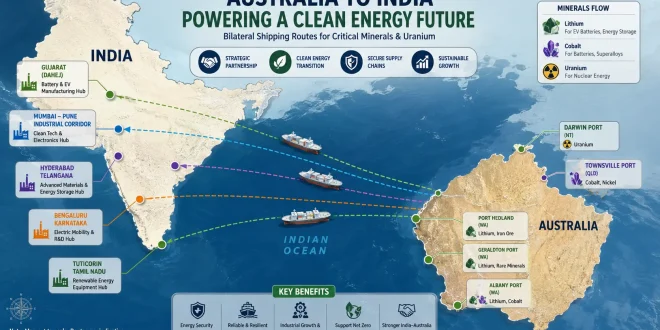
[Australian Extraction] ➔ [Joint Processing & Refining] ➔ [Indian Advanced Manufacturing] ➔ [Global Resilient Supply Chains]
This integration spans advanced refining technologies, domestic battery manufacturing, and joint circular-economy recycling initiatives. By building the entire value chain together, both nations are strengthening the economic stability of the broader region.
This deep cooperation directly supports the regional goals outlined during the high-level diplomatic visits and strategic discussions featured on Matribhumi Samachar International Hub, where leaders continue to map out a secure, collaborative future for the Indo-Pacific.
Navigating the Roadblocks Ahead
Despite the strong alignment, executing this grand strategy involves navigating real industry hurdles:
-
High Upfront Costs: Refining critical minerals requires heavy capital expenditure and sophisticated technical infrastructure.
-
Price Volatility: Global mineral markets face rapid price swings that can impact project financing timelines.
-
Regulatory Timing: Aligning cross-border environmental clearances and multi-tier mining laws takes careful political navigation.
Overcoming these challenges requires continuous government-to-government communication and private-sector joint ventures to share risk.
Alternative Text for Visual Layouts
-
Infographic Suggestion (Alt Text):
Frequently Asked Questions (FAQ)
Q1: Which major critical minerals does India primarily look to source from Australia?
A: India focuses heavily on securing a steady supply of lithium, cobalt, nickel, graphite, and rare earth elements to feed its booming domestic electric vehicle (EV) battery and electronics manufacturing industries.
Q2: How does uranium fit into India’s climate action and clean energy plans?
A: Nuclear power offers carbon-free baseload electricity that works around the clock. Australian uranium ensures that India’s civil reactors have a diversified, stable fuel supply, reducing dependency on fossil fuels.
Q3: What role does the private sector play in this bilateral mineral partnership?
A: While governments set the regulatory and diplomatic frameworks, commercial implementation relies on private and state-backed Indian firms investing directly in Australian mining operations and establishing joint mineral-processing ventures.
Disclaimer: This article is prepared for general informational and educational purposes only. It tracks broad geopolitical, economic, and industrial trends based on available bilateral frameworks, and does not constitute formal investment, legal, or commercial supply-chain advice.