 Matribhumi Samachar English


New Delhi. Thursday, 9 July 2026
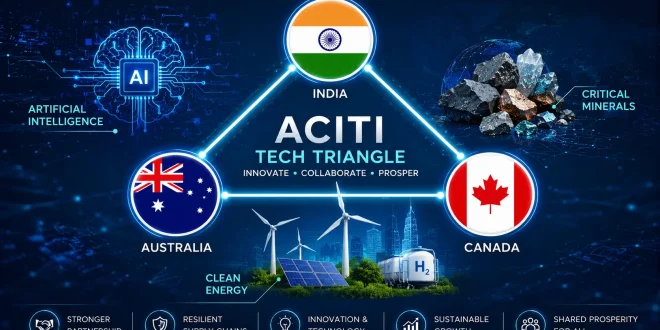
A major shift is taking place in global technology alignment. India, Australia, and Canada have formalized a strategic trilateral framework known as the Australia–Canada–India Technology and Innovation (ACITI) Partnership.
First conceptualized during the G20 Leaders’ Summit in Johannesburg, the alliance has transitioned from high-level strategic alignment into operational reality following the official Memorandum of Understanding (MoU) signing. This tech triangle unites three unique economic powerhouses to build secure supply chains, advance artificial intelligence, and accelerate the transition to clean energy.
What is the ACITI Partnership?
The ACITI Partnership is a trilateral agreement focused heavily on innovation, collaborative research, and long-term economic security. Rather than operating as a standard trade agreement aimed purely at cutting tariffs, ACITI focuses on weaving together the industries, universities, startups, and policy frameworks of India, Australia, and Canada.
The primary goal is to address deep-seated bottlenecks in global supply lines, fast-track the commercialization of emerging tech, and lower production costs across critical industrial sectors.
5 Pillars of Trilateral Cooperation
The ACITI framework operates across five interconnected, high-growth technology vectors:
1. Responsible Artificial Intelligence
AI forms a foundational pillar of this agreement. Each country brings a localized advantage to the table: Canada contributes its robust academic AI research hubs; India offers massive data scale, public digital infrastructure, and a booming tech service ecosystem; and Australia provides commercialization frameworks. Collaboration focuses on deploying safe, ethical AI algorithms across fields like healthcare diagnostics, smart agricultural infrastructure, and national energy grid management.
2. Critical Minerals & Supply Chain Resilience
The transition to clean tech relies heavily on securing raw materials. This partnership addresses vulnerabilities caused by highly concentrated global supply chains by focusing on the extraction, processing, and value-addition of key materials:
-
Lithium & Cobalt (for electric vehicle batteries)
-
Nickel & Graphite (for battery anodes and energy storage)
-
Rare Earth Elements (for wind turbines and advanced electronics)
-
Uranium (supported by a parallel India-Australia civil nuclear agreement ensuring long-term fuel corridors)
3. Green Energy Technologies
To hit aggressive global net-zero targets—including India’s goal of reaching 500 Gigawatts (GW) of renewable energy capacity by 2030—the three nations are combining efforts. Joint priorities focus heavily on green hydrogen scaling, domestic battery cell manufacturing, and large-scale carbon reduction initiatives.
4. Advanced Manufacturing & Semiconductors
The trilateral alliance establishes a collaborative bridge between key national manufacturing frameworks, notably linking India’s “Make in India” initiative with Australia’s “Future Made in Australia” program. The partnership aims to build decentralized semiconductor fabrication pipelines and resilient electronics production hubs.
5. Cybersecurity and Digital Resilience
With the development of sovereign compute clusters and advanced digital public infrastructure comes increased cyber risk. ACITI focuses on building trusted technology standards, cross-border cybersecurity protocols, and highly resilient digital networks capable of resisting systemic disruptions.
Complementary Strengths: Who Brings What?
The strategic significance of the ACITI Partnership lies in how naturally the strengths of the three nations interlock:
-
India: Offers an unmatched consumer market, a massive talent pool of developers, rapid manufacturing scaling capabilities, and robust digital public infrastructure.
-
Australia: Acts as a resource superpower with massive global reserves of lithium and critical minerals, paired with a sophisticated mining equipment, technology, and services (METS) sector.
-
Canada: Brings top-tier institutional innovation capacity, world-renowned AI research safety frameworks, and a highly competitive clean-technology startup ecosystem.
Frequently Asked Questions (FAQs)
What does ACITI stand for?
ACITI stands for the Australia–Canada–India Technology and Innovation Partnership.
When was the ACITI Partnership officially launched?
The trilateral partnership framework was originally announced at the G20 Leaders’ Summit in Johannesburg, South Africa, and progressed into signed Memorandum of Understanding (MoU) implementations following ministerial and leadership summits.
Why are critical minerals a core focus of the ACITI Partnership?
Critical minerals like lithium, cobalt, and rare earth elements are required to build next-generation tech like electric vehicle (EV) batteries, semiconductors, and clean energy grids. Because global supply chains for these minerals are highly centralized, the ACITI alliance helps diversify sourcing and refining pipelines among trusted democratic nations.
How does the ACITI framework benefit technology startups?
The partnership sets up dedicated trilateral innovation funds, cross-border technology incubators, and university-led research programs. This helps startups in India, Canada, and Australia access new capital, share talent, and scale their clean-tech or AI products globally.
Disclaimer
This article is provided for informational and educational purposes only. The information regarding the Australia–Canada–India Technology and Innovation (ACITI) Partnership is accurate based on current official government declarations, bilateral agreements, and public statements. Strategic outcomes, corporate investments, and implementation timelines are subject to changing geopolitical conditions and policy modifications by the respective nations.
Related Links from Matribhumi Samachar:
-
To understand how emerging digital systems are transforming regional industry, read about The AI Renaissance in India’s Tech Services Sector.
-
Explore how localized innovation is scaling across the landscape in Sovereign AI and India’s Next-Generation Digital Infrastructure.