 Matribhumi Samachar English


Mumbai. Friday, 10 July 2026
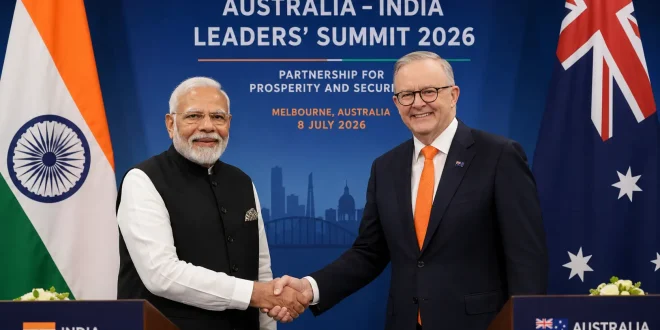
If you’ve been keeping an eye on the news lately, you’ve probably noticed that the relationship between India and Australia is stronger than ever. Following Prime Minister Narendra Modi’s highly successful visit to Melbourne in July 2026, the buzz around the Comprehensive Economic Cooperation Agreement (CECA) has reached a fever pitch.
But what exactly does this mean for the everyday business owner, the tech enthusiast, or the consumer?
Building on the massive success of the 2022 Economic Cooperation and Trade Agreement (ECTA)—which already pushed bilateral trade past the $33 billion mark—the upcoming India Australia CECA 2026 isn’t just about cutting tariffs. It’s a massive, future-ready blueprint covering everything from clean energy and critical minerals to artificial intelligence and defence. Let’s break down why this landmark trade pact is a game changer.
Beyond Tariffs: The Critical Minerals & Green Energy Boom
One of the biggest takeaways from the July 2026 summit is the heavy focus on securing supply chains for the future. As India aggressively scales up its “Make in India” initiative and the National Semiconductor Mission, access to high-value raw materials is non-negotiable.
Through CECA, India gains streamlined access to Australia’s abundant reserves of:
-
Lithium, Cobalt, and Nickel: The holy trinity for manufacturing electric vehicle (EV) batteries.
-
Rare Earth Minerals: Essential for electronics, solar equipment, and semiconductors.
The July 2026 Nuclear Milestone: In a historic move during the Melbourne summit, the two nations finalized a landmark nuclear cooperation arrangement enabling the export of Australian uranium to India under IAEA safeguards. This is a massive leap forward for India’s clean energy objectives and civilian nuclear power expansion.
Powering Up Manufacturing and MSMEs
For India’s vibrant Small and Medium Enterprises (MSMEs), CECA is essentially rolling out the red carpet to premium Australian markets.
Here is how Indian businesses stand to win:
-
Lower Production Costs: Reduced tariffs on industrial inputs (like base metals and copper) will slash manufacturing overheads for sectors like automotive, engineering goods, and chemicals.
-
Easier Export Procedures: Simplified customs and harmonized regulatory standards mean Indian pharmaceutical companies, textile manufacturers, and food processors can seamlessly expand their footprint in Australia.
-
Digital Trade & Innovation: The newly launched Australia-India Partnership on Cyber, Critical Technologies and Supply Chains (AI-PACTS) ensures that tech startups and digital service providers can collaborate securely across borders.
Stay Updated: If you run a business aiming to scale globally, staying compliant with domestic economic shifts is just as important as international trade. Check out the latest financial rules in India affecting your wallet to ensure your accounting stays on track!
Strengthening Defence and Maritime Security
Economic growth requires a secure geopolitical environment, especially in the Indo-Pacific. The July 2026 talks elevated the strategic partnership by introducing an advanced Joint Declaration on Defence and Security Cooperation.
Both countries are now moving toward co-developing military hardware, expanding aircraft deployments, and building a robust Defence Innovation Corridor. This beautifully complements the rapid expansion of India’s indigenous defence manufacturing and drone ecosystems.
Furthermore, the new Maritime Security Collaboration Roadmap builds heavily on previous joint efforts, such as the India-Australia-Indonesia Trilateral Maritime Security Workshop, ensuring freedom of navigation and shared security in the Indian Ocean.
Are There Any Roadblocks Left?
While the excitement is palpable, a few sensitive areas remain on the negotiating table. India is carefully balancing the opening of its markets with the need to protect its local agriculture and dairy farmers from large-scale Australian commercial farming imports. Both governments are working closely to finalize strict “Rules of Origin” and phased tariff reductions to ensure the final CECA is balanced, fair, and a win-win for everyone.
Frequently Asked Questions (FAQ)
Q1: What is the difference between ECTA and CECA?
A: ECTA (enforced in December 2022) was an “early harvest” or interim agreement that primarily focused on immediate tariff reductions on major goods. CECA is the comprehensive, final treaty that dives much deeper into digital trade, investments, services mobility, government procurement, and critical mineral supply chains.
Q2: How does the India Australia CECA help the Electric Vehicle (EV) industry?
A: Australia is one of the world’s largest suppliers of lithium, cobalt, and nickel. CECA guarantees reliable, cost-effective access to these critical minerals, allowing Indian manufacturers to produce EV batteries domestically at a lower cost, supercharging the “Make in India” EV revolution.
Q3: Will the 2026 CECA agreement allow Indians to work more easily in Australia?
A: Yes, enhanced services mobility is a core pillar of the ongoing negotiations. The agreement aims to make cross-border movement smoother for IT professionals, STEM experts, and students, integrating the talent pools of both nations.
Q4: What was the major outcome of the July 2026 PM Modi visit to Australia?
A: Alongside fast-tracking CECA, the July 2026 Melbourne Summit resulted in a historic uranium supply agreement for India’s clean energy sector, the launch of the AI-PACTS technology framework, and a new Maritime Security Collaboration Roadmap.
Disclaimer: This article is for informational purposes only and is based on the latest geopolitical developments and trade negotiations as of July 2026. Trade policies and international agreements are subject to change based on ongoing bilateral discussions. Readers and business owners are advised to consult official government portals and trade experts before making international investment or export decisions.