 Matribhumi Samachar English


Mumbai. Sunday, 12 July 2026
Have you ever wondered what happens when you mix massive industrial machinery with cutting-edge digital brains? The result is smart manufacturing—a complete paradigm shift where factories stop being mechanical assembly lines and become self-thinking, hyper-efficient ecosystems.
Driven by the Industrial Internet of Things (IIoT), advanced robotics, and cloud computing, Artificial Intelligence (AI) has evolved from a tech-bro buzzword into the foundational infrastructure of modern manufacturing. As industries smoothly transition from Industry 4.0 into the collaborative era of Industry 5.0, AI is permanently changing how things are made. Let’s dive into how this digital revolution actually works, the massive benefits it brings, and the real-world challenges companies face when making the leap.
What Exactly is Smart Manufacturing?
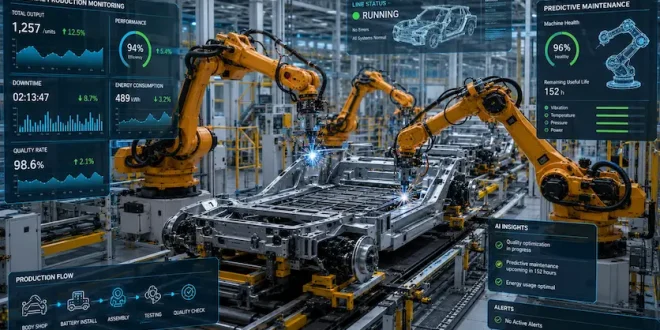
At its core, smart manufacturing means using connected technologies to monitor, analyze, and optimize production lines in real time. Instead of relying entirely on fixed human schedules or waiting for something to break, smart factories continuously ingest operational data. AI algorithms then process this data to make split-second, data-driven decisions with minimal human intervention.
The AI Production Workflow
How does an AI model actually run a assembly line? The process is a continuous loop broken into six clear, practical phases:
-
Data Collection: Thousands of internet-connected sensors harvest metrics like machine temperature, vibration frequency, and processing speed.
-
Real-Time Processing: Edge devices or cloud networks stream this data without lag.
-
AI Model Analysis: Machine learning algorithms check current numbers against years of historical baselines.
-
Predictive Insights: The software spots minute anomalies that human operators could never see.
-
Automated Actions: The system automatically schedules repairs, changes machine speeds, or sends a notification.
-
Continuous Learning: Every mistake or success trains the model to be more accurate next time.
However, relying entirely on identical digital systems across an industry has raised concerns among tech and financial watchdogs. When an entire industrial ecosystem relies on the same cloud infrastructures, it can create unexpected vulnerabilities. To understand this deeper side, read about why global regulators are shifting focus to systemic AI risks.
Heavy Hitter Applications of AI on the Factory Floor
AI isn’t just performing one single task; it’s restructuring every corner of the warehouse floor. Here are the major areas where it’s making the biggest impact:
1. Industrial Internet of Things Predictive Maintenance
Traditional factories fix machines after they break, losing millions in unplanned downtime. AI tracks subtle changes in sound, pressure, or thermal output to predict exactly when a component will fail. This simple shift keeps production reliable and extends the operational life of heavy equipment.
2. Automated Quality Inspection
Manual human inspection is slow and prone to fatigue. AI-powered computer vision uses high-resolution cameras and deep learning models to screen items flying down a conveyor belt. It catches microscopic scratches, incorrect wiring, or packing faults instantly. This technology has become essential across several high-stakes fields:
-
Automotive assembly
-
Semiconductor manufacturing
-
Pharmaceutical packaging
-
Food processing lines
3. Collaborative Robotics and Automation
Modern factory robots are no longer bolted inside safety cages doing a single repetitive motion. Today’s AI-powered collaborative robots, or cobots, work safely alongside humans, learning new tasks via visual demonstration and assisting with everything from precision welding to heavy material handling.
In the defense space, these autonomous software frameworks are accelerating localized tech hardware. You can see a great example of this trend in how the country is engineering its new era of indigenous defense drones using specialized robotics and autonomous navigation algorithms.
4. Dynamic Supply Chain and Energy Management
AI models look at raw material supply chains and customer demands simultaneously to dynamically adjust factory output. This keeps inventory costs low while ensuring products are available on time. On top of that, smart software tracks electrical loads to cut power waste without slowing down production speed.
Industry Deep-Dives: Semiconductors, Cars, and Electronics
While AI is versatile, three highly advanced manufacturing sectors have embraced it more than anyone else:
-
Semiconductor Fabrication: Creating microchips leaves zero margin for error. AI assists in wafer defect detection, lithography optimization, and yield predictions to ensure silicon wafers are flawless. This requires massive material precision, leading to major policy pushes like the government’s extended application deadline for the Rare Earth Permanent Magnet Manufacturing Scheme, which powers clean-room automation motors.
-
Automotive & Electric Vehicles (EVs): Car plants rely on AI to balance robotic assembly lines, inspect paint quality, and schedule supply chains to match dynamic electric vehicle demand.
-
Electronics Manufacturing: Factories use AI for Surface Mount Technology (SMT) optimization and Automated Optical Inspection (AOI) to verify that every minute capacitor and chiplet is placed perfectly onto Printed Circuit Boards (PCBs).
The Hurdles: Why AI Adoption Isn’t Always Easy
Despite the undeniable benefits of artificial intelligence in factories, migrating to a smart manufacturing setup comes with real-world growing pains:
-
High Initial Cost: Upgrading hardware and buying complex enterprise software requires hefty upfront capital.
-
Legacy Equipment Integration: Getting a 25-year-old hydraulic press to talk to a cutting-edge cloud platform can be a massive engineering headache.
-
Workforce Skill Gaps: Factory teams must pivot from mechanical maintenance to understanding data-driven dashboards and software-guided tasks.
-
Cybersecurity Threats: Connecting a factory directly to the internet exposes internal operations to hackers, malware, and network manipulation.
The Road Ahead
Tomorrow’s factories will be almost completely autonomous. Through the combination of 5G, edge computing, and Digital Twins (virtual replicas of the real factory line), systems will fix their own errors and reconfigure themselves instantly to build custom products on demand. Generative AI will also play a massive role by writing automated technical manuals and helping industrial engineers design parts faster than ever.
Frequently Asked Questions (FAQs)
Q1: What is the difference between standard automation and AI smart manufacturing?
Traditional automation runs on rigid, pre-set rules (e.g., a robotic arm moving left to right every three seconds). AI smart manufacturing adapts on its own using real-time data inputs—meaning the system can alter its own behaviors if a part arrives slightly misaligned or if machine temperatures spike.
Q2: Does implementing AI mean humans won’t work in factories anymore?
No. AI is designed to handle repetitive, dangerous tasks and process massive amounts of raw data. This shifts the human role toward creative troubleshooting, process oversight, engineering, and working hand-in-hand with collaborative cobots.
Q3: How does computer vision detect product defects?
Computer vision systems use ultra-high-resolution industrial cameras linked to deep learning neural networks. The system is trained on thousands of examples of “perfect” products, allowing it to instantly spot a sub-millimeter scratch, crack, or missing component on a fast-moving production line.
Disclaimer: This article is prepared strictly for informational and educational purposes. The field of industrial artificial intelligence, enterprise software integration, and smart manufacturing compliance changes rapidly. Readers and business owners should conduct independent technical and financial due diligence before investing in industrial automation or AI systems.