 Matribhumi Samachar English


New Delhi. Sunday, 12 July 2026
Every single time you tap a digital banking application, stream a high-definition movie, purchase an item online, or prompt a generative Artificial Intelligence (AI) platform, you trigger a massive physical response. Miles away, inside heavily fortified, climate-controlled facilities, thousands of microprocessors spin up to process your request.
Modern data centres are no longer just storage vaults for digital documents. In 2026, they have evolved into the core industrial engines of global tech geography—often referred to as “AI factories.” This detailed guide explores the essential ecosystems that allow these facilities to run continuously without a single second of downtime.
What is Data Centre Infrastructure?
Data centre infrastructure refers to the entire physical and digital ecosystem that allows computing hardware to run efficiently, securely, and without interruption. It represents the intersection of heavy electrical engineering, advanced thermodynamics, high-speed networking, and cryptographic security.
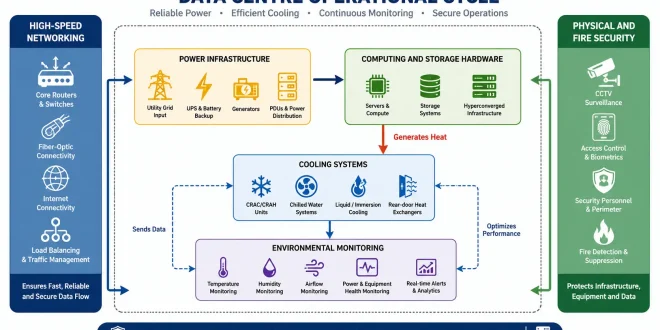
To maintain 24/7/365 availability, these components operate in a tight dependencies loop:
[Power Infrastructure] ➔ Drives ➔ [Computing & Storage Hardware]
                                              │
                                        Generates Heat
                                              │
[Environmental Monitoring] ➔ Regulates ➔ [Cooling Systems]
                                              │
              Linked globally via: [High-Speed Networking]
              Protected entirely by: [Physical & Fire Security]
9 Core Components of Data Centre Infrastructure
1. Servers (Computing Hardware)
Servers are the brain cells of the data centre. They are the specialized computers designed to run application code, manage complex databases, support virtualization layers, and host cloud workloads. In hyperscale facilities, tens of thousands of these servers sit stacked inside vertical steel racks, working in parallel.
2. Advanced Storage Systems
Data must be preserved at speeds that match modern processing times. While legacy architectures relied on mechanical hard disks, today’s data centres rely heavily on Solid State Drive (SSD) arrays. For modern machine learning frameworks, high-speed NVMe (Non-Volatile Memory Express) storage architectures are mandatory to give chips instantaneous access to massive training datasets.
3. High-Speed Networking Infrastructure
Networking equipment dictates how fast data moves between servers and travels out to the public internet. This ecosystem includes core switches, leaf switches, routers, hardware firewalls, load balancers, and fiber-optic interconnects. While a standard home network runs at a fraction of a gigabit, modern AI clusters are deploying ultra-high-speed networks running between 100 Gbps and 800 Gbps to prevent data transmission bottlenecks.
4. Power Infrastructure & Redundancy
Even a microsecond power flicker can corrupt databases and crash critical global services. Data centres insulate themselves from power grid instability using a robust, multi-tiered electrical pipeline:
-
Grid Transformers: Draw heavy industrial voltage down to safe operational levels.
-
Uninterruptible Power Supplies (UPS): Large battery banks that instantly bridge the electrical gap if utility power drops out.
-
Emergency Generators: Industrial diesel or gas generators capable of running the entire facility for days during a blackout.
-
Power Distribution Units (PDUs): Smart power strips that clean, regulate, and monitor electricity levels directly at the server rack level.
5. Advanced Cooling Systems
Electricity passing through a microchip generates immediate heat. Left unchecked, modern high-density hardware would self-destruct in minutes. While traditional facilities rely on Computer Room Air Conditioning (CRAC) and Chilled Water loops, the explosive rise of high-wattage Graphics Processing Units (GPUs) has pushed the industry toward liquid-based cooling strategies. Technologies like direct-to-chip cooling (running coolant pipes straight over the processors) and immersion cooling (submerging servers entirely in non-conductive dielectric fluid) are now common signatures of modern green data centre design.
6. Layered Physical Security
Data centers secure their physical space as tightly as their networks. Unauthorized entry is prevented using a sequence of security layers: outer perimeter fencing, biometric scanners (hand or iris patterns), smart-card checkpoints, high-definition CCTV monitoring, and mantraps (interlocking double-door entry chambers that isolate visitors before letting them move forward).
7. Specialized Fire Detection and Suppression
Standard water sprinklers would destroy millions of dollars of delicate electrical hardware. Instead, data centres use highly specialized fire safety configurations. These combine high-sensitivity smoke sensors with gas-based fire suppression systems. These systems flood sealed spaces with clean chemical agents that extinguish fires by removing heat and oxygen without leaving behind conductive or corrosive residues.
8. Continuous Environmental Monitoring Software
Thousands of sensory points track ambient operational metrics across the facility. Operators use automated dashboards to monitor real-time changes in temperature, relative humidity, airflow velocities, power load qualities, and individual rack capacity usage. This constant flow of data lets management spot minor hardware anomalies before they turn into full system failures.
9. Backup and Disaster Recovery Systems
True operational resilience requires data to exist in more than one place. Data centre infrastructure integrates automated digital replication processes that constantly mirror live applications across geographically separated backup facilities. If an unexpected natural disaster strikes one data centre campus, secondary platforms instantly pick up the load.
Mapping the Data Centre Landscape: 4 Common Models
Data centers vary widely in scale, operational models, and geographical proximity to users:
| Data Centre Type | Primary Target Workload | Unique Infrastructure Profile |
| Enterprise | Internal corporate computing and data management. | Custom-built, owned, and operated exclusively by a single business entity. |
| Colocation | Multi-tenant commercial hosting. | The facility provider supplies the power, cooling, and security; independent clients rent space to install their own server racks. |
| Hyperscale | Global public cloud platforms and massive AI services. | Massive campuses drawing hundreds of megawatts of electricity, managing hundreds of thousands of individual servers through automated software. |
| Edge Computing | Ultra-low latency edge applications (5G networks, autonomous vehicles, smart cities). | Compact, decentralized processing hubs located closer to end-users to cut down data travel distances. |
The growth of these spaces is directly shifting employment trends worldwide. For insights into how this is playing out on a macro level, check out India’s AI Infrastructure Boom: Why Data Centres, Cloud and AI Jobs Are Growing Rapidly.
Reliability Tiers: The Uptime Institute Standard
To help businesses choose the right operational environment, the Uptime Institute separates data centre designs into four distinct tier levels based on infrastructure redundancy:
The Sustainable Push: Green Data Centres and PUE
Because data centres pull massive amounts of energy from global electrical grids, operators are under intense pressure to improve resource efficiency. This metric is tracked globally via Power Usage Effectiveness (PUE):
An ideal PUE score is 1.0, meaning every watt of electricity coming into the facility goes directly into running the computing servers rather than keeping them cool. Modern green data centre designs drive down their PUE scores by integrating renewable wind and solar energy grids, optimizing airflow with AI algorithms, and recycling waste heat to warm nearby communities.
As processing requirements hit traditional power grid barriers, developers are even exploring exotic alternatives—including orbital networks. To see how these constraints are driving next-generation engineering shifts, explore the concepts behind Space-Based AI Computing and Sovereign Compute architectures.
Frequently Asked Questions (FAQ)
What are the core hardware parts inside data centre infrastructure?
The core elements include processing servers, high-capacity storage arrays (like NVMe and SSD), high-speed networking equipment (routers and core/leaf switches), electrical support networks (UPS systems, transformers, and diesel generators), and advanced climate control setups like liquid or air cooling.
Why are cooling systems so critical in an AI-driven data centre?
Modern artificial intelligence training loops run on power-dense GPU clusters that generate far more heat than traditional enterprise CPUs. Without specialized liquid cooling architectures like direct-to-chip or immersion setups, high-density chips would instantly overheat, leading to hardware throttling or physical component damage.
What is the main difference between hyperscale data centres and edge computing?
Hyperscale data centres are massive, centralized facilities that manage enormous amounts of data and compute across global cloud networks. Edge data centres are small, distributed hubs built geographically close to the end-users to reduce data latency for real-time services like 5G, autonomous vehicles, and industrial IoT.
How does Power Usage Effectiveness (PUE) impact data centre operations?
PUE measures the overall energy efficiency of a data centre facility. A lower score (closer to 1.0) shows that the site spends less overhead energy on auxiliary support systems like cooling, making it more cost-effective and environmentally sustainable.
Disclaimer
The information provided in this article is for educational and general informational purposes only. Data centre technologies, infrastructure architectures, and industry engineering standards evolve rapidly. Readers are advised to consult certified infrastructure architects or technology professionals before making capital investment or deployment decisions.