

Mumbai. Monday, 13 July 2026
India has taken another definitive step toward cementing its status as a global technology powerhouse. The Telecom Regulatory Authority of India (TRAI) has officially launched a comprehensive consultation process targeting the nation’s Data Centres and Data Economy. By inviting actionable insights from tech conglomerates, telecom operators, cloud providers, and government agencies, TRAI aims to craft a structural policy framework for the fastest-growing segment of the domestic digital landscape.
This regulatory push emerges at a critical juncture. The demand for generative artificial intelligence (AI), rapid cloud computing adoption, high-speed data processing, and next-generation digital public infrastructure (DPI) is expanding exponentially. As the country accelerates its overarching digital transformation, policymakers are moving swiftly to guarantee that India’s data center footprint can handle upcoming workloads while remaining highly attractive to global capital.
Why TRAI’s Consultation Matters to the Modern Economy
Data centers have transitioned from standard corporate utilities into the foundational backbone of the modern economy. Every digital payment confirmation, cloud application deployment, generative AI prompt response, e-commerce check-out, and digital governance interaction relies entirely on secure, high-capacity computing infrastructure.
With expanding 5G connectivity, the rollout of advanced iterations like 5G-Advanced and 6G, and the deep integration of Edge Computing and the Internet of Things (IoT), the physical demands placed on infrastructure will skyrocket over the next decade. TRAI’s consultation acts as an exploratory roadmap to eliminate systemic bottlenecks, optimize resource sharing, and build institutional resilience.
Key Strategic Areas Under the Spotlight
The ongoing policy discussions delve deeply into several highly interconnected focus areas:
Connectivity Backbones: Enhancing international submarine cable landings and expanding high-speed domestic optical fiber networks to optimize cross-border data transfer speeds.
Power and Sustainability: Overcoming the “energy wall” by facilitating reliable electricity distribution and easing the corporate sourcing of renewable energy to create sustainable green data centers.
Localized Edge Growth: Stimulating the setup of micro and edge data centers closer to regional users to slash network latency.
Regulatory Simplification: Standardizing single-window clearances across multiple central and state agencies to reduce deployment lead times for investors.
AI-Ready Compute Capabilities: Ensuring architectural support for high-density servers equipped to run massive Large Language Models (LLMs) and complex machine learning workloads.
Fueling India’s AI and Telecom Ecosystems
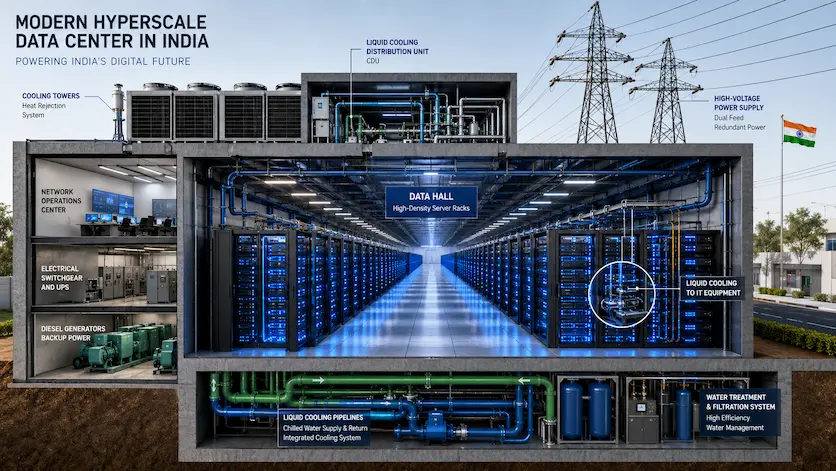
Artificial Intelligence is rewriting the laws of data center design. Traditional server layouts cannot easily withstand the severe thermal and power loads demanded by modern AI accelerators. A unified regulatory framework will empower businesses to invest confidently in advanced cooling mechanisms and localized high-performance compute clusters. This shift directly supports advancements in smart manufacturing, healthcare analytics, fintech platforms, and sovereign AI models.
Concurrently, telecom infrastructure stands to gain immensely. By expanding edge data centers right at the intersection of local fiber loops and cellular base stations, latency drops to single-digit milliseconds. This provides the low-latency cushion required for autonomous vehicles, industrial robotics, cloud gaming, and real-time security systems.
+-------------------------------------------------------------+
|               TRAI DATA ECONOMY OBJECTIVES                  |
+-------------------------------------------------------------+
|                                                             |
|  [AI-Ready Compute] ----> High-density server support      |
|  [Telecom Integration] -> Low-latency edge deployment       |
|  [Green Initiatives] ---> Renewable energy sourcing        |
|  [Ease of Business] ----> Single-window project approvals   |
|                                                             |
+-------------------------------------------------------------+
Navigating Structural Bottlenecks
While the industry’s growth trajectory is strong, scaling the physical layer presents distinct, real-world operational challenges:
High Capital Expenditure: Setting up next-generation hyperscale facilities requires massive upfront investments in high-end semiconductor chips and power hardware.
Resource Scarcity: Access to enormous tracts of litigation-free land near major metropolitan fiber nodes remains highly competitive.
Grid Reliability: Data infrastructure demands continuous power; any fluctuation risks systemic hardware damage or disruptive service downtime.
By leveraging direct industry feedback, this consultation aims to create an equilibrium between strict data sovereignty mandates and the open, fluid infrastructure needed to remain globally competitive.
Frequently Asked Questions (FAQs)
What is the primary objective of TRAI’s data center consultation?
The consultation aims to gather recommendations from diverse industry stakeholders to design a forward-looking, sustainable, and globally competitive policy framework that supports India’s expanding data storage, AI compute, and cloud needs.
What are green data centers, and why are they included in the policy discussion?
Green data centers utilize energy-efficient cooling technologies, sustainable building materials, and renewable energy sources. They are included in policy talks because traditional data infrastructure consumes vast amounts of power, making clean energy sourcing vital to minimizing environmental impacts.
How do edge data centers help telecom networks?
Edge data centers process data geographically closer to the end user rather than routing information to distant centralized hubs. This drastically cuts down latency, allowing telecom networks to smoothly run real-time applications like autonomous systems and cloud gaming.
Related Dynamic Policy Insights
To explore how adjacent macroeconomic frameworks, industrial policies, and infrastructure changes are shaping India’s tech landscape, review these in-depth structural reports:
Learn how regional states are building tailored legal environments in the Haryana Digital Transformation: Capitalizing on the 2026 AI and Data Centre Policies report.
Understand the hardware side of the equation via the comprehensive analysis on Modern Data Centre Infrastructure Foundations.
Explore how regulators manage broader automated financial systems in The Hidden Threat: Systemic AI Architecture Risks.
Disclaimer: The information provided in this article is for educational and informational purposes only, based on current public policy consultations and regulatory announcements issued by the Telecom Regulatory Authority of India (TRAI). For definitive legislative directives and updated policy outcomes, refer directly to official government notifications.
