 Matribhumi Samachar English


New Delhi. Monday, 13 July 2026
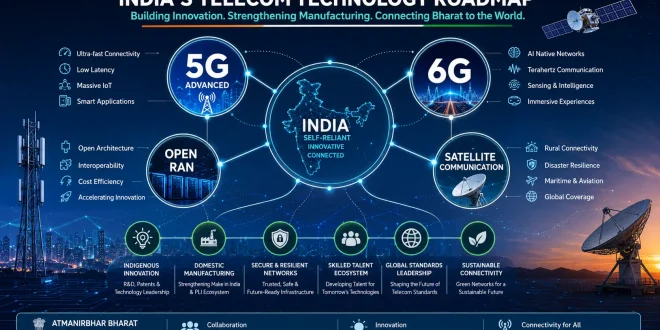
India is actively working on a comprehensive telecom technology roadmap designed to steer the nation’s strategy for technological innovation, domestic manufacturing, deep research, and global competitiveness. Moving away from being merely one of the world’s largest consumer markets, the government’s new blueprint aims to establish India as an influential creator, developer, and exporter of next-generation communication systems.
By bringing together government bodies, industry stakeholders, cutting-edge startups, academic institutions, and premier research hubs, the initiative seeks to foster a highly collaborative ecosystem. The roadmap directly focuses on building local capabilities in emerging high-tech domains like 5G Advanced, 6G, artificial intelligence-driven network automation, satellite communications, and Open Radio Access Networks (Open RAN).
A Vision for Indigenous Telecom Technologies
The core philosophy of the proposed framework centers on retaining intellectual property (IP) and commercializing homegrown telecom products. Rather than relying heavily on imported gear, India’s research and development focus is shifting toward creating internationally recognized patents and standards.
Key technology verticals prioritized in this upcoming roadmap include:
-
Advanced Wireless Platforms: 5G Advanced and foundational research into 6G architectures.
-
Intelligent Infrastructure: AI-enabled network automation, telecom software, and cloud-native network environments.
-
Open & Optical Systems: Open RAN solutions alongside high-capacity optical communication systems.
-
Space & Security: Satellite-based connectivity, integrated terrestrial-satellite networks, and advanced network security systems.
-
Hardware & Silicon: Indigenous telecom chip development to anchor complete hardware design control.
This strategic push matches recent global recognition of Indian telecom innovation, such as the C-DOT UN WSIS Award for Mobile-Enabled Disaster Resilience, demonstrating India’s growing capacity to engineer world-class, socially impactful communication frameworks natively.
Expanding the “Make in India” Manufacturing Footprint
A vital objective of the upcoming roadmap is transforming India’s local manufacturing architecture under the broader “Make in India” banners. By increasing local value addition, the telecom sector expects to stabilize hardware supply chains, dramatically lower import bills, and capture major international export corridors.
The domestic manufacturing expansion will explicitly scale up production for:
-
Base stations and radio equipment.
-
Routers, physical switches, and edge computing hardware.
-
Optical fiber networking equipment and next-gen components.
-
Integrated network testing devices and localized telecom software platforms.
This manufacturing surge relies closely on broader economic engines. The massive scaling up of technology supply chains is heavily fueled by India’s expanding economic formalization and capital investments, reflected in the steady rise of India’s monthly GST collections, which continue providing the fiscal flexibility needed to finance large-scale digital public infrastructure.
Nurturing Deep-Tech Startups and Global Standards
Innovation acts as the primary driver of this unified telecom strategy. The upcoming roadmap ensures enhanced technical and financial support for deep-tech startups, micro, small, and medium enterprises (MSMEs), universities, and dedicated incubation centers. Support comes in the form of dedicated funding for prototyping, accessible testing facilities, and seamless avenues for industry commercialization.
Simultaneously, India is amplifying its presence in global standards organizations. Increased active participation ensures that innovations designed by Indian researchers help shape future global wireless protocols while securing an expansive portfolio of standard-essential patents (SEPs).
Accelerating the Bharat 6G Mission
The roadmap naturally complements the Bharat 6G Mission, an ambitious national program targeted at establishing India as a leading contributor to sixth-generation wireless technologies by 2030.
[Future Research Vectors under Bharat 6G]
 ├── AI-Native Communication Networks
 ├── Ultra-Low Latency Applications
 ├── Intelligent Spectrum Management
 ├── Integrated Satellite-Terrestrial Comms
 ├── Sustainable & Green Infrastructure
 └── Advanced Semiconductor Integration
These foundational technologies will provide the high-speed backbone for high-value applications including autonomous vehicles, industrial IoT automation, smart cities, digital healthcare systems, and immersive extended reality (XR) platforms.
Strategic Integration with National Initiatives
To avoid siloed growth, the new telecom technology roadmap integrates dynamically with several ongoing national programs to maximize strategic and economic impact:
-
Production-Linked Incentive (PLI) Scheme & Semiconductor Mission: Directly anchoring large-scale domestic equipment manufacturing and chip fabrication.
-
Digital India & BharatNet: Accelerating rural broadband expansion and the rollout of next-gen Digital Public Infrastructure (DPI).
-
National Broadband Mission: Assuring universal, high-speed, and resilient connectivity across the domestic grid.
As competitive pressures intensify worldwide in advanced telecommunications, India’s unified strategy represents a significant leap toward long-term digital sovereignty. By fusing domestic innovation with scaled-up electronics production and global standards leadership, the nation is steadily reshaping its identity from a massive consumer market into a premier global exporter of next-generation connectivity solutions.
Frequently Asked Questions (FAQ)
What is the primary objective of India’s upcoming telecom technology roadmap?
The primary goal is to transition India from a massive consumer of telecom equipment into a global developer, creator, and exporter of homegrown next-generation technologies, reducing reliance on imported equipment and enhancing digital sovereignty.
How does this roadmap interact with the Bharat 6G Mission?
The roadmap directly complements the Bharat 6G Mission by establishing research priorities in AI-native networks, ultra-low latency setups, intelligent spectrum allocation, and sustainable infrastructure to make India a leading global 6G contributor by 2030.
Which manufacturing areas are prioritized under the roadmap?
The strategy promotes the domestic production of essential infrastructure items like base stations, radio equipment, routers, switches, optical fiber networking gear, edge computing hardware, and specialized next-generation telecom chips.
Disclaimer: The details outlined in this article are structured based on India’s developing telecom policy frameworks and strategic objectives for next-generation communication ecosystems. Project details, allocations, and specific rollout timelines may vary as official government guidelines continue to evolve.