
New Delhi. Monday, 13 July 2026
The Office of the Development Commissioner (Handlooms), under the Ministry of Textiles, Government of India, has officially unveiled the Handloom Hackathon 2026 – “Weaving Innovation.” Organized as a premier segment of the upcoming National Handloom Day 2026 celebrations, this nationwide challenge calls upon students, innovators, designers, engineers, and tech startups to engineer modern, scalable solutions to safeguard and revitalize India’s historic handloom ecosystem.
With the handloom industry standing as India’s second-largest rural employment provider right after agriculture, the initiative addresses pressing obstacles such as fierce powerloom competition, rising material costs, and severe supply chain inefficiencies. By embedding cutting-edge tech into legacy practices, the government aims to boost weaver incomes and strengthen the creative economy within the vision of Atmanirbhar Bharat.
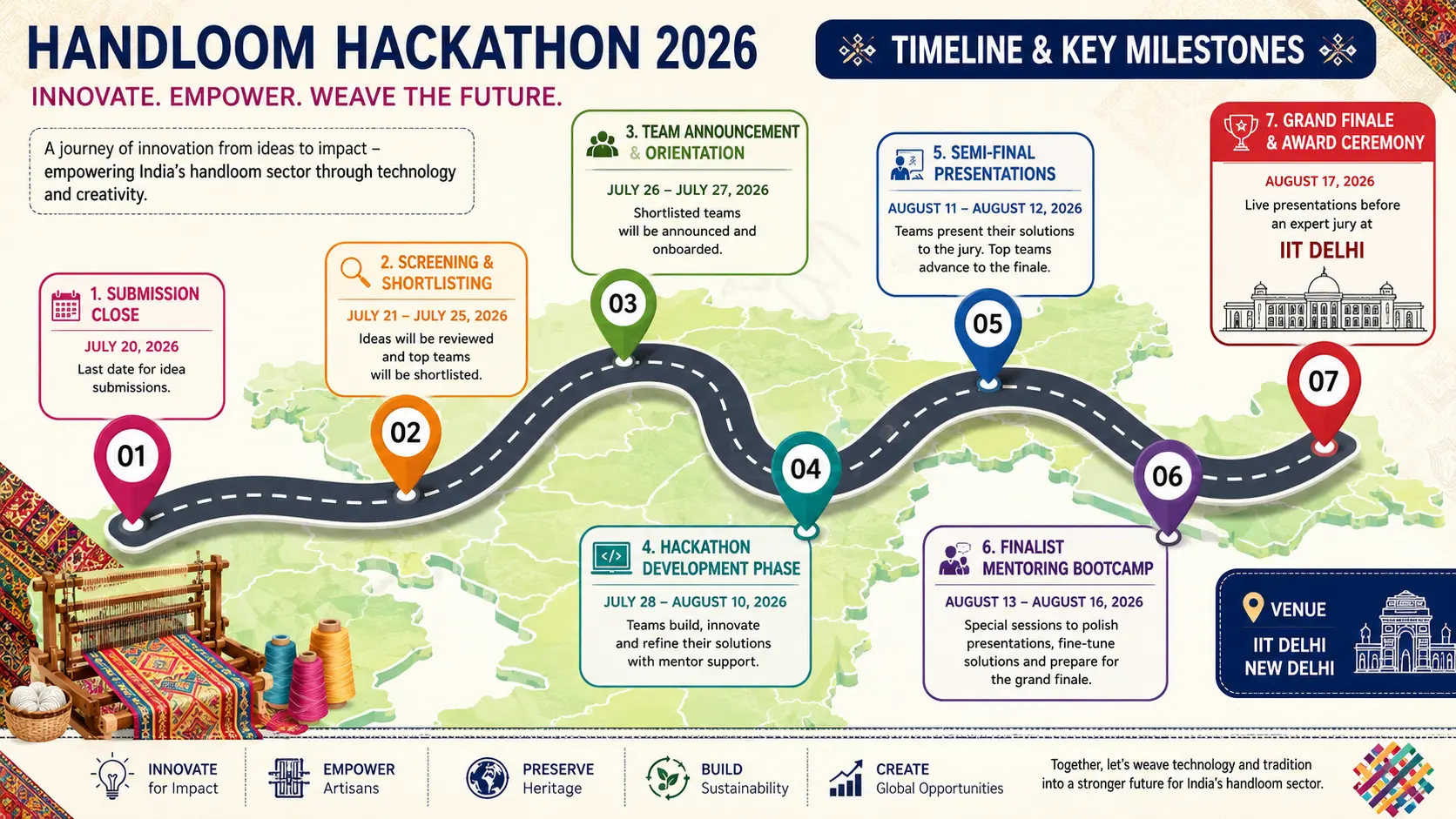
📅 The Official Timeline & Key Event Phases
Core Operational Themes for 2026
The competition layout targets four major operational challenges, allocating a distinct ₹60,000 cash prize for the Winner and ₹40,000 for the Runner-Up in every individual track, alongside special recognition for Best User Research and Weaver-Entrepreneur Excellence:
1. Innovation in Design & Operations
AI-Driven Customization: Platforms that morph ancient, traditional motifs into highly marketable global patterns using machine learning.
Ergonomics: Redesigning handloom components to lower physical fatigue for lifelong artisans.
2. Market Access & Digital Integration
Authenticity Badging: Relying on decentralized ledger systems (Blockchain) and secure QR codes to fight counterfeit powerloom duplicates by sharing real weaver background stories.
Direct Commerce Engines: Custom digital marketplaces that trim out parasitic middleware layers to connect rural artisan clusters with wholesale B2B international buyers.
3. Sustainability & Environmental Impact
Clean Practices: Developing closed-loop organic dye methods and intelligent water reclamation mechanics to scale down production waste.
Energy Adaptation: Safe integration of renewable green energy resources within production units.
4. Weaver Livelihoods & Financial Inclusion (New Track for 2026)
Micro-Financing Portals: Tailored fintech channels built for rural weaving cooperatives to secure accessible, low-interest micro-credits.
Predictive Demand Analytics: Utilizing big data analysis tools to forecast textile trends, preventing overproduction.
The Road Beyond the Cash Prizes
Beyond the immediate ₹4,00,000 collective prize pool, the highest-scoring teams receive a significant post-event accelerator. The top 15 finalists earn a clear path into a 1-year structured incubation program managed by prominent institutional hubs. This pipeline guarantees that prototypes are fully commercialized, tested, and implemented directly within active production clusters instead of remaining static theoretical designs.
Eligible entities—spanning students in design, technology, engineering, management, and textile disciplines to research scholars, independent inventors, MSMEs, and traditional handloom practitioners—can officially enroll and submit blueprints online through the centralized Youth Ideathon Handloom Portal.
Frequently Asked Questions (FAQ)
Who is eligible to enter the Handloom Hackathon 2026?
Participation welcomes all Indian nationals, working individuals, and student groups across design, engineering, textiles, management, and technology domains. Collaborative teams combining technological engineers with local artisans are highly preferred.
What is the maximum size allowed for participating teams?
Innovators can enter as single applicants or construct multidisciplinary teams consisting of 2 to 5 members max, in accordance with the rules of the portal.
Is there an application fee required to join the challenge?
No, registration and project submission across all four designated thematic tracks remain entirely free of charge for all candidates.
Where will the final prototype evaluation occur?
The physical evaluation takes place on August 1, 2026, on-site at the Foundation for Innovation and Technology Transfer (FITT) within the Indian Institute of Technology (IIT) Delhi campus.
Links & External Resources
To read expanded current affairs coverage on upcoming digital transformation schemes, visit the global archive at Matribhumi Samachar English Edition.
Disclaimer: This article is prepared exclusively for informational and educational use based on formal notifications issued by the Office of the Development Commissioner (Handlooms), Ministry of Textiles, Government of India. Deadlines, award rules, and evaluation criteria may be subject to changes by the host authorities. Users are advised to verify details directly on the official registration portals before final applications.
