 Matribhumi Samachar English


New Delhi. Tuesday, 14 July 2026
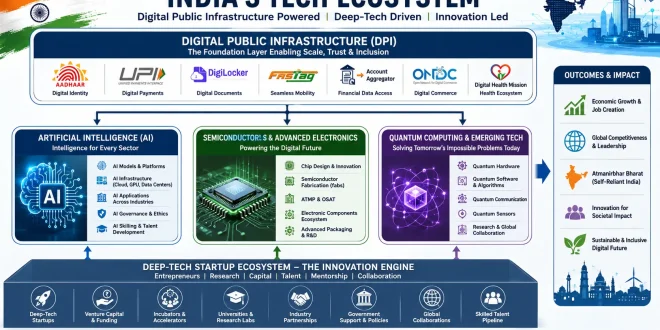
India is entering a defining phase of technological transformation. After building one of the world’s largest digital public infrastructure (DPI) ecosystems through foundational platforms like Aadhaar, UPI, DigiLocker, and ONDC, the country’s focus is rapidly shifting toward frontier technologies that could shape global innovation over the next decade.
Artificial Intelligence (AI), quantum computing, semiconductor manufacturing, advanced electronics, high-performance computing, robotics, and space technology are becoming central pillars of India’s long-term economic strategy. Supported by active government policies, rising private investment, academic research, and grassroots startup innovation, India aims to permanently move from being primarily a software services powerhouse to becoming a global deep-tech leader.
1. Artificial Intelligence Becomes India’s New Growth Engine
Artificial Intelligence has evolved from an emerging technology into a strategic national capability. Across healthcare, agriculture, manufacturing, finance, education, and governance, businesses are increasingly integrating AI into core operations.
Several key trends are accelerating India’s AI infrastructure boom:
-
Sovereign AI Models: Developing large language models (LLMs) trained explicitly on Indian languages to serve millions across diverse linguistic communities.
-
Compute Expansion: Rapidly building localized AI cloud infrastructure and scaling up GPU computing capacity.
-
Enterprise Adoption: Deep integration of AI solutions among MSMEs and major commercial enterprises to scale day-to-day productivity.
-
Next-Gen Governance: Implementing AI-powered digital governance architectures for smoother public service delivery.
-
Security Frameworks: Designing robust, AI-enabled cybersecurity solutions to safeguard state and private data networks.
2. Semiconductor Manufacturing Creates Strategic Independence
For decades, India relied heavily on imported semiconductor components. Today, that landscape is changing as multi-billion-dollar investments lay the physical foundation for domestic chip production.
Building out a self-reliant chip ecosystem focuses heavily on:
-
Semiconductor Fabrication Plants (Fabs): Setting up operational facilities to manufacture raw silicon wafers.
-
ATMP and OSAT Facilities: Establishing high-volume Assembly, Testing, Marking, and Packaging (ATMP) and Outsourced Semiconductor Assembly and Test (OSAT) facilities to process chips locally.
-
Compound Semiconductors & Displays: Investing in specialized compound semiconductor variants and display manufacturing ecosystems.
-
Design Innovation: Expanding India’s massive engineer pool from working on international chip design projects to creating home-grown IP.
A stronger semiconductor industry reduces global supply chain vulnerabilities while anchoring critical sectors like automotive electronics, telecommunications, defense, and industrial automation.
3. Quantum Computing and Deep-Tech Startups
Quantum technologies are moving rapidly from pure academic research into commercial reality. India is aggressively funding quantum communication, quantum encryption, hardware sensors, and specialized quantum algorithms to tackle complex optimization problems in logistics, pharmaceutical discovery, weather forecasting, and national security.
Simultaneously, the next generation of Indian startups is shunning traditional internet consumer models to solve complex physical problems. Ventures focusing on drone technology, advanced industrial robotics, space systems, climate tech, and biotechnology are securing global venture capital and building highly valuable, indigenous intellectual property right inside the country.
4. The Structural Foundation: DPI and Electronics
India’s world-class Digital Public Infrastructure (DPI) gives its deep-tech transition a competitive edge that few nations possess. With digital identity systems, instant digital payments, and open commerce frameworks like ONDC, innovators can build highly scalable digital applications on pre-existing public rails at a fraction of standard development costs.
Furthermore, production-linked incentives (PLI) are pulling global hardware manufacturing into the country. Electronics assembly is expanding comprehensively into consumer tech, medical devices, defense equipment, electric vehicle (EV) components, and high-density battery packs.
Overcoming Critical Bottlenecks
Despite significant progress, India must navigate major structural hurdles to sustain this momentum:
-
Equipment Capital: Acquiring highly advanced, tightly controlled semiconductor manufacturing equipment remains incredibly expensive.
-
Talent Retainment: Competing globally to retain elite AI and quantum engineering talent within local research environments.
-
Critical Minerals: Reducing external dependencies on imported critical minerals (like lithium and rare earth elements) vital for electronics and batteries.
-
Commercialization Pipeline: Better bridging the gap between scientific breakthroughs in university laboratories and market-ready products.
Over the next decade, India’s technological ecosystem will be defined by its ability to combine its world-famous software prowess with scalable hardware execution. If current public and private investments hold steady, the country is well on its way to cementing its place among the world’s leading technology superpowers.
Frequently Asked Questions (FAQ)
Q: Why is sovereign AI important for India’s future?
A: India’s unique multilingual population requires AI models trained on regional languages to truly optimize public services, agriculture, and healthcare for millions of citizens who do not use English as a primary language.
Q: What strategic advantage does domestic semiconductor manufacturing provide?
A: Microchips power everything from everyday smartphones to advanced defense equipment. Local manufacturing safeguards the country against global supply chain shocks and boosts national technological security.
Q: How does India’s Digital Public Infrastructure (DPI) help deep-tech startups?
A: By offering open-access, secure building blocks like UPI and DigiLocker, startups do not have to rebuild identity verification or payment networks from scratch. This dramatically reduces early-stage innovation costs.
Related Coverage from Matribhumi Samachar
To explore further detailed reports on India’s evolving tech landscape, review these insights from Matribhumi Samachar:
-
Read about the infrastructure supporting these innovations in the article on India’s Sovereign Compute Race and Data Center Boom.
-
Discover how individual states are pushing boundaries in the comprehensive report on the Uttar Pradesh Startup Revolution, U-Hubs, and Deep-Tech Funding.
-
Explore how deep learning algorithms are currently changing operational paradigms in the feature on How Artificial Intelligence is Rewriting the Rules of Indian Banking.
Disclaimer: The information presented in this article is compiled for educational and informational purposes only, detailing technological, industrial, and economic trends as observed in 2026. Policy guidelines, investment figures, and project timelines are subject to change by respective government ministries and private corporate entities.