

Bhopal | Tuesday, 14 July 2026
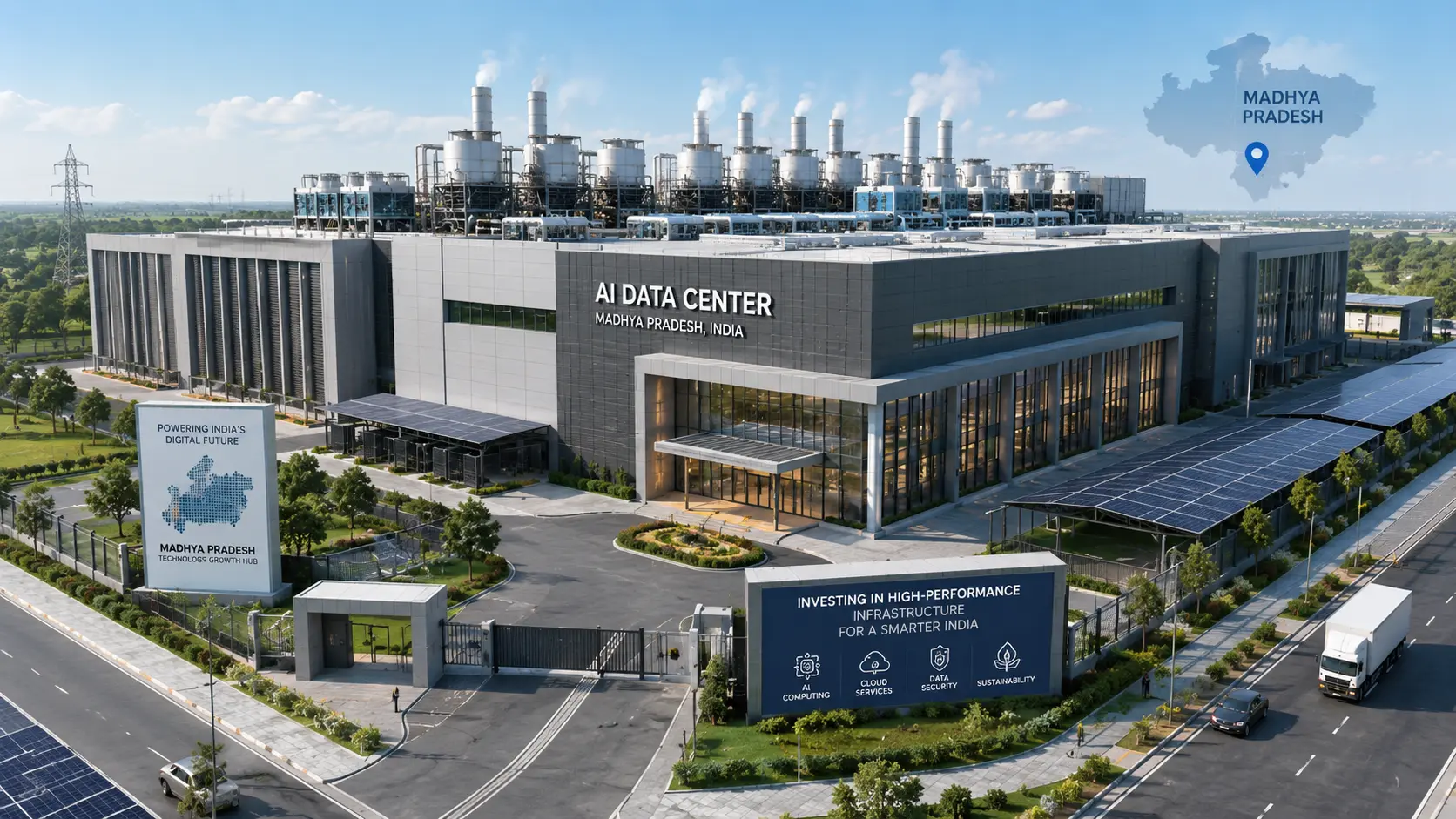
Madhya Pradesh is rapidly transitioning from its traditional industrial identity to establish itself as one of India’s leading technology destinations. In a massive boost to the country’s digital infrastructure, a proposed ₹19,000 crore investment in a state-of-the-art Artificial Intelligence (AI) data centre is set to transform the local economy, create thousands of employment opportunities, and anchor India’s growing demand for advanced cloud services and sovereign AI processing capabilities.
As Indian states increasingly architect their own decentralized technological revolutions to power localized deep-tech growth, this massive influx of capital marks a permanent shift toward building resilient, localized computing hubs outside of traditional tier-1 metropolitan cities.
Supercharging India’s Sovereign AI Ambitions
The proposed mega-facility is engineered to be a high-capacity computing powerhouse, heavily equipped with advanced servers, next-generation Graphics Processing Unit (GPU) clusters, and scalable cloud networks. Unlike standard data repositories built merely for storage, this center will be fine-tuned to process massive AI workloads, complex machine learning iterations, and high-performance computing (HPC) tasks.
By localizing these massive computing resources within Madhya Pradesh, the project acts as a cornerstone for India’s sovereign AI vision. Expanding domestic server footprints directly safeguards data governance, improves cybersecurity, reduces network latency for domestic digital applications, and curbs heavy reliance on overseas cloud infrastructure.
A Catalyst for 10,000 Jobs and Economic Growth
Official projections indicate that the infrastructure project will generate roughly 10,000 direct and indirect employment opportunities across multiple sectors. While it will draw high-skilled professionals in AI engineering, cloud architecture, data center operations, and advanced cybersecurity, the economic ripples will go much deeper.
The physical execution and operational sustenance of a data center require a massive secondary labor force:
Advanced cooling and HVAC technicians
High-voltage electrical grid engineers
Construction, logistics, and supply chain security professionals
Facilities management and localized IT support
Beyond immediate payrolls, the facility is highly likely to seed a thriving regional ecosystem of technology startups, ancillary hardware providers, and boutique digital services looking to capitalize on cheap, localized cloud compute access.
Why Tech Conglomerates are Looking at Madhya Pradesh
Historically known for its manufacturing and agricultural output, Madhya Pradesh has systematically spent years laying down competitive frameworks to attract high-tech enterprise capital. Tech giants and infrastructure funds are actively prioritizing the state due to a few standout operational advantages:
Abundant Land Parcels: Massive, contiguous tracts of industrial land that make scaling complex server farms easy.
Cost Advantages: Highly competitive land procurement and overall facility operating costs relative to saturated tech clusters like Mumbai or Bengaluru.
Reliable Utility Infrastructure: Rapidly expanding power grids capable of satisfying the massive electricity demands of running data centers, combined with robust optical fiber networks.
Strategic Centrality: Its geographical location in the heart of India offers unique layout advantages, minimizing latency delays to major economic zones in both northern and southern corridors.
Pro-Business Governance: Proactive state policies designed specifically to incentivize information technology, electronics manufacturing, and deep-tech innovation.
Powering the Next Generation of Apps
From enterprise solutions to public digital infrastructure, the applications supported by the Bhopal data center will form the digital baseline for several sectors across India:
AI Model Training: Training large language models (LLMs) adapted specifically for regional Indian languages.
High-Performance Computing (HPC): Providing the massive compute capabilities required for scientific research, academic breakthroughs, and deep-tech modeling.
Government Digital Ecosystems: Hosting robust, secure, and fast national public health, finance, and citizen service portals.
Disaster Recovery: Creating secure, geographically isolated data backups for financial enterprises and critical industries.
As India continues its aggressive push into domestic semiconductor design, electronic public goods, and systemic AI deployment, foundational investments of this scale are no longer optional—they are the underlying engines that will dictate the future speed of India’s digital economy.
Frequently Asked Questions (FAQs)
Q1: What is the main objective of the ₹19,000 crore AI data centre in Madhya Pradesh?
A: The primary objective is to build massive, localized high-performance computing (HPC) and cloud infrastructure. This supports the growing demands of generative AI, large language model (LLM) training, and secure cloud storage, while accelerating India’s national push for data sovereignty and decentralized AI.
Q2: How will this project impact the local job market in Madhya Pradesh?
A: It is projected to create over 10,000 direct and indirect jobs. These include highly technical roles (AI engineers, cloud architects, cybersecurity specialists) alongside vital support roles in construction, advanced electrical engineering, cooling management, and logistical services.
Q3: Why is Madhya Pradesh becoming an attractive spot for major data centers?
A: The state offers an optimal balance of vast industrial land parcels, lower real estate and operational costs, strong power and optical fiber networks, and a strategic, centrally located position within India that helps minimize network latency nationwide.
Disclaimer: The details regarding the proposed ₹19,000 crore data centre investment are based on preliminary policy frameworks, enterprise proposals, and state-level infrastructure objectives. Final project specifications, timelines, and hiring benchmarks remain subject to definitive corporate agreements and government regulatory sign-offs.
For deeper insights into how regional Indian states are shifting policy to capture the next wave of tech growth, read more about The Subnational Blueprint: How Indian States Are Architecting a Decentralized AI Revolution on Matribhumi Samachar.
