 Matribhumi Samachar English


New Delhi. Tuesday, 14 July 2026
The architecture of the global digital economy is undergoing a foundational shift. High-speed terrestrial networks are no longer working in isolation. Instead, a unified digital fabric is emerging—one that seamlessly fuses orbital satellite communications (SatCom) with hyper-density, AI-native data infrastructure on the ground.
Driven by the computation demands of generative artificial intelligence and the geopolitical urgency for absolute geographic connectivity, these technologies have evolved from basic utilities into the primary pillars of national digital sovereignty.
What is Satellite Communications (SatCom)?
Satellite communications use a network of orbiting spacecraft to transmit voice, video, internet, and data signals across vastly separated locations on Earth. Unlike traditional fiber-optic cables or cell towers, satellite architectures require zero ground footprints between the transmitter and receiver. This makes them the only viable solution for delivering high-speed internet to remote, maritime, mountainous, and disaster-stricken territories.
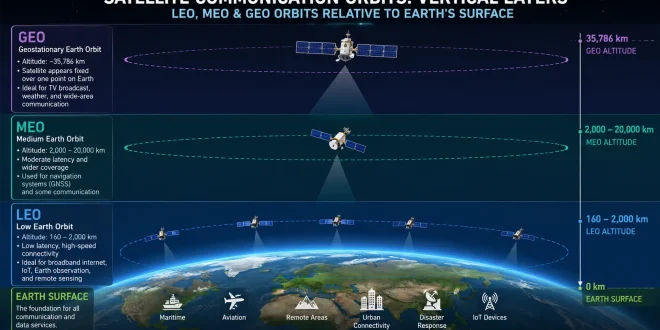
Modern satellite networks are categorized by their orbital mechanics:
-
Low Earth Orbit (LEO): Positioned at altitudes between 500 km and 2,000 km. LEO constellations have become the focal point of modern space-based internet. Their proximity to Earth reduces signal travel time, yielding latencies of 20–40ms—performance comparable to standard terrestrial broadband.
-
Medium Earth Orbit (MEO): Positioned between 2,000 km and 35,786 km. These constellations strike a mid-point balance between coverage footprint and latency, primarily powering global navigation satellite systems (GNSS) like GPS and high-bandwidth maritime data links.
-
Geostationary Earth Orbit (GEO): Stationed precisely at 35,786 km above the equator. Because their orbital speed matches the Earth’s rotation, they appear completely fixed in the sky. While a small handful of GEO satellites can cover almost the entire planet, their massive distance introduces a latency delay exceeding 500ms, restricting their use to traditional television broadcasting and legacy weather monitoring systems.
Why Satellite Communications Matter
As digital services expand into every corner of the global economy, satellite networks are moving away from replacing fiber and 5G networks, functioning instead as a vital complement to them.
[ Terrestrial Fiber / 5G ] <--- High-Density Mesh ---> [ Edge Data Centers ]
         ^                                                      ^
         |                                                      |
         +----------------- [ LEO SatCom Array ] --------------+
                       (Low-Latency Orbital Link)
Key sectors reliant on this hybrid infrastructure include:
-
Broadband for Remote Regions: Bringing digital access to communities separated by rugged terrain.
-
Emergency Communications: Providing immediate, resilient backups when natural disasters sever ground cables.
-
Defense and Border Security: Securing high-altitude logistics, persistent border surveillance, and drone array communication systems.
-
Industrial Mobility: Providing uninterrupted tracking and telemetry for global aviation, maritime cargo, and the Internet of Things (IoT).
Data Infrastructure: The Digital Economy’s Foundation
If satellite networks act as the nervous system transporting data across the globe, data infrastructure is the brain that processes, stores, and protects it. This physical foundation includes:
-
Hyperscale Data Centers: Fortified facilities housing thousands of networked servers.
-
Edge Data Centers: Smaller facilities located closer to users to reduce processing latency.
-
Fiber-Optic Backbones & IXPs: The physical glass cables and exchange points anchoring high-speed cross-border data routing.
AI is Driving Massive Infrastructure Investments
The explosive adoption of artificial intelligence has fundamentally changed the requirements for building data infrastructure. Traditional data center setups built for standard cloud storage (CPUs, standard air cooling) are physically incapable of supporting modern workloads. Training advanced AI models demands immense computational power, triggering a global investment surge in specialized hardware:
-
GPU-Based AI Servers: High-performance hardware arrays explicitly optimized for parallel processing matrix mathematics.
-
Liquid Cooling Systems: Direct-to-chip fluid loops and total immersion tanks designed to manage heat loads from high-density server racks.
-
Energy-Efficient Systems: High-density power grids designed to handle large, volatile spikes in electricity demand during heavy machine learning training cycles.
India’s Growing Opportunity
India has emerged as one of the fastest-growing digital infrastructure destinations in the world, shifting away from software assembly and toward deep tech and hardware processing power. This growth is driven by massive data consumption, expanding cloud adoption, and strategic public policy.
Satellite Broadband in India
Space-based broadband is essential for bridging India’s digital divide in regions where laying fiber cables is physically or economically impossible—including remote Himalayan villages, isolated islands, and heavily forested border zones. Following recent regulatory changes shifting satellite spectrum allocation to an administrative assignment system, the market has expanded to welcome major international and domestic private sector participants.
The Role of Data Centers
The nation is seeing an unprecedented wave of data center development. State-level blueprints, such as the Haryana AI and Data Centre Policies, are offering subsidized, protected frameworks designed to draw hyperscale investments. While coastal metros like Mumbai continue to process the bulk of incoming subsea cable data, new mega-campuses are rapidly scaling across inland hubs, supporting real-time digital payments, Digital Public Infrastructure (DPI), and local AI model training.
Critical Infrastructure Challenges
Despite rapid technological progress, several systemic challenges remain:
-
High Capital Expenditures: Launching LEO constellations and building AI-native data centers requires massive, upfront capital investments.
-
The Energy Wall: High-density AI server farms consume immense amounts of electricity, forcing operators to secure clean, renewable energy sources to avoid straining municipal grids.
-
Space Debris Management: The rapid deployment of thousands of new LEO satellites increases orbital congestion, requiring tighter international tracking standards.
-
Data Governance & Cybersecurity: Tightening cross-border regulations and data localization mandates require information to be physically stored and processed within national boundaries, adding operational complexity.
Future Outlook
Satellite communications and advanced data infrastructure are no longer separate industries; they are converging into a unified, resilient network fabric. Emerging trends like integrated terrestrial-satellite networks (allowing standard smartphones to connect directly to satellites in dead zones) and quantum-safe encryption will define the next phase of tech leadership. Nations and enterprise networks that invest heavily in scaling these interconnected systems will be best positioned to anchor the next generation of global economic growth.
Frequently Asked Questions (FAQ)
1. How do LEO satellites differ from traditional communication satellites?
Traditional communication satellites occupy Geostationary Earth Orbit (GEO) at an altitude of 35,786 km, remaining fixed over one spot but causing high signal latency (~500ms+). Low Earth Orbit (LEO) satellites operate much closer to Earth (500 to 2,000 km), reducing latency down to 20–40ms, which makes them suitable for real-time applications and standard internet browsing.
2. Why does artificial intelligence require new data center infrastructure?
AI model training requires massive parallel computing power provided by dense arrays of GPUs rather than standard CPUs. These setups generate intense heat and consume vast amounts of electricity per rack, requiring data centers to transition from traditional air-cooling units to advanced direct-to-chip liquid cooling systems.
3. How will satellite broadband complement India’s existing 5G networks?
Rather than replacing ground infrastructure, satellite broadband extends connectivity to locations where laying physical fiber-optic cables or building cell towers is impossible, such as deep mountain valleys, remote islands, and active maritime corridors.
Disclaimer: The analytical perspectives and policy details presented in this report are for informational purposes only, reflecting the technological landscape, infrastructure investments, and industry frameworks current as of mid-2026.